
CES 2019: Unveiling the Future of 3D Printing and Additive Manufacturing Innovations
The annual Consumer Electronics Show (CES), a global stage for innovation and technological breakthroughs, once again captivated thousands in Las Vegas, kicking off on January 8th. For over five decades, CES has been instrumental in providing a crucial platform for pioneers and their groundbreaking creations, touching every facet of emerging technologies. From the intricate networks of smart cities and advancements in sustainability to the revolutionary progress in self-driving cars, cryptocurrencies, robotics, drones, artificial intelligence, and gaming, CES showcases the cutting edge. This year, additive manufacturing, more commonly known as 3D printing, also took a prominent position, with an impressive 79 exhibitors showcasing their latest innovations. The presence ranged from established industry giants to agile startups, all eager to present their contributions to the evolving landscape of consumer technology. As CES 2019 drew to a close on the evening of the 11th, it provided the perfect moment to reflect on the most significant 3D printing innovations unveiled over these dynamic few days.
Key 3D Printing Innovations Announced at CES 2019
1. XYZPrinting Debuts Da Vinci Color Mini: A Leap in Full-Color Consumer 3D Printing
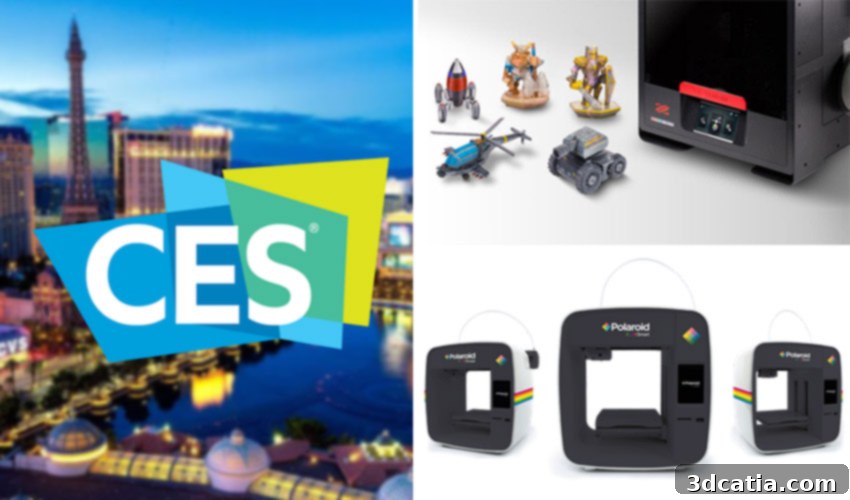
Taiwanese company XYZPrinting has a strong tradition of unveiling new products at CES, and 2019 was no exception. This year, they officially introduced the Da Vinci Color Mini FDM 3D Printer, a remarkable addition that signifies a tremendous step forward for consumer 3D printing. Unlike conventional Fused Deposition Modeling (FDM) machines that typically print in a single filament color, the Da Vinci Color Mini offers full-color 3D prints. This capability is a significant differentiator in a market where options for affordable and accessible color 3D printing are still limited, making it a game-changer for a broad audience. XYZPrinting announced an accessible starting price of $1,599 for this innovative printer, positioning it within reach for many enthusiasts, small businesses, and educational institutions.
Simon Shen, CEO of XYZPrinting, emphasized the company’s vision: “By providing an affordable and compact full-colour printer, we are very pleased to be bringing colour 3D printing technology within reach for small businesses, schools, designers, makers and general consumers. We will continue to provide innovative, high-quality 3D printers while making it affordable for everyone to utilise this technology and incorporate it into their daily lives”. This statement underscores a commitment to democratizing advanced 3D printing capabilities, extending beyond industrial applications to everyday users and creative professionals seeking enhanced visual fidelity in their prints.
The technology powering this full-color capability is called 3DColor Jet technology. This ingenious system works by precisely mixing magenta, cyan, and yellow ink droplets, allowing for the creation of millions of distinct colors. During the FDM printing process, these ink droplets are meticulously ingrained into a specially designed, color-absorbing filament known as 3D Color-inkjet PLA. This integration ensures vibrant, consistent colors throughout the printed object, eliminating the need for multi-filament setups for color changes. The Da Vinci Color Mini boasts a respectable printing volume of 130 x 130 x 130 mm, suitable for a wide range of consumer and small business projects, from educational models to intricate prototypes. Beyond the printer itself, XYZPrinting also unveiled a suite of new, advanced filaments, including antibacterial PLA for hygienic applications, PLA with added copper for unique aesthetic and functional properties, and robust carbon fiber filaments, further expanding the creative and practical possibilities for its users.
2. Polaroid Enters the 3D Printing Market with the Stylish PlaySmart 3D Printer
Polaroid, a brand synonymous with instant cameras and capturing memories, made a significant entry into the additive manufacturing space at CES 2019 with the introduction of its new PlaySmart 3D Printer. This move signals a growing trend of established consumer brands diversifying their portfolios to include 3D printing technology, aiming to make it more accessible and user-friendly for a wider audience. The PlaySmart is designed with aesthetics and practicality in mind: it’s a light, compact, and office-friendly machine, offering a printing volume of 120 x 120 x 120 mm. Its sleek design, while resembling many existing FDM machines on the market, stands out for its particularly appealing aesthetic, reflecting Polaroid’s legacy of design-conscious products and making it an attractive addition to any modern workspace or home setup.
Beyond its looks, the PlaySmart comes equipped with a suite of features tailored for convenience and ease of use. It includes seamless Wi-Fi control, allowing users to manage their prints remotely from a smartphone or computer, a built-in webcam for monitoring print progress from anywhere, and an integrated filament scale to precisely keep track of material usage, preventing unexpected run-outs mid-print. These features collectively enhance the user experience, making 3D printing less intimidating for newcomers and more efficient for experienced hobbyists and small businesses. Set to launch in Europe and the UK on March 1st, the PlaySmart 3D printer will be available at a competitive starting price of €449 (approximately $517). This strategic pricing positions it as an attractive option for educational institutions, small businesses, and home users looking for a reliable, feature-rich, and stylish entry-level 3D printer.
3. Formlabs Unveils Elastic Resin and Digital Dentures Materials for SLA Printing
Formlabs, a leader in desktop Stereolithography (SLA) 3D printing, further expanded its material portfolio at CES 2019 with the introduction of two significant new products: Elastic Resin and Digital Dentures materials. These innovations cater to specialized applications, demonstrating Formlabs’ commitment to pushing the boundaries of what SLA technology can achieve in diverse industries, from advanced engineering and product design to transformative healthcare solutions.
The new Elastic Resin is particularly noteworthy, hailed as the softest resin the company has ever produced. Once printed, objects made with Elastic Resin exhibit properties remarkably similar to molded silicone, boasting exceptional elasticity, durability, and transparency. This material addresses a long-standing challenge in SLA 3D printing, as Formlabs explained at the event: “Developing soft stereolithography (SLA) resins can be challenging. Parts must be highly elastic, yet strong enough not to tear during printing—two properties that are typically diametrically opposed”. The successful development of Elastic Resin represents a significant engineering feat, enabling the production of highly flexible parts that maintain structural integrity during the printing process and rigorous use. This new resin opens up numerous possibilities for engineers and product developers, offering a convenient material for quickly producing small to moderate batches of flexible prototypes and functional parts, thereby accelerating product development cycles in fields such as consumer electronics (e.g., grips, buttons), medical devices (e.g., patient-specific models, wearables), and robotics (e.g., soft grippers, gaskets).
In parallel, Formlabs announced the much-anticipated availability of its Digital Dentures materials. This comprehensive solution includes both Dental Base Resin and Denture Teeth Resin, providing dental laboratories with the means to produce custom dentures with unprecedented cost and time efficiency. Traditionally, denture fabrication is a labor-intensive, multi-step process involving multiple appointments and manual crafting. By leveraging SLA 3D printing with these specialized, biocompatible resins, dental professionals can streamline their workflows, reduce material waste, and deliver highly personalized prosthetic solutions faster and with greater precision. This digital workflow leads to improved patient comfort and fit. Currently, these materials are available exclusively in the United States, but Formlabs is actively working on establishing partnerships to expand their availability to other countries, promising a global impact on dental care and prosthetics manufacturing by making advanced solutions more accessible worldwide.
4. Nexa3D Showcases the NXE400: High-Speed, Large-Format SLA 3D Printer
Nexa3D made a significant splash at CES 2019 by officially displaying its new flagship SLA machine, the NXE400 3D printer, to the North American market. This impressive Stereolithography 3D printer is poised to redefine expectations for industrial-grade additive manufacturing, particularly in terms of speed and build volume. Nexa3D claims the NXE400 is an astounding six times faster than comparable machines from its competitors, a game-changing acceleration that could dramatically reduce production bottlenecks in demanding environments. Furthermore, its build volume is also a remarkable 2.5 times larger, allowing for the printing of bigger, monolithic parts or multiple components simultaneously in a single print job, thus maximizing throughput and efficiency for batch production.
The implications of such speed are profound: the production time for prototypes, which previously might have taken hours or even days using traditional methods or slower 3D printers, is expected to be reduced to mere minutes. This rapid iteration capability is invaluable for design and engineering teams, enabling them to test and refine concepts at an unprecedented pace, significantly shortening product development cycles. The NXE400 will also come equipped with a range of specialized, tough materials specifically formulated to endure the stresses of ultra-fast 3D printing, ensuring part integrity and performance even under high-speed processes. This potent combination of unparalleled speed, expansive build size, and material resilience positions the NXE400 as a formidable tool for industries requiring high-performance prototypes, robust functional parts, and even short-run manufacturing for end-use components. Its North American debut at CES 2019 marks a crucial step in Nexa3D’s strategy to capture a significant share of the rapidly evolving industrial 3D printing market and accelerate the adoption of additive manufacturing in mainstream production.
5. Wiivv and Dr. Scholl’s Collaborate to Offer Custom 3D Printed Insoles
A compelling trend observed at CES 2019 was the increasing embrace of 3D printing by “conventional” consumer goods companies, demonstrating additive manufacturing’s growing relevance beyond niche industrial applications. Among the most exciting collaborations announced for 2019 was the partnership between Dr. Scholl’s, a household name synonymous with foot care for over a century, and Wiivv, a leading manufacturer of custom 3D printed insoles. This collaboration signifies a bold and innovative step for Dr. Scholl’s into advanced personalization, offering customers precisely customized insoles that promise enhanced comfort, superior support, and improved biomechanical alignment. The initiative leverages the power of additive manufacturing to move beyond generic, off-the-shelf solutions, providing a truly bespoke product tailored to individual foot needs and preferences.
The accessibility and user-friendliness of these custom 3D printed insoles were a key highlight at CES 2019. The process is remarkably straightforward, facilitated through an intuitive smartphone app. Customers simply use their smartphone to capture a series of photos of their feet from various angles – a process that takes just minutes. The app then utilizes sophisticated, proprietary algorithms to analyze these images, generating a precise insole structure based on an impressive 400 mapping points derived from the customer’s unique foot anatomy. This meticulous data capture ensures that each insole provides optimal arch support, cushioning, and pressure distribution, addressing specific foot geometries and biomechanical needs with unparalleled accuracy. The ability to achieve such a high degree of personalization through an easily accessible digital platform represents a significant advancement in consumer health and wellness products, bridging the gap between clinical precision and everyday convenience.
Claudia F. Metcalf, U.S. Marketing Director of Dr. Scholl’s, eloquently articulated the vision behind this transformative partnership: “Dr. Scholl‘s understands the importance of customisation for a growing number of consumers. This new offering enables us to make inserts to the exact specifications of our customers‘ feet, with just the right support in just the right places. Using Wiivv Fit Technology, we are bringing a custom 3D experience to the reliable, comfortable inserts Dr. Scholl’s is known for. This is a breakthrough in premium personalisation with the ability to shop from home.” Her comments underscore the harmonious blend of Dr. Scholl’s trusted legacy of comfort and foot health with Wiivv’s cutting-edge 3D printing expertise, delivering a premium, personalized product that can be conveniently ordered and received from the comfort of one’s home, truly exemplifying how advanced technology can enhance consumer well-being.
CES 2019 has once again proven to be a pivotal event for the 3D printing industry, showcasing a vibrant array of innovations that promise to reshape consumer and industrial landscapes alike. From accessible full-color FDM printers and stylish desktop models to specialized resins for diverse applications and revolutionary customized medical solutions, the future of additive manufacturing appears brighter and more integrated into our daily lives than ever before. These advancements highlight a trend towards greater personalization, speed, and versatility, making 3D printing an indispensable tool for creators, professionals, and consumers globally. The event underscored the relentless pace of innovation in additive manufacturing, positioning it as a key technology driving progress across countless sectors.
We’d love to hear your thoughts! Which 3D printing innovation from CES 2019 did you find most exciting and why? Share your opinions and join the conversation on our Facebook and Twitter pages! Don’t forget to sign up for our free weekly Newsletter, to receive all the latest news in 3D printing delivered straight to your inbox and stay ahead of the curve!