
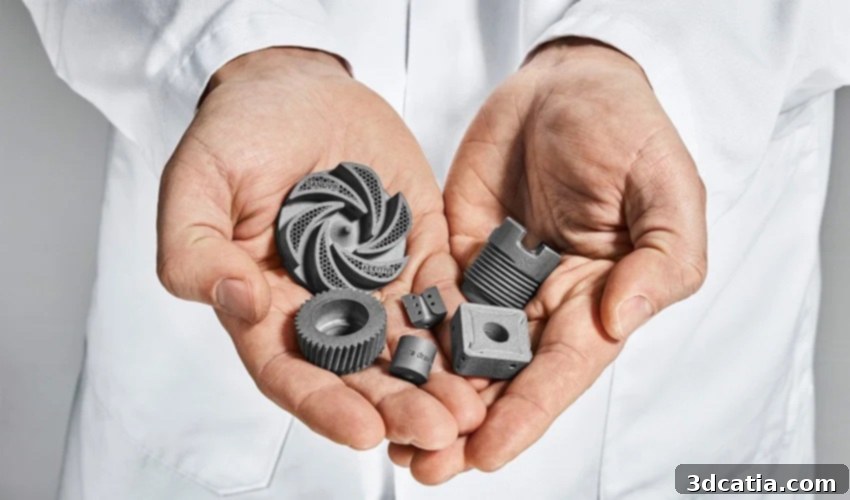
Sandvik Elevates Additive Manufacturing with Breakthrough Cemented Carbide for Extreme Performance
The landscape of additive manufacturing is continuously evolving, driven by the relentless pursuit of materials that can withstand the most demanding industrial conditions. Swedish materials engineering giant Sandvik has long been at the forefront of this innovation, with decades of expertise in developing advanced materials for the manufacturing industry. Building on this rich heritage, the company recently unveiled a significant advancement: a novel range of cemented carbide materials specifically engineered for additive manufacturing processes. This groundbreaking development empowers manufacturers to 3D print components that exhibit unparalleled resistance to wear and exceptional hardness, maintaining their integrity even under the most extreme thermal and mechanical stresses. Sandvik’s latest offering positions itself as one of the hardest and most robust 3D printing materials available, dramatically expanding the realm of possibilities for designers and engineers across various high-stakes industries.
For those familiar with the cutting edge of material science in additive manufacturing, Sandvik’s name resonates with pioneering developments. The company has consistently pushed boundaries, demonstrating its commitment to transforming industrial production through innovative material solutions. A notable example from 2019 was the unveiling of a 3D printed diamond composite – a market first that showcased Sandvik’s capability to harness the extraordinary properties of superhard materials for additive processes. Now, their focus shifts to cemented carbide, a sophisticated composite revered for its exceptional properties. Cemented carbide is fundamentally composed of extremely hard carbide particles, typically tungsten carbide, bound together within a metallic matrix, most commonly cobalt. This unique combination results in a material that boasts not only outstanding electrical and thermal conductivity but also remarkable hot hardness – its ability to retain hardness and strength at elevated temperatures. However, its inherent hardness, while beneficial for performance, poses significant challenges during traditional machining, especially when attempting to create intricate or complex geometries. Recognizing this bottleneck, Sandvik embarked on developing a cemented carbide material perfectly compatible with 3D printing, thereby leveraging additive manufacturing’s inherent freedom of design to overcome conventional manufacturing limitations and unlock new levels of part complexity and performance.

Photo Credits: Sandvik
Unveiling the Unique Characteristics of Sandvik’s 3D Printing Cemented Carbide
Sandvik’s latest innovation represents a significant leap forward in metal additive manufacturing, particularly for powder bed fusion processes. The company has meticulously engineered a cemented carbide material specifically optimized for these advanced 3D printing techniques. The core of this optimization lies in the meticulous development of the raw material itself – the powder. Anders Ohlsson, Product Manager at Sandvik Additive Manufacturing, articulates the critical nature of this aspect: “The most critical component in our process is to work with powders that have the right properties. Above all, high density brings a whole range of benefits regarding the kind of materials we can produce, and crucially impacts the quality achievable in terms of material properties and geometry. Sandvik has developed both a powder and a process that are unique. With our powders, we can print components that look great, work well, and are fit for use in actual applications and serial production.” This statement underscores Sandvik’s holistic approach, combining material science expertise with process optimization to deliver superior results.
The high density of the powder is a cornerstone of this innovation. In additive manufacturing, powder density directly correlates with the final part’s integrity, mechanical properties, and dimensional accuracy. A higher density powder translates to fewer voids and defects in the printed component, leading to enhanced strength, toughness, and fatigue resistance – all vital for parts operating in harsh environments. Furthermore, Sandvik’s proprietary powder formulation and process control allow for the precise creation of complex geometries that would be impossible or prohibitively expensive to achieve with traditional methods. The resulting material structure is primarily composed of tungsten carbide and a cobalt binder, which collectively impart the extraordinary hardness and wear resistance that differentiate it from more conventional, often more brittle, metal alloys. This careful balance of composition and processing parameters ensures that Sandvik’s 3D printed cemented carbide not only possesses excellent mechanical properties but also exhibits consistent quality essential for demanding industrial applications and reliable serial production.
Transformative Applications: Where Sandvik’s Cemented Carbide Excels
The potential applications for Sandvik’s 3D printed cemented carbide are vast and transformative, particularly in sectors where components are subjected to extreme wear, impact, and high temperatures. To validate its capabilities, Sandvik’s teams have successfully printed various parts, notably collaborating with the company Varel for a compelling real-world demonstration. For Varel, Sandvik engineered and 3D printed specialized nozzles designed for injecting fluid through rotary drilling tools. These tools are indispensable in underground exploration and mining operations, environments notorious for their punishing conditions. The nozzles themselves endure immense hydraulic pressures, abrasive fluid flows, and constant contact with highly resistant rock formations. In such an application, material failure can lead to costly downtime and operational inefficiencies.
By leveraging 3D printing with Sandvik’s advanced cemented carbide, Varel realized significant advantages. The additive manufacturing process not only streamlined production, saving both time and money compared to traditional machining of such hard materials, but it also enabled the creation of nozzles with optimized internal geometries that enhance fluid dynamics and overall drilling efficiency. More critically, the 3D printed cemented carbide nozzles delivered superior performance, proving to be stronger, tougher, and significantly more durable than conventionally manufactured alternatives. This direct improvement in part longevity and resilience translates into extended operational cycles, reduced maintenance, and improved safety in hazardous drilling environments, illustrating the profound impact of this material innovation on critical industrial components.

A 3D printed cemented carbide nozzle (photo credits: Sandvik)
Expanding Horizons: Industries Poised for Disruption
Beyond the success with Varel, Sandvik identifies numerous other industries poised to benefit immensely from this high-performance material. The **metal cutting industry**, for instance, has a perpetual need for cutting tools, inserts, and dies that can withstand immense forces and temperatures while maintaining a sharp edge. Cemented carbide is already a staple in this sector, but 3D printing allows for unprecedented design freedom, enabling the creation of tools with optimized internal cooling channels, complex geometries, or lightweight structures that can enhance performance and extend tool life significantly. Imagine bespoke cutting tools perfectly contoured for specific applications, drastically reducing waste and improving precision.
The **oil and gas sector** is another prime candidate. Components like valves, pump parts, and downhole tools operate under extreme pressures, corrosive chemicals, and abrasive slurries, often at high temperatures. Sandvik’s cemented carbide can provide the exceptional wear and corrosion resistance necessary for these critical components, leading to greater reliability, reduced downtime, and enhanced safety in demanding exploration and extraction processes. Its ability to retain hardness at elevated temperatures is particularly valuable in deep-sea or geothermal drilling applications where thermal stability is paramount.
Similarly, the **mining industry** faces constant challenges from highly abrasive materials. Wear parts for crushing equipment, drilling bits, and heavy machinery are continuously subjected to severe impact and abrasion. 3D printed cemented carbide offers a solution for producing parts that not only endure longer but can also be designed with optimized geometries to resist specific wear patterns, thereby boosting efficiency and operational uptime in harsh mining environments. The ability to quickly produce replacement parts with superior properties can significantly reduce the logistical burden and costs associated with maintaining large fleets of heavy machinery.
Even the **food industry**, with its stringent hygiene and durability requirements, stands to gain. Components in food processing machinery, such as mixers, grinders, and pumps, need to be highly resistant to wear from abrasive food products and chemical cleaning agents, while also being non-contaminating. Cemented carbide’s hardness and chemical stability make it an ideal choice for these applications, extending the lifespan of critical equipment and ensuring compliance with food safety standards. The precise nature of 3D printing also allows for smoother, more intricate surfaces, which can be easier to clean and sterilize, further benefiting food processing operations.
The list of potential applications extends even further, encompassing general industrial tooling, specialized molds and dies, and even certain high-stress aerospace components where exceptional durability and thermal stability are required. Sandvik’s innovative approach, combining deep material science expertise with advanced additive manufacturing capabilities, positions them as a leader in delivering high-performance solutions for the toughest industrial challenges. This cemented carbide powder is not just another material; it is a catalyst for next-generation engineering, enabling the creation of parts previously deemed impossible to manufacture, leading to enhanced performance, greater efficiency, and substantial cost savings across a multitude of high-demand sectors.
For those eager to delve deeper into the technical specifications and explore the full potential of this revolutionary powder for 3D printing, further information is available directly on Sandvik’s official website. You can access detailed insights and resources HERE.
What are your thoughts on this pioneering cemented carbide material and its potential impact on additive manufacturing? We invite you to share your insights in a comment below or join the conversation on our LinkedIn, Facebook, and Twitter pages! Don’t miss out on the latest advancements in 3D printing – remember to sign up for our free weekly Newsletter here, delivering the most important industry news straight to your inbox. You can also explore all our comprehensive videos and interviews on our YouTube channel.
*Cover Photo Credits: Sandvik