

3D Systems’ Strategic Refocus: Unpacking Q1 Financials and the Future of Additive Manufacturing
3D Systems, a leading American manufacturer renowned for its innovative 3D printers, advanced materials, and precision scanners, stands as an undeniable titan within the additive manufacturing industry. The company has consistently been at the forefront of technological advancement, pushing the boundaries of what’s possible with three-dimensional printing. However, its recently published financial report for the first quarter of the year has brought to light a nuanced picture, revealing a slight decline in sales compared to the previous year. This decrease, approximately nine percent, might initially seem concerning, yet a deeper dive into the figures and the company’s strategic maneuvers reveals a deliberate and transformative corporate strategy focused on targeted acquisitions and significant divestments, which played a pivotal role in shaping these results.
As a major corporation, 3D Systems continues to be a driving force behind the evolution of additive manufacturing technologies, materials science, and sophisticated software solutions. Its groundbreaking innovations contribute significantly to numerous high-stakes sectors, including the demanding automotive industry, the intricate railway sector, cutting-edge aerospace applications, and even the foundational education sectors. Despite these widespread contributions and continuous development, the company reported a drop in revenue exceeding $10 million for Q1. To put this into perspective, during the first quarter of 2021, 3D Systems achieved impressive sales of $146.1 million. This year, the figure stands at $133 million. This headline reduction, however, masks an exciting and ambitious new strategy being implemented by the 3D printing goliath, repositioning itself for long-term, focused growth.
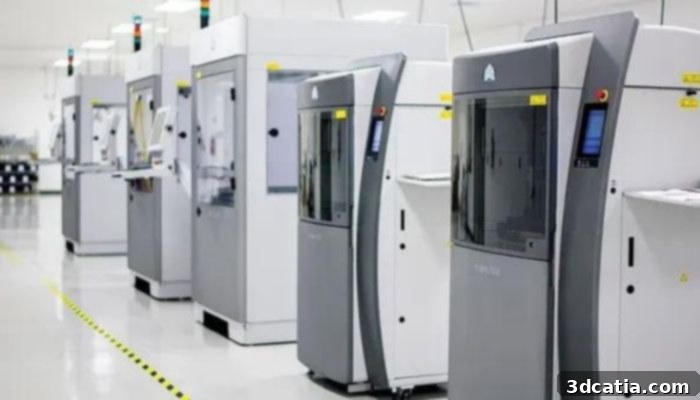
Photo Credits: 3D Systems
Strategic Reshaping: 3D Systems’ Bold Divestment and Acquisition Strategy
The most crucial factor contributing to 3D Systems’ altered financial landscape is its newly adopted, aggressive divestment and merger strategy. This bold move reflects a significant organizational realignment, where the company is streamlining its operations to focus squarely on its core strengths and most promising growth areas within additive manufacturing. Specifically, this involved the strategic sale of non-core assets, including its on-demand production services, as well as businesses like Simbionix, a leader in surgical simulation, and Cimatron, known for its CAD/CAM software solutions. These divestments were not merely offloading; they were deliberate decisions to shed divisions that, while profitable, did not align with the company’s refined vision for its future. By divesting these assets, 3D Systems aims to unlock capital and resources that can be redeployed into areas with higher strategic value and growth potential.
Simultaneously, the company has been active on the acquisition front, strategically bringing new entities under its umbrella to bolster its industrial and healthcare portfolios. Notable acquisitions include Kumovis, a specialist in medical device and implant manufacturing using high-performance polymers; Titan Robotics, known for its large-format, industrial 3D printing solutions; and Allevi, a pioneering company in bioprinting and regenerative medicine technologies. These acquisitions are not random; they are highly targeted moves designed to expand 3D Systems’ capabilities and market reach in specific, high-growth segments. Kumovis strengthens its position in advanced medical manufacturing, Titan Robotics enhances its industrial capacity for larger, more complex parts, and Allevi pushes the frontier in biological applications of 3D printing. Each acquisition is a testament to 3D Systems’ commitment to building a comprehensive and leading portfolio in its chosen core markets.
The financial impact of these strategic shifts is evident in the Q1 report. The sale of its entire on-demand part, for instance, naturally led to a significant decrease in reported revenue from that specific segment. The financial report indicates that 3D Systems experienced a substantial 38.1% drop in sales attributable to divested businesses. In numerical terms, this represents a decrease from $52.5 million in the first quarter of the previous year to $32.5 million in this year’s first quarter. This decline, therefore, is not a reflection of a weakening market position or operational struggles in its core business, but rather a direct and expected outcome of the planned divestment strategy. It highlights the company’s willingness to make bold decisions to streamline its operations and focus on its long-term strategic objectives, even if it means a temporary dip in overall reported revenue.
To the contrary of the overall revenue decline, and providing a more optimistic outlook for the American 3D printing company, is the robust growth observed in its core production sales. This segment experienced a notable increase of a full $7 million. This positive momentum indicates that despite the strategic restructuring, 3D Systems’ foundational business in delivering additive manufacturing solutions for end-use production is thriving. According to the company’s own statements, this growth is primarily driven by a higher acceptance and adoption of its offerings within sophisticated ‘production environments.’ This signifies a critical shift in the additive manufacturing landscape, where 3D printing is moving beyond mere prototyping and into mainstream industrial applications for manufacturing finished goods. The increased demand from these production environments underscores the growing maturity of additive manufacturing technologies and 3D Systems’ success in providing reliable, scalable solutions for these demanding applications.
The strategic clarity behind these moves was further articulated by 3D Systems CEO Dr. Jeffrey Graves, who emphasized the company’s renewed focus. Dr. Graves stated, “With our organization now fully-centered on our two business units, we are focused on offering the strongest and most complete portfolio of additive manufacturing technologies, brought together with the most knowledgeable and creative engineering teams. The effectiveness of this approach, which differentiates us in our industry, was demonstrated in the first quarter with revenue growth in our core businesses of 10% when adjusted for divestitures.” This statement is highly significant, as it provides the context necessary to understand the Q1 report. While total revenue decreased due to planned divestments, the core industrial and healthcare businesses – the future engines of growth for 3D Systems – actually experienced a healthy 10% revenue increase. This adjusted growth figure is a testament to the success of their strategic reorientation, proving that the company’s focused approach is yielding positive results in its most vital segments. The emphasis on offering a “complete portfolio” and leveraging “knowledgeable and creative engineering teams” highlights 3D Systems’ commitment not just to hardware, but also to materials, software, and comprehensive support, positioning it as a holistic solution provider in the evolving additive manufacturing ecosystem. To find out more about their updated strategy and offerings, visit the company’s website HERE.
This strategic transformation by 3D Systems reflects a broader trend within the additive manufacturing industry towards specialization and consolidation. Companies are increasingly identifying their core competencies and shedding tangential operations to invest more deeply in areas where they can achieve market leadership and sustainable growth. For 3D Systems, this means a sharpened focus on high-value applications in industrial manufacturing and advanced healthcare, two sectors where additive manufacturing offers unparalleled advantages in terms of customization, complexity, and on-demand production. The acquisitions of Kumovis, Titan Robotics, and Allevi directly support this strategy, providing cutting-edge technologies and expertise that complement 3D Systems’ existing offerings and expand its addressable market within these key verticals. This strategic repositioning is not without its challenges, as it requires careful management of integration and a clear communication of the company’s vision to investors and customers alike. However, the Q1 results, when viewed through the lens of adjusted core business growth, suggest that 3D Systems is successfully navigating this complex transition.
The path forward for 3D Systems appears to be one of targeted innovation and deepened market penetration in its chosen segments. The emphasis on industrial and healthcare solutions means addressing specific customer needs with highly engineered materials and reliable production systems. This includes continued development in areas like bioprinting for regenerative medicine, custom implants and prosthetics, and advanced manufacturing solutions for aerospace and automotive components. The strategic divestments have allowed the company to free up resources to accelerate R&D in these areas, ensuring it remains at the technological forefront. As the additive manufacturing industry continues to mature, companies that can offer specialized, high-performance solutions for critical applications are best positioned for long-term success. 3D Systems’ Q1 financials, despite the headline decline, signal a strong commitment to this strategic direction, setting the stage for potentially significant growth in its core, high-value markets.
What are your thoughts on 3D Systems’ new financial metrics and bold strategic shift? Do you believe this refocus on industrial and healthcare will secure its leadership in additive manufacturing? Let us know your insights in a comment below or join the conversation on our Linkedin, Facebook, and Twitter pages! Don’t forget to sign up for our free weekly Newsletter here to get the latest 3D printing news straight to your inbox! You can also find all our compelling videos on our YouTube channel, offering visual insights into the world of additive manufacturing.
Photo Credits: 3D Systems