

Apple Watch Ultra: Exploring the Rumored Shift to Titanium 3D Printing for Next-Gen Wearables
From innovative sneakers and high-performance bikes to sophisticated cameras, 3D printing, also known as additive manufacturing (AM), is rapidly transforming the landscape of consumer goods production. This revolutionary technology offers unparalleled advantages, including significant cost reduction, accelerated production cycles, and the ability to create highly customized and uniquely designed products. Now, the tech world is abuzz with a compelling rumor suggesting that technology giant Apple is poised to embrace this manufacturing paradigm for its eagerly anticipated Apple Watch Ultra, slated for release later this year. The speculation centers around Apple’s potential adoption of titanium 3D printing for the creation of crucial mechanical components within the device.
While this remains a rumor at present, with neither Apple nor the purportedly involved 3D printing companies offering official confirmation, its source lends it considerable weight. The speculation originates from Ming-Chi Kuo, a renowned analyst at TF International Securities, a prominent financial services group based in the Asia-Pacific region. Kuo has built an impressive reputation for his accuracy in predicting Apple’s future trends and product developments. His insights are often derived from a vast network of contacts within Apple’s extensive Asian supply chain, making him a highly reliable source for pre-release information and rumors. This latest insight, which was published by Bloomberg at the close of last week, posits that Apple plans to utilize 3D printing for the titanium mechanical parts of the 2H23 Apple Watch Ultra, specifically leveraging advanced manufacturing solutions from two leading Chinese companies: Farsoon and BLT.
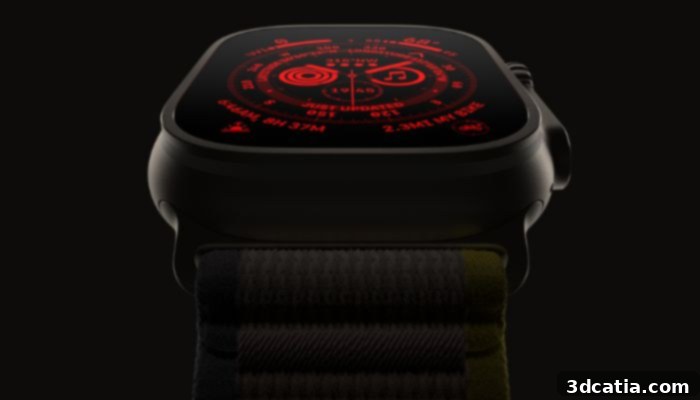
The original Apple Watch Ultra is marketed as a watch for serious athletes (photo credits: Apple)
Apple’s Evolving Relationship with Additive Manufacturing
This potential move into 3D printing for the Apple Watch Ultra isn’t the mobile device giant’s first foray into additive manufacturing. Apple has a documented history of exploring and utilizing 3D printing technologies, primarily for prototyping and specific niche applications. For instance, reports from Forbes last year suggested that Apple might already be incorporating solutions from Optomec, a company celebrated for its Aerosol Jet technology, which is specifically engineered for electronics additive manufacturing. This technology is ideal for printing fine-feature circuits and functional electronics. Furthermore, Apple has consistently used 3D printing for rapid prototyping throughout its product development cycles, allowing engineers to quickly iterate on designs and test functionalities before committing to mass production tooling.
However, if this latest rumor proves accurate, it would represent a significant paradigm shift. It would mark the first time that 3D printing takes center stage in the production of core mechanical components for a brand-new Apple product release destined for the consumer market. This transition from prototyping or specialized electronics manufacturing to structural, end-use parts signifies a deeper integration of additive manufacturing into Apple’s supply chain and product design philosophy, signaling a major endorsement of the technology’s readiness for high-volume, premium consumer electronics.
Leveraging Farsoon and BLT for Titanium Production
According to Kuo’s intelligence, the rumored titanium 3D printing for the Apple Watch Ultra will be executed using advanced solutions provided by Farsoon Technologies and BLT (Bright Laser Technologies). Both of these Chinese manufacturers are globally recognized leaders in the field of metal additive manufacturing, particularly for their sophisticated laser powder bed fusion (L-PBF) machines. L-PBF is a highly precise additive manufacturing process that uses a laser to selectively melt and fuse metallic powder particles layer by layer, building complex 3D objects directly from a digital design. Their machines are renowned for their compatibility with a wide array of metal powders, including high-performance materials like titanium, which is particularly relevant to the Apple Watch Ultra.
Farsoon and BLT have established themselves through their strong focus on industrial applications, serving diverse sectors ranging from aerospace, where precision and strength are paramount, to healthcare, automotive, and general industrial manufacturing. Their expertise in producing high-quality, dense metal parts with excellent mechanical properties makes them ideal partners for Apple’s demanding specifications. Given their proven track record in manufacturing robust, end-use parts for critical applications, it would be a logical choice for Apple to consider these two companies if the goal is to integrate 3D printed titanium components directly into a flagship consumer product like the Apple Watch Ultra. Titanium itself is a material highly prized for its exceptional strength-to-weight ratio, superior corrosion resistance, and biocompatibility, making it an excellent choice for premium wearables designed for durability and comfort.
The Compelling Benefits of 3D Printing for Apple
The mere possibility of Apple adopting 3D printing for its Watch Ultra has sparked considerable discussion across technology forums and industry circles. This widespread interest underscores the transformative potential that additive manufacturing offers, particularly to a company known for its meticulous engineering and premium product design. The strategic decision to integrate metal additive manufacturing could unlock a multitude of significant benefits for Apple.
Firstly, metal additive manufacturing has been consistently proven to **reduce production costs** in various industrial applications. While the initial cost of AM equipment can be high, it significantly cuts down on tooling expenses typically associated with traditional manufacturing methods like CNC machining or injection molding. For complex geometries, 3D printing can be more cost-effective as it creates parts directly from powder, minimizing material waste which is especially critical with expensive materials like titanium. Furthermore, the ability to consolidate multiple parts into a single, complex 3D printed component reduces assembly costs and simplifies the overall bill of materials. Secondly, 3D printing can dramatically **accelerate time to market**. By enabling faster design iterations and eliminating the need for complex tooling, product development cycles can be significantly shortened. This agility allows companies like Apple to respond more quickly to market demands and introduce innovations at an unprecedented pace.
Thirdly, adopting additive manufacturing can **strengthen the supply chain**. By potentially allowing for localized production or a more distributed manufacturing network, Apple could reduce its reliance on single-point suppliers and mitigate risks associated with global supply chain disruptions. This enhanced resilience is a major strategic advantage in today’s volatile economic climate. Beyond these overarching manufacturing benefits, 3D printing offers unique advantages that directly address some of the common critiques leveled against the original Apple Watch Ultra. The watch, while lauded for its ruggedness and extensive features, has often been described as bulky and heavy by some users. Additive manufacturing excels at creating highly complex geometries and lattice structures that are virtually impossible to achieve with traditional methods. This design freedom enables engineers to optimize parts for maximum strength with minimal material, resulting in significant **weight reduction** and a more streamlined profile. By printing intricate, hollowed-out titanium structures for mechanical parts, Apple could potentially reduce the overall mass of the Watch Ultra without compromising its renowned durability, thereby enhancing user comfort and appeal. This ability to innovate on both functional performance and user experience through advanced geometries is a cornerstone of additive manufacturing’s appeal to premium consumer brands.
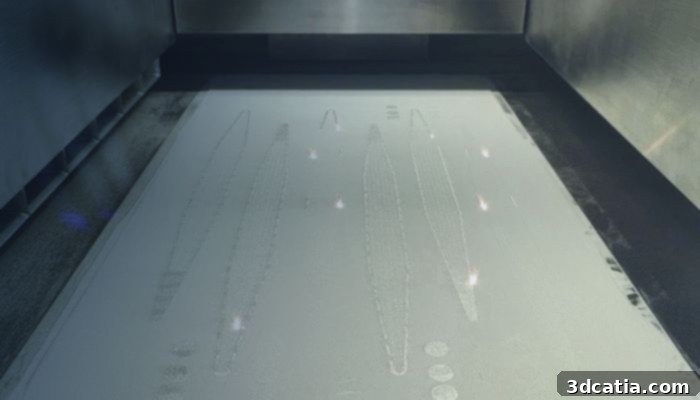
Apple is rumored to be adopting metal laser powder bed fusion for the Apple Watch Ultra (photo credits: Farsoon)
Future Outlook and Industry Implications
Despite the myriad advantages, Kuo’s report also offers a nuanced perspective, indicating that even if 3D printing is utilized for the mechanical parts of the Apple Watch Ultra, these components would still necessitate subsequent CNC (Computer Numerical Control) processes for back-end finishing. This is a common practice in metal additive manufacturing, where post-processing steps like machining, surface treatment, and heat treatment are crucial to achieve the desired surface finish, tight dimensional tolerances, and optimal material properties required for high-performance consumer electronics. This highlights that 3D printing, while revolutionary, often complements existing precision manufacturing techniques rather than entirely replacing them, especially for products with Apple’s stringent quality standards.
Furthermore, Kuo suggests that the new Apple Watch Ultra’s integration of 3D printing could serve as a critical “test case” for Apple. This implies a cautious, phased approach to adopting a novel manufacturing technology for core product components. If this initial deployment proves successful—meeting quality benchmarks, scalability requirements, and cost efficiencies—it could pave the way for a broader integration of additive manufacturing across Apple’s extensive product portfolio. This success would not only validate the technology for high-volume premium electronics but also send a powerful signal to the entire tech industry, potentially accelerating the adoption of 3D printing for various consumer electronics, from smartphones and laptops to smart home devices and accessories. The implications for the additive manufacturing industry itself would be monumental, driving further investment in R&D, material science, and process optimization to meet the demands of such a colossal consumer market. We will undoubtedly be keeping a close watch on any official announcements or further developments emanating from Apple, Farsoon, or BLT in the months ahead, as this rumor has the potential to redefine manufacturing in the wearables sector.
What are your thoughts on this intriguing rumor concerning the Apple Watch Ultra? Do you believe Apple is truly on the verge of embracing 3D printing for its flagship products? Share your insights and predictions in a comment below or join the conversation on our LinkedIn, Facebook, and Twitter pages! Don’t forget to sign up for our free weekly Newsletter here to get the latest 3D printing news delivered straight to your inbox. You can also explore all our videos on our YouTube channel.
*Cover Photo Credits: Apple