
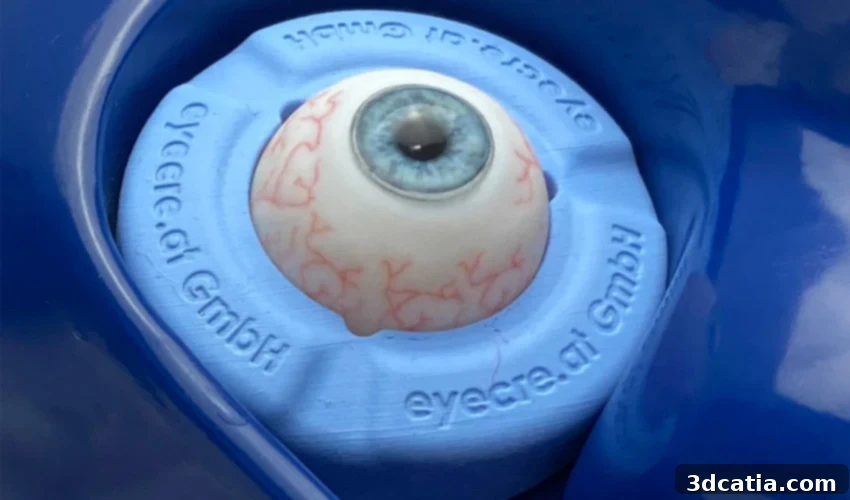
Revolutionizing Ophthalmic Training: Ultra-Realistic 3D Printed Eye Models by Addion and Stratasys
The field of medical education and surgical preparation is continually seeking innovative methods to enhance training effectiveness and improve patient outcomes. One of the most challenging areas involves delicate organs like the human eye, where traditional models often fall short in replicating the intricate, soft, and watery tissues with sufficient realism. This significant gap is now being expertly addressed by Addion GmbH, an Austrian 3D printing service specializing in advanced medical devices. By harnessing the cutting-edge capabilities of Stratasys PolyJet technology, Addion is producing ultra-realistic surgical eye models that promise to profoundly transform how surgeons prepare for critical ophthalmic operations. This multi-material, multi-color additive manufacturing process delivers an unprecedented level of anatomical accuracy and tactile realism, marking a monumental step forward in leveraging 3D printing for highly specialized surgical training.
The complexity of the human eye makes its replication a formidable task. Conventional methods struggle to reproduce the subtle variations in tissue softness, translucency, and the precise color gradients necessary for truly authentic models. These limitations often result in training tools that lack the fidelity required to adequately simulate real-world surgical scenarios, leaving a critical void in preparation. Historically, the creation of highly detailed and personalized surgical models has been a time-consuming and expensive endeavor, often failing to meet the diverse needs of surgical training due to constraints in materials, transparency, and color accuracy. Additive manufacturing offers a pathway to overcome some of these barriers, but not all 3D printing technologies are equally equipped for such intricate demands. This is precisely where material jetting, particularly Stratasys PolyJet technology, demonstrates its unparalleled advantage. Its ability to precisely combine multiple photopolymers and vibrant colors enables the creation of ultra-realistic parts, setting a new standard for medical simulation.
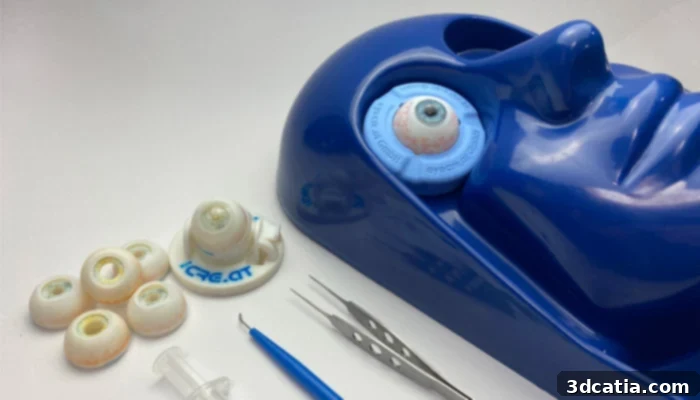
Photo Credits: Addion/Stratasys
The Unmatched Realism of 3D Printed Ophthalmic Models
Addion GmbH’s success in this niche stems from their strategic utilization of Stratasys’ Digital Anatomy Printer. This specialized solution, meticulously engineered for the medical sector, is designed to accurately reproduce the biomechanical behavior and appearance of human tissue. At the heart of this capability are advanced proprietary materials such as TissueMatrix™ and GelMatrix™. These innovative photopolymers allow Addion to meticulously mimic the soft, delicate, and watery appearance of the eye, achieving an extraordinary level of realism that was previously unattainable. The tactile feedback and visual authenticity provided by these materials are crucial for surgeons to gain practical experience that closely mirrors real-life operating conditions.
Alexander Hechenberger, CEO of Addion, emphasizes the groundbreaking precision made possible by this technology. He states, “The skin layer on the model is one-tenth of a millimeter and is detached with very small, fine instruments, implanted, and then reattached. This level of detail was previously unimaginable.” This statement highlights the micro-level accuracy required for ophthalmic procedures and the capacity of the Digital Anatomy Printer to deliver it. The ability to produce a surgical model where the cornea can be easily removed, manipulated, and reattached offers invaluable opportunities for doctors. It allows them to simulate complex operations repeatedly, enhancing their dexterity, precision, and understanding of ocular anatomy and surgical techniques. This hands-on experience not only better prepares them for critical interventions but also deepens their comprehension of the eye’s intricate functionalities, ultimately leading to safer and more effective patient care.
The Power of Stratasys PolyJet and the Digital Anatomy Printer
The Stratasys PolyJet technology, particularly embodied in the Digital Anatomy Printer, operates on principles of material jetting, a sophisticated additive manufacturing process. Unlike other 3D printing methods, PolyJet works by jetting minute droplets of liquid photopolymer onto a build tray. These droplets are then immediately cured by UV light, layer by layer, to form a solid object. The crucial differentiator for medical applications, especially in replicating complex organs like the eye, is its multi-material and multi-color capability. This means the printer can simultaneously jet different types of photopolymers, each with distinct mechanical properties (e.g., varying levels of hardness, flexibility, or transparency), and integrate a full spectrum of colors into a single print. This unique ability is paramount for recreating the nuanced textures, transparency, and vibrant vascular details of human tissues. For ophthalmic models, this translates into models that not only look authentic but also feel and behave like real eyes under a surgeon’s instruments.
The Digital Anatomy Printer takes these capabilities further by integrating software and hardware designed specifically to mimic human anatomical structures. It goes beyond simple geometry to reproduce the functional biomechanics of tissues, allowing surgeons to practice incisions, sutures, and complex manipulations on models that respond much like live tissue. The combination of TissueMatrix™ and GelMatrix™ is a prime example of this synergy. TissueMatrix provides a robust, soft tissue-like material, while GelMatrix offers the gelatinous, watery consistency that is characteristic of ocular components. By strategically combining these materials, Addion can create models with varying densities and transparencies within the same print, ensuring that everything from the cornea’s translucency to the sclera’s firmness is accurately represented. This level of detail and functional accuracy is what truly distinguishes Addion’s 3D printed eye models from conventional alternatives, providing a training experience that is unparalleled in its realism and educational value.
Transforming Ophthalmic Surgical Training and Beyond
Alexander Hechenberger further elaborated on the immense potential, stating, “For us, the possibilities with the Digital Anatomy Printer are endless, and despite the incredible results we’ve enjoyed to date, we are still just scratching the surface in terms of the technology’s potential. There are hardly any comparable alternatives for eye model production in our industry, particularly in the complex recreation of soft tissue with realistic colors and the variety of materials.” This highlights a significant competitive advantage and a pioneering spirit in advancing medical simulation. The ability to create models with such high fidelity directly addresses critical training needs that have long been unmet.
The impact of these ultra-realistic eye models extends far beyond simple visual aids. They serve as invaluable tools for pre-surgical planning, allowing surgeons to practice challenging or unique cases multiple times before stepping into the operating room. This iterative practice reduces surgical risks, minimizes complications, and significantly enhances patient safety. Furthermore, these models are instrumental in the education of medical students and residents, providing a safe, repeatable, and ethical platform for learning and honing essential surgical skills without the limitations associated with cadaveric specimens or animal models. The tactile realism means trainees can develop a nuanced understanding of tissue manipulation, instrument handling, and the physical responses of ocular structures.
The Austrian company’s vision for the future is equally ambitious. Addion already has plans to test other advanced materials offered by Stratasys, such as BoneMatrix™ for the creation of incredibly accurate bone structures, or additional applications of TissueMatrix for complex vascular structures. While the immediate focus is on ophthalmic models, the underlying technology and material science have broad implications for other medical specialties. Imagine realistic heart models for cardiovascular surgeons, intricate neurological models for neurosurgeons, or complex orthopedic models for bone repair. These advancements herald a new era in medical training, where anatomical models are not just static representations but dynamic, functional replicas that can simulate disease states and surgical interventions with unprecedented accuracy. This continuous innovation underscores the transformative power of additive manufacturing in pushing the boundaries of medical education and patient care. More details on Addion’s work can be found in the official press release HERE.
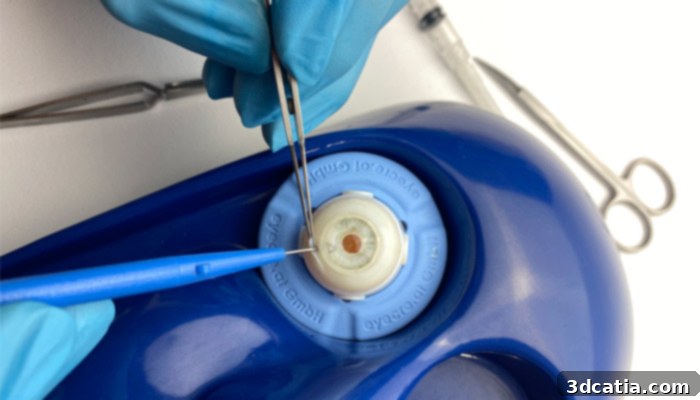
Using additive manufacturing, doctors can better understand the structure of the eye (photo credit: Addion/Stratasys)
The Broader Impact of Advanced Medical 3D Printing
The success of Addion and Stratasys in creating these highly realistic eye models is a testament to the immense potential of medical 3D printing. This technology is not merely about producing prototypes; it’s about creating functional, patient-specific tools that directly contribute to better surgical outcomes. The ability to rapidly iterate on designs and customize models for individual patient pathologies means that surgeons can prepare for unique challenges with unparalleled confidence. This level of personalization is a game-changer, moving beyond generic anatomical models to truly tailored training and planning solutions. Furthermore, the development of these advanced models fosters a collaborative environment between engineers, material scientists, and medical professionals, driving continuous innovation in both additive manufacturing and surgical techniques.
Beyond surgical training and planning, the implications for medical device development are also significant. By accurately mimicking human tissues, these 3D printed models can be used to test new instruments, implants, and surgical approaches in a simulated environment before human trials. This not only accelerates the development cycle but also enhances the safety and efficacy of new medical technologies. The economic benefits are also considerable; while initial investment in advanced 3D printing technology can be substantial, the long-term returns in reduced surgical errors, improved training efficiency, and enhanced patient safety far outweigh the costs. The ability to produce complex, multi-material models on demand offers a flexible and cost-effective alternative to traditional manufacturing methods for medical training aids, democratizing access to high-quality surgical education.
What are your thoughts on these ultra-realistic 3D printed eye models and their potential to revolutionize medical training? We invite you to share your insights in a comment below or join the conversation on our Facebook and Twitter pages. To stay informed about all the latest advancements and breaking news in the exciting world of 3D printing, don’t forget to sign up for our free weekly newsletter, delivered straight to your inbox!