
Revolutionizing Fusion Energy: How 3D Printed Tungsten is Powering the Future
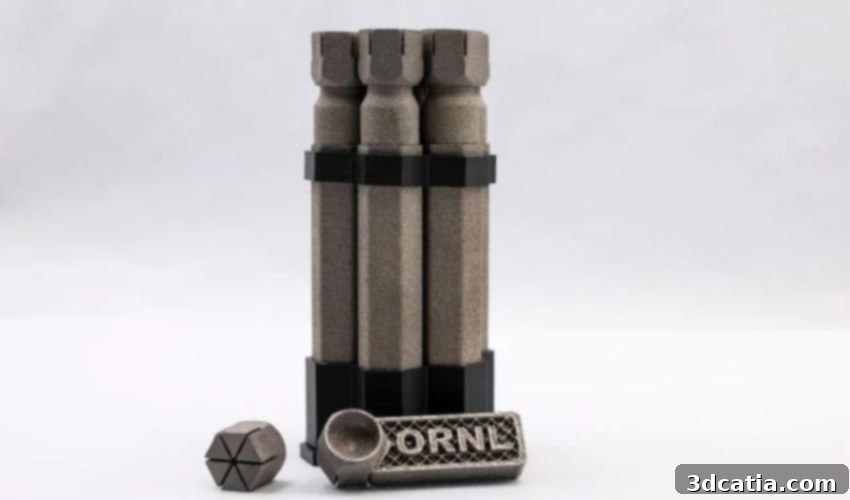
Fusion energy, the same process that powers our sun, represents a monumental frontier in humanity’s quest for clean, abundant, and sustainable energy. Its potential to provide virtually limitless, carbon-free power, without the long-lived radioactive waste associated with traditional nuclear fission, positions it as a highly promising solution to our escalating global energy demands. However, transforming this scientific dream into an economically viable reality presents a formidable set of engineering and material science challenges. Among the most critical hurdles is the extreme environment within a fusion reactor, where materials are subjected to unprecedented conditions. Intense neutron irradiation from the fusion reaction subjects reactor components to immense stress, leading to material degradation, including a high risk of embrittlement and structural failure. Addressing this, groundbreaking research at Oak Ridge National Laboratory (ORNL) has pivoted towards advanced manufacturing techniques, specifically 3D printing, to engineer flawless tungsten components. These innovative parts are meticulously designed to not only withstand the scorching temperatures and brutal conditions inside future fusion reactors but also to significantly extend their operational lifespan and enhance safety. By leveraging additive electron beam manufacturing, ORNL has successfully demonstrated the production of intricate tungsten parts with complex geometries, marking a pivotal step forward in the development of fusion energy technology.
The Paradox of Tungsten: Ideal Yet Challenging for Fusion
The inherent challenges in developing commercial fusion technology are largely dictated by the extraordinary demands placed on the materials used to construct the reactor. These materials must exhibit exceptional resilience against astronomical temperatures, intense electromagnetic fields, and relentless high-energy particle bombardment. Tungsten emerges as a leading candidate for critical plasma-facing components due to its extraordinary physical properties. It boasts the highest melting point of all metals, soaring to an incredible 3422°C (6192°F), making it uniquely suited for environments where plasma temperatures can exceed 180 million degrees Fahrenheit. This extreme thermal stability is crucial for components directly interacting with the superheated fusion plasma, preventing melting and erosion that could contaminate the reaction.
However, despite its favorable high-temperature properties, tungsten presents a significant paradox that has historically limited its widespread application. While incredibly durable under extreme heat, pure tungsten becomes notoriously brittle and prone to fracture at room temperature. This intrinsic fragility is exacerbated by even the slightest impurities, which can introduce microscopic defects and alter its crystalline structure, further compromising its mechanical integrity. Traditional manufacturing methods often struggle to produce tungsten components that are both pure enough and possess the complex shapes required for fusion reactors, frequently leading to residual stresses and micro-cracks that enhance brittleness. Overcoming this fundamental material limitation has been a cornerstone of fusion material research for decades, highlighting the need for innovative processing techniques.
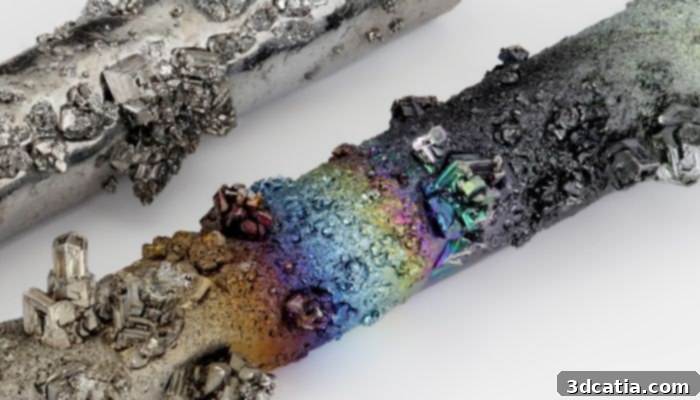
Tungsten is a shiny white heavy metal with a high density and has the highest melting point of all metals at 3422°C. (Photo Credits: Heinrich Pniok via Wikimedia Commons)
Electron Beam Melting: The Additive Manufacturing Solution
The solution to tungsten’s embrittlement dilemma, particularly for complex geometries required in advanced reactor designs, lies in advanced additive manufacturing processes. Specifically, electron beam 3D printing (EBM) has proven to be a transformative technology. Unlike conventional manufacturing that often involves subtractive processes or high-temperature forging that can introduce impurities and stresses, EBM builds components layer by layer with exceptional precision. The process takes place within a high-vacuum chamber, which is crucial for working with highly reactive or sensitive materials like tungsten.
Within this vacuum, a magnetically directed stream of high-energy electrons precisely melts metallic powder, bonding it into a solid, fully dense object. The high vacuum environment is a key advantage, as it drastically reduces the possibility of contamination from foreign materials, which, as noted, can severely impair tungsten’s structural integrity. Furthermore, the EBM process allows for careful control over the cooling rates and solidification patterns, which significantly minimizes the formation of residual stresses within the material. These stresses are often a precursor to cracks and material failure, especially in brittle materials. The ability of EBM to produce parts with near-net shape, reducing post-processing, and its capacity to create intricate internal cooling channels or support structures, make it an ideal choice for the next generation of fusion reactor components. This level of control and purity is unprecedented in traditional manufacturing methods for refractory metals, opening new avenues for material design and performance.
ORNL’s Breakthrough: Paving the Way for Safer, More Efficient Fusion Reactors
The breakthrough achieved by researchers at ORNL’s Manufacturing Demonstration Facility is not merely an incremental improvement; it represents a fundamental shift in how we approach material challenges for fusion energy. With crucial support from the Department of Energy’s (DOE) Advanced Materials and Manufacturing Technologies Office, their work has demonstrated the viability of producing robust, pure tungsten components through EBM that can directly address the problem of embrittlement. By carefully optimizing powder characteristics, electron beam parameters, and build strategies, the ORNL team has successfully engineered tungsten parts with superior mechanical properties, capable of enduring the harsh neutron flux and extreme temperatures present in a fusion environment.
This advancement holds immense potential to significantly enhance both the safety and efficiency of fusion reactors moving forward. Stronger, more durable materials mean longer operational lifespans for reactor components, reducing downtime and maintenance costs. Critically, improved material integrity directly translates to enhanced safety by mitigating the risk of structural failures. Such robust components are essential for the long-term reliability and commercial viability of fusion power plants. This development not only offers a promising alternative to traditional nuclear reactors but also represents a monumental stride toward truly sustainable energy production, free from the challenges of fossil fuels and the byproducts of fission.
Broader Implications: A Sustainable, Carbon-Free Future
The successful 3D printing of high-performance tungsten components for fusion reactors aligns perfectly with global efforts to combat climate change. Fusion technology promises a clean energy source that produces no carbon emissions, thereby directly contributing to a decarbonized global energy mix. Unlike fossil fuels, fusion reactions produce no greenhouse gases, and unlike fission, they generate minimal long-lived radioactive waste. This makes fusion an exceptionally attractive candidate for future energy systems, providing a sustainable pathway to power humanity for millennia. The ability to manufacture critical reactor parts with unprecedented durability and purity is a key enabler for accelerating the timeline for commercial fusion power, moving us closer to a future where energy is abundant, safe, and environmentally responsible.
Moreover, the innovative development of 3D-manufactured tungsten components, and the expertise gained in advanced refractory metal additive manufacturing, could extend far beyond fusion applications. These resilient, high-temperature materials hold immense utility in a myriad of high-stress scenarios across diverse industries. Consider aerospace, where lightweight yet incredibly strong and heat-resistant components are critical for advanced propulsion systems and spacecraft. In the defense sector, superior materials are needed for hypersonic vehicles and protective systems. Medical implants requiring biocompatibility and durability, as well as specialized tooling and industrial machinery operating in extreme conditions, could all benefit from tungsten parts manufactured with this level of precision and material integrity. This research effectively pushes the boundaries of material science and manufacturing, demonstrating the broad applicability of electron beam melting for other refractory metals and superalloys, thereby catalyzing innovation across multiple high-tech sectors.
Expert Insights and The Road Ahead
The scientific community widely acknowledges the transformative potential of these advancements. Michael Kirka, a Senior Research Staff Member at ORNL, emphasized the significance of this work, stating:
Electron-beam additive manufacturing is promising for the processing of complex tungsten geometries. This is an important step for expanding the use of temperature-resistant metals in energy resources that will support a sustainable, carbon-free future.
Kirka’s statement underscores not only the technical achievement but also its profound implications for sustainable energy. The ability to precisely control the material properties of tungsten at a microscopic level, producing parts that can withstand the harshest environments, is a game-changer. It signifies a future where material limitations are no longer insurmountable barriers but rather engineering challenges that can be overcome with innovative manufacturing techniques. The research at ORNL and similar institutions globally is continuously refining these processes, exploring new material combinations, and pushing the boundaries of what’s possible with additive manufacturing. The road to commercial fusion energy is long, but breakthroughs like this significantly shorten the journey, making the promise of clean, virtually limitless power an increasingly tangible reality.
Conclusion: Forging a Fusion-Powered Tomorrow
The development of 3D-printed tungsten components through electron beam melting represents a monumental leap forward in the quest for practical fusion energy. By meticulously addressing the critical challenge of material resilience in the face of extreme temperatures and intense neutron irradiation, researchers at Oak Ridge National Laboratory have demonstrated a viable path to creating the durable, complex parts essential for future fusion reactors. This innovative approach promises to enhance reactor safety, improve operational efficiency, and significantly accelerate the timeline for realizing a carbon-free energy future. As additive manufacturing continues to evolve, its synergy with advanced material science will undoubtedly unlock further potential, not only for fusion power but across a spectrum of industries requiring components capable of performing under the most demanding conditions. The future of energy is being forged, layer by precise layer, by technologies like electron beam 3D printing, bringing us closer to a world powered by the stars.
What do you think of these 3D printed tungsten components and their potential impact on fusion energy? We’d love to hear your thoughts! Let us know in a comment below or join the conversation on our LinkedIn, Facebook, and Twitter pages! Don’t forget to sign up for our free weekly newsletter here for the latest 3D printing news straight to your inbox! You can also find all our videos on our YouTube channel.
*Cover Photo Credits: Oak Ridge National Laboratory