
Top 5 3D Printing Videos: Innovations in Sports, Construction, Software, and Supply Chain Solutions
Welcome back to another exciting week in the world of additive manufacturing! Every Sunday, we bring you a curated selection of the most impactful and inspiring 3D printing videos that showcase the transformative power of this technology across diverse industries. From enhancing athletic performance to revolutionizing construction, optimizing industrial design, tackling manufacturing challenges, and even fortifying global supply chains, this week’s Top 5 list provides an insightful look into how 3D printing is shaping our future. Get ready to explore compelling stories, expert insights, and impressive demonstrations that highlight the incredible versatility and potential of modern additive manufacturing techniques.
Our journey begins on the frosty tracks of elite sports, revealing how advanced manufacturing gives athletes a crucial edge. We then shift our focus to urban landscapes, where a visionary entrepreneur discusses the seismic shifts 3D printing is bringing to construction. Next, we delve into the sophisticated software powering these innovations through an exclusive interview with a leading industry CEO. Following this, we witness an ambitious manufacturing challenge that pushes the boundaries of production efficiency. Finally, we conclude with an essential discussion on how 3D printing is providing robust solutions to some of the most pressing global supply chain dilemmas. We trust you’ll find these videos as engaging and informative as we do!
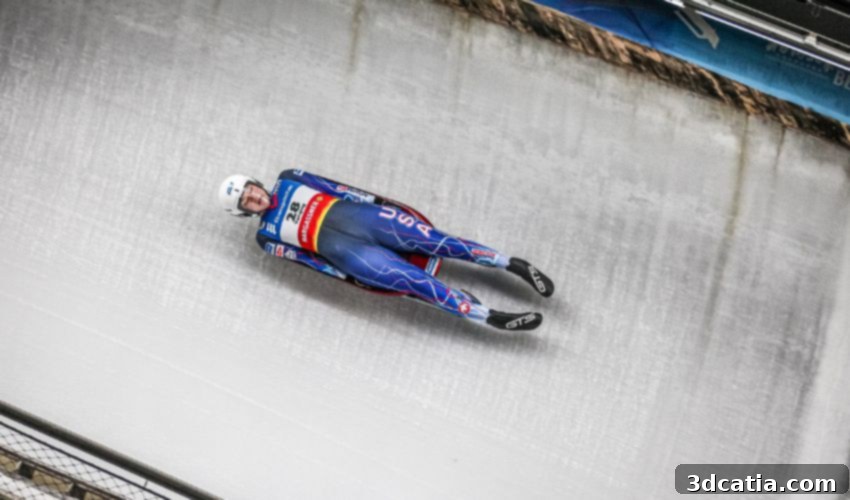
Top 1: Stratasys Powers the US Olympic Luge Team to Victory with 3D Printing
The pursuit of excellence in sports often hinges on fractional advantages, and for the US Olympic Luge team, 3D printing is providing just that. In an ongoing partnership with US-based additive manufacturing giant Stratasys, the team is leveraging cutting-edge Fused Deposition Modeling (FDM) technology to design, prototype, and produce critical luge components. This collaboration, which saw notable success at the 2022 Pyeongchang Games, continues to push the boundaries of performance and customization in competitive sports.
This insightful video offers an exclusive look into how Stratasys’ FDM solutions are instrumental in manufacturing streamlined luge parts. The ability to rapidly iterate on designs and produce specialized components in as little as two weeks dramatically accelerates the development cycle. Traditional manufacturing methods often involve lengthy lead times and significant costs for mold creation, making bespoke parts difficult and expensive. With industrial 3D printing, the team can experiment with various geometries, optimize aerodynamics, and fine-tune ergonomics to perfectly match each athlete’s physique and racing style. This level of customization ensures maximum comfort, control, and ultimately, saves precious milliseconds on the track—a difference that can mean the distinction between a medal and coming up short. The agility provided by additive manufacturing not only enhances performance but also offers a cost-effective way to achieve unparalleled precision and innovation in high-stakes athletic competitions, demonstrating the immense potential of advanced manufacturing in sports.
Top 2: Unlocking Efficiency and Innovation: The Benefits of 3D Printing in Construction
The construction industry, often perceived as traditional and slow to adapt, is on the cusp of a profound transformation thanks to additive manufacturing. Entrepreneur Anna Cheniuntai, in her compelling TED Talk featured this week, dives deep into the myriad benefits that 3D printing brings to construction, positioning it as a powerful antidote to the inefficiencies and limitations of conventional building processes. Her visionary insights highlight how this emerging technology can redefine future housing and urban development by offering unprecedented speed, cost-effectiveness, and design flexibility.
Cheniuntai masterfully outlines the potential of 3D printing to address some of the most pressing challenges in construction today, including labor shortages, extensive material waste, and the notoriously slow pace of project completion. She emphasizes that 3D printing enables unprecedented design freedom, allowing for the creation of complex architectural geometries and intricate structural elements that would be cost-prohibitive or impossible with traditional methods. Moreover, the technology promises significant improvements in speed and overall cost-efficiency. Her memorable analogy comparing the efficiency of 3D printing in construction to a Formula 1 pitstop—where rapid, precise adjustments are made in seconds to ensure continuous progress—powerfully illustrates this point. This capability allows for faster deployment of structures, reduced on-site labor requirements, and optimized material usage, leading to more sustainable and economically viable building solutions. As 3D concrete printing advances, it holds the immense promise of rapidly erecting affordable, robust, and aesthetically pleasing housing, potentially revolutionizing how we approach global housing crises and contributing to the creation of more resilient and adaptable communities worldwide. The future of construction is truly being printed, layer by layer, with unparalleled precision and accelerated timelines.
Top 3: A Vision for the Future with Bradley Rothenberg, CEO of nTopology
In an exclusive interview with the 3Dnatives team, we had the distinct pleasure of sitting down with Bradley Rothenberg, the insightful CEO of nTopology. As a leading software company at the forefront of additive manufacturing, nTopology is revolutionizing how engineers design and develop complex structures for diverse applications. Our conversation with Rothenberg offered a deep dive into the current trajectory of the 3D printing industry and elucidated nTopology’s pivotal role within this rapidly evolving landscape, particularly in advanced computational design.
Rothenberg shared fascinating insights into nTopology’s extensive work across critical sectors such as aerospace, defense, and automotive. He explained how their powerful computational design software empowers engineers to create previously impossible geometries, including intricate lattice structures, functionally graded materials, and topology-optimized parts that significantly reduce weight while maintaining or even improving performance. These advancements are crucial for industries where every gram counts, structural integrity is paramount, and innovative part design can lead to breakthrough products. Beyond showcasing their technological prowess, Rothenberg adeptly addressed common misconceptions surrounding the capabilities and limitations of 3D printing design software, providing much-needed clarity on its true potential to democratize complex engineering. He concluded by sharing his compelling vision for the future of additive manufacturing, emphasizing its growing importance in global manufacturing innovation and its capacity to solve increasingly complex engineering challenges, ultimately driving efficiency, sustainability, and groundbreaking product development across a multitude of global industries. His perspective offers a valuable roadmap for understanding where the industry is headed and how nTopology is helping to pave the way with intelligent design solutions.
Top 4: The Metal Additive Manufacturing Challenge: Printing 100 Bike Levers on a Single Build Plate
One of the most exciting aspects of 3D printing is its continuous push towards greater efficiency, scalability, and integration into mainstream manufacturing. This week, we feature a captivating challenge video that puts these advancements to the test: a dedicated team attempts to manufacture an astounding 100 metal mountain bike brake levers on a single build plate! This ambitious endeavor not only highlights the remarkable productivity and precision achievable with modern metal additive manufacturing technologies but also showcases the practical application of mass customization and on-demand production.
The video meticulously documents the entire journey, from initial design concepts and meticulous build plate preparation to the intricate layering process within the metal 3D printer and the essential post-processing stages required to achieve final parts. Viewers get a front-row seat to the impressive efficiency of their equipment, witnessing how the printer skillfully builds multiple complex parts simultaneously without compromising quality or geometric accuracy. The team walks through their strategy for maximizing the build volume, discussing critical considerations like optimal part orientation, efficient support structure generation, and the specific material properties chosen for high-performance bicycle components—all crucial factors for a successful print of such density. The visual displays vividly illustrate the intricate planning involved in scaling metal additive manufacturing. The ultimate success of this project (yes, it’s a spoiler, but the sheer achievement is worth celebrating!) demonstrates the growing viability of metal 3D printing for not just rapid prototyping, but also for efficient small-batch production, custom component manufacturing, and potentially even high-volume applications where design complexity or customization is key. This challenge underscores how additive manufacturing is enabling manufacturers to produce high-performance, durable metal components with unprecedented speed and efficiency, opening new avenues for product development, agile manufacturing, and robust supply chain flexibility.
Top 5: Reshaping Supply Chains and Overcoming Labor Crises with Additive Manufacturing
In an increasingly interconnected yet volatile global economy, resilience and adaptability are paramount for businesses seeking to maintain continuity and competitiveness. This week’s list concludes with an incredibly timely and informative webinar that tackles two critical contemporary issues: persistent global supply chain disruptions and escalating labor crises. The discussion features an expert panel, including the CEOs of Aidro and Desktop Metal, who collectively explore how additive manufacturing (AM) serves as a powerful, strategic solution to these multifaceted challenges faced by industries worldwide.
The webinar provides a comprehensive analysis of how integrating 3D printing into manufacturing strategies can significantly mitigate vulnerabilities within complex supply chains. By enabling on-demand, localized production, companies can drastically reduce their reliance on distant suppliers, shorten lead times for critical components, and drastically cut down on inventory holding costs, thereby freeing up capital and reducing warehousing needs. This strategic shift towards distributed manufacturing offers greater agility, allowing businesses to respond more rapidly and effectively to unforeseen disruptions, geopolitical shifts, or sudden spikes in market demand. Furthermore, the discussion highlights AM’s increasingly crucial role in addressing prevalent labor shortages. The high degree of automation inherent in many 3D printing processes can effectively compensate for reduced manual labor availability, while simultaneously creating new opportunities for a highly skilled workforce focused on the design, operation, and maintenance of advanced additive manufacturing systems. Our esteemed guests presented compelling real-world examples of manufacturers successfully deploying additive manufacturing tools for both metal and sand applications. These detailed case studies underscore how companies are leveraging AM to produce critical components closer to the point of need, optimize spare parts management, reduce waste, and even innovate in areas like tooling and molds, ultimately enhancing operational resilience, fostering economic stability, and creating more sustainable manufacturing practices in an unpredictable global landscape. This webinar is a must-watch for anyone looking to understand the strategic advantage of 3D printing in today’s global market.
What an insightful week it has been, showcasing the incredible breadth and depth of 3D printing innovation! From precision sports equipment and revolutionary construction methods to advanced software design, efficient metal production, and strategic solutions for global supply challenges, additive manufacturing continues to prove its indispensable value across all sectors. We hope this week’s selection has sparked your curiosity and provided valuable perspectives on the evolving landscape of 3D printing technology and its transformative applications.
We always love hearing from our readers! Share your thoughts on this week’s video roundup in a comment below, or connect with us on our LinkedIn, Facebook, and Twitter pages. Don’t miss out on the latest advancements and breaking news in additive manufacturing – be sure to sign up for our free weekly Newsletter here, delivered straight to your inbox! For an even deeper dive, explore our extensive library of videos and subscribe to our YouTube channel for continuous updates. Until next time, keep printing the future!