
Revolutionizing Spinal Surgery: The Future of 3D Printed Implants for Enhanced Patient Outcomes
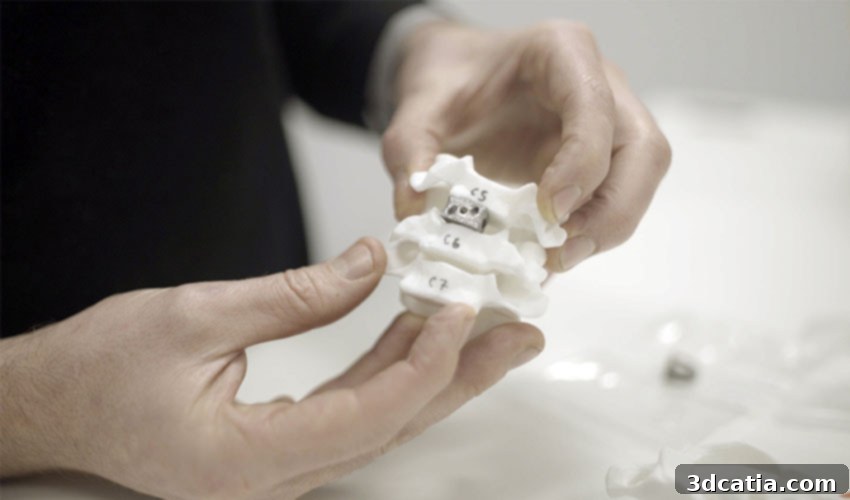
In a significant stride towards advancing medical technology and patient care, Renishaw, a global engineering powerhouse, has announced a groundbreaking collaboration with Irish Manufacturing Research (IMR) and nTopology. This strategic partnership is dedicated to showcasing the transformative advantages of additive manufacturing in the intricate process of producing spinal implants. Beyond merely demonstrating technological capability, this initiative also aims to illustrate how seamlessly the transition from innovative design concepts to their physical realization through additive manufacturing can be achieved when synergistic partners combine their expertise and resources. This collaborative effort signifies a pivotal moment for the medical sector, promising to redefine the standards of spinal implant development and delivery.
Additive Manufacturing Revolutionizing Applications in the Medical Sector
Renishaw, headquartered in the UK, stands as a prominent global engineering company and a recognized leader in the field of additive manufacturing. The company’s diverse product portfolio spans a wide array of applications, from critical components for jet engines and wind turbines to highly specialized instruments for dentistry and complex brain surgery. Their latest pioneering project is sharply focused on developing a comprehensive solution for patients grappling with debilitating medical conditions that severely impact their spine. These conditions encompass a broad spectrum of diagnoses, including degenerative disc disease, which involves the breakdown of spinal discs; herniated disc, where a disc protrudes and irritates nerves; spondylolisthesis, a condition in which a vertebra slips forward over another; spinal stenosis, a narrowing of the spinal canal; and osteoporosis, which causes bones to become brittle. Should these advanced 3D printed spinal implants prove successful in clinical applications, they hold immense potential to significantly reduce surgery times for patients, minimize post-operative complications, and most critically, lower the frequency of revision surgeries. The ripple effect of such advancements would be profound, translating directly into substantial reductions in healthcare resources utilization and overall medical costs, thereby alleviating the burden on healthcare systems globally.
The innovative application of 3D printing in spinal care is not an isolated phenomenon. Earlier this year, researchers from the University of California, San Diego, embarked on an equally promising endeavor focused on treating spinal cord injuries using cutting-edge 3D printing techniques. Their ingenious method involved the 3D printing of intricate scaffolding structures, meticulously designed to facilitate the implantation and guided growth of stem cells. These stem cells, strategically placed within the printed scaffold, are intended to promote neural regeneration and repair damaged spinal cord tissue. Initial experiments conducted on laboratory rats have yielded profoundly promising results, demonstrating the potential for significant functional recovery. Building upon this success, the research team is now progressing to testing these advanced techniques on larger animal models, marking a crucial step towards eventual human clinical trials. These parallel advancements underscore the rapidly accelerating pace of innovation in medical additive manufacturing, particularly within the challenging and critical domain of spinal health.
The Advanced Process of Manufacturing 3D Printed Spinal Implants
The collaborative project saw Irish Manufacturing Research (IMR), a leading manufacturing Research and Technology Organisation, take the initial critical step of designing a highly representative titanium spinal implant. This complex design was brought to life using nTopology’s advanced generative design software, a tool specifically engineered to create optimized, intricate geometries that are often impossible with traditional design methods. Following the sophisticated design phase, the conceptual implants were then meticulously manufactured using Renishaw’s state-of-the-art RenAM 500M metal additive manufacturing system. This industrial-grade 3D printer is renowned for its precision and capability in producing complex metal components. A key differentiator of additive manufacturing, particularly in this medical application, is its unparalleled ability to create intricate, complex structures with internal features and lattice designs that are simply unachievable through conventional subtractive or formative manufacturing techniques. This capability is vital for engineering implants that mimic the natural properties of bone and promote superior biological integration.
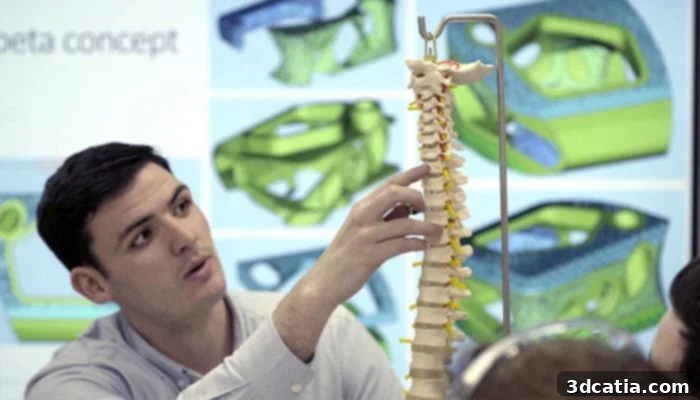
Photo Credits: Renishaw
Ed Littlewood, Marketing Manager of Renishaw’s Medical and Dental Products Division, eloquently explains the profound advantages of this approach: “Additive manufacturing (AM) can be uniquely utilized to manufacture implants featuring advanced lattice structures, a level of complexity and internal architecture that simply cannot be achieved with conventional manufacturing techniques. An implant meticulously engineered with a lattice structure offers a multitude of benefits: it is inherently lightweight, significantly reducing the overall burden on the patient’s body; it can be precisely optimized to meet specific required loading conditions, ensuring biomechanical compatibility and stability; and crucially, it boasts a significantly greater surface area at the microscopic level. This increased surface area is paramount as it dramatically aids osseointegration, the vital process where bone grows directly onto and into the implant, establishing a strong, lasting bond. Therefore, AM implants can be designed to meticulously mimic the mechanical properties and porous architecture of natural bone, which invariably leads to better patient outcomes, including faster healing and reduced risk of complications. However, all these theoretical advantages remain just that – theoretical – if one does not possess the sophisticated tools and software required to initially create and refine such intricate designs with precision and efficiency.”
The emphasis on advanced design tools is equally critical for the entire implant development pipeline. Traditional CAD (Computer-Aided Design) tools, while powerful for conventional geometries, were inherently not built to efficiently design the kind of highly complex, generative, and lattice structures crucial for advanced medical implants. This limitation often led to prohibitive design times and a steep learning curve for engineers attempting to achieve biomimetic geometries. This is precisely where nTopology’s cutting-edge software shines, as it has fundamentally simplified the entire design process for intricate structures. Matt Rohr, nTopology’s Application Engineering Manager, highlights this transformative capability: “We successfully cut the design time of these complex structures from days, sometimes even weeks, down to mere minutes. This drastic reduction in design lead time was an absolutely crucial component in ensuring this ambitious project could run effectively and efficiently, adhering strictly to its schedule and accelerating the path to viable implant prototypes.” The ability to rapidly iterate and optimize designs is a cornerstone of agile development, and nTopology’s contribution exemplifies how specialized software can unlock new frontiers in manufacturing.
The collaborative spirit and technical excellence extended beyond design and initial manufacturing. An McConnell, Senior Research Engineer at IMR, offered valuable insights into the iterative optimization process: “Renishaw worked tirelessly and collaboratively with us on continuously improving the additive manufacturing process specifically tailored for producing these advanced spinal implants. Together, we meticulously designed and executed a comprehensive set of experiments that allowed us to systematically identify and refine the most appropriate parameter settings for optimal product quality and performance. As a direct result of this dedicated effort, we were able to achieve a remarkable reduction in the amount of post-processing required on several key features of the implants, reducing it by an impressive factor of ten.” This significant reduction in post-processing steps not only streamlines the overall production workflow but also contributes to lower manufacturing costs, faster turnaround times, and potentially improved geometric accuracy by minimizing manual intervention after the printing process. This level of process optimization is essential for the scalability and commercial viability of 3D printed medical devices.
The Broader Impact and Future of 3D Printed Spinal Implants
This pioneering partnership among Renishaw, IMR, and nTopology represents far more than a mere technological demonstration; it signifies a tangible leap forward in patient care and the broader medical device industry. The ability to produce customized, lightweight, and bio-integrating spinal implants through additive manufacturing offers transformative benefits. Patients can look forward to implants that are specifically tailored to their unique anatomical needs, potentially leading to reduced discomfort, faster rehabilitation, and a higher quality of life post-surgery. The enhanced osseointegration properties, driven by sophisticated lattice structures, promise greater long-term stability and a lower risk of implant failure. From a healthcare system perspective, the potential reduction in revision surgeries and associated costs, coupled with more efficient surgical procedures, translates into significant resource savings and improved patient throughput. This collaborative model – uniting experts in additive manufacturing hardware, generative design software, and advanced manufacturing research – showcases the power of interdisciplinary innovation in addressing complex medical challenges.
Looking ahead, the success of projects like this one paves the way for a broader adoption of 3D printed medical devices across various orthopedic and surgical specialties. The principles demonstrated here – precision design, advanced material utilization, process optimization, and strong collaboration – are transferable to other areas, from joint replacements to craniofacial implants. As the technology matures and regulatory pathways become more streamlined, we can anticipate an acceleration in the development and availability of highly customized, patient-specific solutions. This not only promises to enhance individual patient outcomes but also drives the entire medical device manufacturing industry towards more agile, efficient, and innovative production methodologies. The future of spinal surgery, and indeed much of personalized medicine, is increasingly being shaped by the relentless advancements in additive manufacturing and smart design tools.
What are your thoughts on this groundbreaking partnership and the exciting potential of 3D printed spinal implants? We invite you to share your insights and comments below, or engage with us on our Facebook and Twitter pages! Stay informed on all the latest developments in additive manufacturing and medical innovation by signing up for our free weekly Newsletter, delivering the most current news in 3D printing directly to your inbox.