
Boosting UK Additive Manufacturing: Coventry University’s £5M Lab Ignites Innovation in Healthcare and Digital Production
The landscape of additive manufacturing, commonly known as 3D printing, presents a paradox within the United Kingdom. Despite its global recognition for cutting-edge research and innovation in this transformative field, the UK significantly lags behind other leading industrial nations in the commercialization and widespread adoption of these advanced technologies. Current statistics paint a stark picture: only 17% of UK companies possess any experience with additive manufacturing, a figure that pales in comparison to Germany’s 37% and China’s 24%. This notable gap highlights an immense, untapped potential within the British economy, as underscored by Jurgen Maier of Siemens UK, who stated, “Although it is widely recognised that the UK is one of the leaders in world-class research and innovation in additive manufacturing, it is falling behind in its commercialisation.” This disparity represents not just a missed economic opportunity, but also a strategic challenge for the nation’s industrial future. Bridging this gap requires concerted efforts in investment, infrastructure, and skills development to translate groundbreaking research into tangible industrial capabilities.
In a crucial and much-needed development to revitalize the UK’s additive manufacturing sector, the market has recently received a substantial boost. Coventry University, a forward-thinking institution renowned for its practical, industry-focused education and research, has proudly announced its plans to establish a brand-new, state-of-the-art laboratory dedicated to advanced manufacturing and research. This ambitious new facility, aptly named the Precision Digital Manufacturing and Healthcare Technology Lab, is poised to become a hub of innovation, pushing the boundaries of what is possible with digital production techniques.
Introducing the Precision Digital Manufacturing and Healthcare Technology Lab
The new lab at Coventry University is designed to be a cornerstone for advanced manufacturing in the UK, with a specific emphasis on precision and digital integration. A core component of its technological arsenal will be a comprehensive suite of metal 3D printing technologies, allowing for the creation of intricate, high-performance components previously unattainable through traditional manufacturing methods. The lab’s mission extends beyond just production; it aims to foster a profoundly collaborative environment, bringing together students, researchers, and professionals from both the healthcare and engineering sectors. This interdisciplinary approach is critical for addressing complex real-world challenges and developing innovative solutions that have a direct, positive impact on society and industry.
Professor Catherine Hobbs, the esteemed Head of Academic Dean at Coventry University’s Faculty of Engineering, Environment and Computing, articulated the transformative potential of this new venture. According to Professor Hobbs, “The precision 3D printing technology available will mean we can create usable components for healthcare applications, while digital twinning will allow us to simulate how objects will work in a virtual environment.” This statement highlights two pivotal technologies at the heart of the lab: advanced 3D printing for tangible outputs and digital twinning for virtual optimization.
Advanced Technologies: Metal 3D Printing and Digital Twinning
The inclusion of metal 3D printing technologies is particularly significant. This capability enables the production of highly customized, lightweight, and complex parts with superior mechanical properties, which are invaluable for demanding applications such as medical implants, intricate surgical instruments, and bespoke prosthetic devices. The ability to tailor designs precisely to individual patient needs or specific engineering requirements opens up unprecedented avenues for innovation in healthcare, leading to more effective treatments and improved patient outcomes. Furthermore, metal additive manufacturing offers advantages in rapid prototyping, reducing product development cycles, and enabling on-demand production, which can revolutionize supply chains in critical sectors.
Equally revolutionary is the emphasis on digital twinning. A digital twin is a virtual representation of a physical object, system, or process, updated with real-time data. By creating digital twins of manufactured components or entire production lines, researchers and engineers can simulate their performance, predict potential failures, and optimize designs and processes in a virtual environment before physical production. This not only significantly reduces development costs and time but also enhances reliability and efficiency. In the context of healthcare, digital twinning could be used to simulate how a new implant interacts with biological tissues or to optimize surgical procedures, ensuring the highest levels of safety and efficacy. This blend of physical and virtual innovation positions the Coventry lab at the forefront of the next industrial revolution.

Coventry University is a modern research institution in the West Midlands (Photo credit: Coventry University)
The Funding Catalyst: £5 Million from the Office for Students
The ambitious project at Coventry University has been made possible through a substantial £5 million grant provided by the Office for Students (OfS). The OfS is an independent regulatory body dedicated to ensuring that every student in English higher education receives a high-quality academic experience that equips them for future success. A key part of their mandate involves offering strategic funding to boost facilities, equipment, and innovative projects across educational institutions. This financial backing from the OfS is more than just a monetary allocation; it is a strategic investment in the future of UK manufacturing, technology, and healthcare.
The funding landscape for higher education projects in the UK is intensely competitive. For the 2022-23 academic year alone, the OfS distributed a staggering £1,347 million of recurrent grant funding to 342 educational institutions, underscoring the scale of their operations and the widespread demand for support. Susan Lapworth, Chief Executive of the OfS, confirmed the rigor of the selection process, stating, “Competition for funding was strong, with high quality applications from across the sector.” This competitive environment ensures that only the most impactful, well-conceived, and strategically aligned projects secure funding. The fact that Coventry University’s proposal was among those chosen speaks volumes about its perceived potential, its alignment with national priorities, and the university’s proven track record in delivering high-impact research and educational programs. This significant investment will undoubtedly be put to excellent use, catalyzing innovation and creating a lasting legacy for the region and the nation.
Coventry University’s Established Expertise in Additive Manufacturing
Coventry University is not a newcomer to the realm of advanced manufacturing and its applications in healthcare. The institution boasts a strong precedent of practical engagement, particularly through initiatives like FabLab Coventry. FabLab, a similar laboratory scheme operated by the University, demonstrated remarkable agility and public service during the peak of the Covid-19 pandemic in 2020. During this critical period, FabLab Coventry leveraged its 3D printing capabilities to produce essential components, most notably straps for face masks, addressing urgent shortages and supporting frontline workers. This experience not only showcased the immediate utility of additive manufacturing in crisis situations but also solidified Coventry’s expertise in rapidly deploying these technologies for societal benefit.
Beyond emergency response, FabLab Coventry also plays a vital role in education and community outreach. The lab offers online tutorials for at-home 3D printing, making this advanced technology accessible to a broader audience, from hobbyists to small businesses. Furthermore, it provides free Digital Fabrication courses for learners, fostering a new generation of skilled individuals ready to engage with the demands of modern manufacturing. This commitment to knowledge dissemination and practical training aligns perfectly with the goals of the new Precision Digital Manufacturing and Healthcare Technology Lab, ensuring that the benefits of additive manufacturing are widely understood and applied.
The Growing Importance of Additive Manufacturing in Higher Education
The investment by Coventry University is part of a broader, global trend recognizing the increasing significance of additive manufacturing in higher education programs. Universities worldwide are integrating AM technologies into their curricula, offering specialized degree courses, and securing substantial research grants to advance the field. This reflects a growing understanding that additive manufacturing is not merely a niche technology but a foundational element across a multitude of disciplines, including engineering, materials science, product design, and, crucially, healthcare. Its ability to create bespoke solutions, accelerate prototyping, and enable complex geometries makes it an indispensable tool for future innovation.
The multidisciplinary nature of AM necessitates an integrated educational approach, preparing graduates not only with technical proficiency but also with the creative problem-solving skills required to leverage these technologies effectively. Institutions are increasingly focusing on interdisciplinary projects that mirror real-world scenarios, encouraging collaboration between different departments and external industry partners. This comprehensive approach ensures that students are well-equipped to drive the next wave of industrial and technological advancements, transforming industries and addressing pressing global challenges. The new lab at Coventry University perfectly embodies this forward-thinking educational philosophy, aiming to cultivate experts who can lead the commercialization of additive manufacturing innovations in the UK.
For those interested in the broader statistics and strategic outlook on additive manufacturing in the UK, further insights can be found by clicking HERE. To delve deeper into the specifics of the Precision Digital Manufacturing and Healthcare Technology Lab at Coventry University, the official press release is available HERE.
A Vision for UK Innovation and Leadership
The establishment of the Precision Digital Manufacturing and Healthcare Technology Lab marks a significant turning point for the UK’s additive manufacturing sector. It represents a tangible commitment to transforming the nation’s strong research capabilities into commercial success and industrial leadership. By focusing on critical areas like healthcare and digital production, Coventry University is poised to address some of the most pressing needs of society while simultaneously driving economic growth and creating high-value jobs. This initiative will not only produce cutting-edge technologies and applications but also cultivate a highly skilled workforce ready to innovate and lead in the advanced manufacturing landscape.
The impact of this £5 million investment will extend beyond the university campus, fostering a vibrant ecosystem of innovation in the West Midlands and inspiring similar advancements across the UK. It symbolizes a crucial step towards realizing the full potential of additive manufacturing, positioning the UK as a competitive player on the global stage. As the nation strives to reindustrialize and embrace the opportunities of the Fourth Industrial Revolution, strategic investments like this are paramount to ensuring future prosperity and technological sovereignty. The lab will serve as a beacon for interdisciplinary collaboration, pushing the boundaries of what is achievable when engineering, healthcare, and digital technologies converge.
What are your thoughts on this groundbreaking new laboratory and its potential impact on the UK’s additive manufacturing capabilities? We invite you to share your insights in a comment below or join the conversation on our Linkedin, Facebook, and Twitter pages! Don’t forget to sign up for our free weekly Newsletter here to receive the latest 3D printing news directly to your inbox. You can also explore all our insightful videos on our YouTube channel for more content on advanced manufacturing.
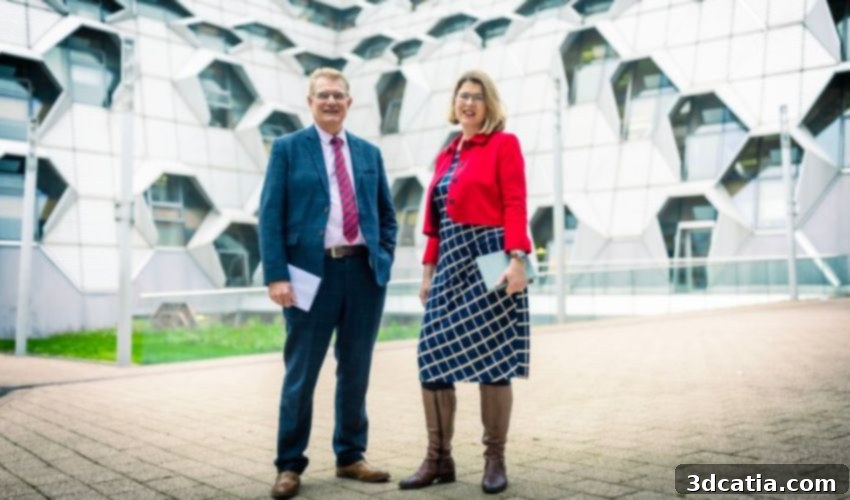
*Cover image shows Professor Stephen Hagen and Professor Catherine Hobbs. Photo credit: Coventry University