
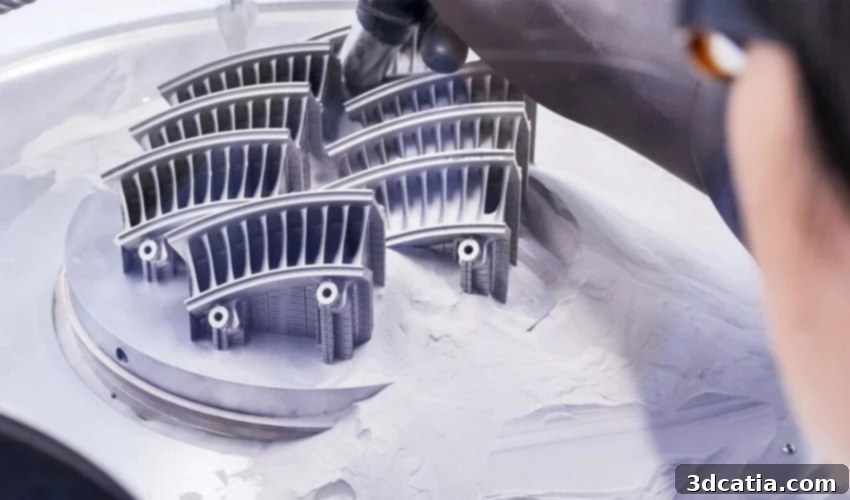
Additive Manufacturing Market Soars: Industrial and Design 3D Printer Shipments Drive Strong Growth Amid Global Challenges
The global additive manufacturing market is experiencing a robust resurgence, defying ongoing economic uncertainties and geopolitical headwinds. A recent quarterly study by CONTEXT, a leading consulting firm specializing in market analysis, reveals a highly optimistic outlook for the 3D printing industry. The report highlights significant growth in both orders and machine shipments, particularly within the high-value industrial 3D printer segment, encompassing solutions priced above $100,000. This positive trend is a compelling indicator of the market’s resilience and increasing adoption, even as the world navigates challenges such as the slowdown of the Chinese economy due the lingering effects of COVID-19, the conflict in Ukraine, and persistent global inflationary pressures. Despite these macro-economic difficulties, key market players remain exceptionally optimistic about the trajectory of the industry for the remainder of 2022 and beyond.
CONTEXT meticulously categorizes the diverse landscape of 3D printers into four distinct segments for its comprehensive market analyses. It’s crucial to note that the firm tracks the number of *shipments* made by manufacturers, rather than focusing solely on *sales figures*, offering a more accurate snapshot of production and distribution activity. These categories include: the “Industrial” segment (printers priced above $100,000), the “Design” segment (ranging from $20,000 to $100,000), the “Professional” segment (between $2,500 and $20,000), and the “Personal” segment (those priced under $2,500, explicitly excluding do-it-yourself kit 3D printers). The latest report underscores a particularly noteworthy trend: a substantial surge in the “Design” and “Industrial” categories, which grew by 7% and an impressive 19% respectively, when compared to the corresponding period in 2021. Collectively, these two segments now command a dominant position, accounting for a remarkable 69% of the total revenue generated during the quarter. This significant share serves as clear evidence that businesses and advanced users are increasingly prioritizing investments in more powerful, efficient, and technologically advanced additive manufacturing solutions to enhance their operational capabilities and boost productivity.
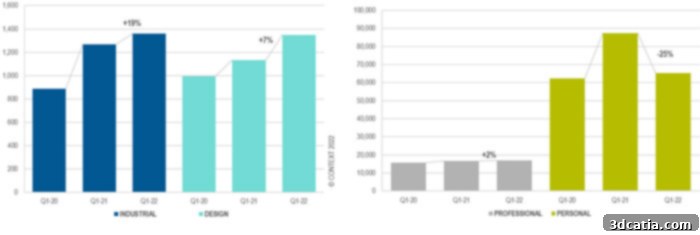
Shipments of so-called industrial and design 3D printers have increased compared to other segments (photo credits: CONTEXT)
Driving Forces: Significant Growth in Industrial and Design 3D Printer Segments
Delving deeper into the performance of the various segments, the CONTEXT study first highlights the robust activity within the “Design” 3D printer category, which encompasses machines priced between $20,000 and $100,000. Remarkably, all of the top 10 manufacturers operating in this space reported increased shipment numbers. This segment’s growth is largely attributable to ongoing innovation and rising demand for high-fidelity prototyping and specialized tooling. Among the most prominent contributors to this surge are established industry leaders such as 3D Systems and Stratasys, both of whom have seen significant increases driven by their respective MultiJet and PolyJet technologies. These material-jetting processes are highly valued by users for their ability to produce parts with exceptionally fine detail, intricate geometries, and the unique capability to design full-color and transparent components. This level of versatility makes them indispensable for product development, design validation, and creating aesthetically complex models. Furthermore, the landscape of the design segment has been invigorated by the emergence and strategic integration of newer players, notably Origin (which was recently acquired by Stratasys, bolstering its polymer 3D printing portfolio) and Kumovis (now part of 3D Systems, enhancing its capabilities in specialized applications like medical devices).
The “Industrial” 3D printer segment, representing the pinnacle of additive manufacturing capabilities with solutions over $100,000, is experiencing an even more dramatic acceleration. Within this category, metal binder jetting technology stands out as the single biggest driver of increased shipments. This process, known for its speed, cost-effectiveness, and ability to produce complex metal parts, has seen an astonishing 113% increase in shipments compared to the first quarter of 2021. The growth in this specific metal additive manufacturing technique has been significantly influenced by key strategic moves within the industry. Desktop Metal, a leader in binder jetting, notably expanded its market share and technological prowess through the acquisition of its competitor, ExOne. This consolidation indicates a strong belief in the future potential of binder jetting for high-volume production. The trend continues with other major players actively entering or expanding their presence in this promising market. For instance, Markforged, traditionally known for its extrusion-based solutions, recently announced its strategic acquisition of Digital Metal, signalling a clear pivot towards broadening its portfolio into metal binder jetting. Furthermore, HP’s highly anticipated Metal Jet Fusion process, poised for wider market availability soon, is expected to become another significant contributor to the segment’s growth, potentially disrupting existing metal AM landscapes with its rapid production capabilities. Beyond binder jetting, the industrial segment as a whole is thriving across various technologies. In the realm of polymer 3D printing, companies such as Prodways, BMF, 3D Systems, Farsoon, and HP are demonstrating strong performance, offering advanced solutions for a wide range of applications from aerospace to medical. For metal additive manufacturing, Eplus3D, Velo3D, TRUMPF, and Farsoon are leading the charge, providing sophisticated machines for demanding industrial applications requiring high-performance metal components. This broad-based growth underscores the increasing integration of additive manufacturing into mainstream industrial production pipelines, addressing needs for rapid prototyping, specialized tooling, and increasingly, end-use parts production.
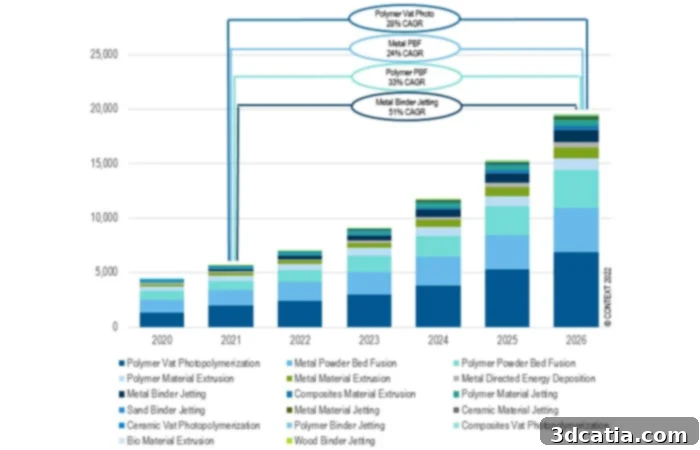
Binder jetting shows strong growth compared to other processes (photo credits: CONTEXT)
Mixed Performance: Professional and Personal Segments Show Varied Trends
While the industrial and design segments command significant attention due to their impressive growth rates, the other two categories—Professional and Personal—are exhibiting more measured or challenging trends, according to CONTEXT’s latest analysis. Printers classified within the “Professional” solutions category, priced between $2,500 and $20,000, experienced a modest increase in shipments of approximately 2% compared to the previous year. This slight uptick suggests a stable but not rapidly expanding market, potentially reflecting cautious investment by small to medium-sized businesses, engineering departments, and prosumers who utilize these machines for advanced prototyping, functional parts, and small-batch production. The future of this segment holds potential for significant shifts, particularly following the groundbreaking merger between Ultimaker and Makerbot. These two companies have been historical pioneers and dominant forces in the desktop Fused Deposition Modeling (FDM) 3D printing space. It will be fascinating to observe the unified strategy adopted by this new entity and the synergies they are able to leverage to reinvigorate and boost innovation within this crucial segment. The combined strength in hardware, software, and community engagement could lead to new product offerings and expanded market reach. Beyond this major development, several other companies are showing strong momentum within the professional category, including Formlabs, renowned for its high-resolution stereolithography (SLA) printers popular in dental and jewelry applications; Raise3D, offering reliable and versatile FDM machines for various professional uses; and Sprintray, a specialist in dental 3D printing solutions.
Conversely, the “Personal” 3D printers, which encompass machines priced below $2,500 (excluding kit-based models), have experienced a notable downturn. This segment saw a significant drop in shipments, registering a 25% decrease compared to the first quarter of 2021. This decline could be attributed to several factors, including market saturation in some regions, a potential shift in consumer interest towards readily available 3D printing services, or a general trend where entry-level users might be holding off purchases in anticipation of more advanced yet still affordable models. Despite this current slump, there remains a promising avenue for growth within the education sector. Increasingly, governments and educational institutions worldwide are recognizing the transformative potential of additive manufacturing and are actively working to promote its integration into school curricula and university programs. By fostering early exposure to 3D printing technologies, from elementary schools to higher education, there’s a long-term potential to cultivate a new generation of designers, engineers, and innovators. Such initiatives, aimed at enhancing accessibility and understanding of additive manufacturing, could play a vital role in reversing the current negative trend in personal 3D printer shipments and ensuring a steady pipeline of future enthusiasts and professionals. For those interested in a deeper dive into the specific data and methodologies of this comprehensive study, further details are available directly from CONTEXT’s research updates, accessible HERE.
The insights from CONTEXT’s latest report paint a compelling picture of an additive manufacturing market that is not only resilient but actively expanding, particularly at the higher end of the technology spectrum. This sustained growth, despite a challenging global economic environment, underscores the critical role 3D printing is beginning to play in modern manufacturing, supply chain optimization, and innovation across numerous industries. What are your thoughts on these latest findings from CONTEXT? Do you believe the additive manufacturing market can maintain this impressive growth trajectory, or are there unforeseen challenges ahead? We invite you to share your perspectives and engage in the discussion by leaving a comment below or by connecting with us on our LinkedIn, Facebook, and Twitter pages! Don’t forget to sign up for our free weekly Newsletter here to receive the latest 3D printing news straight to your inbox! You can also find all our engaging videos and interviews on our dedicated YouTube channel.
*Cover Photo Credits: TRUMPF