
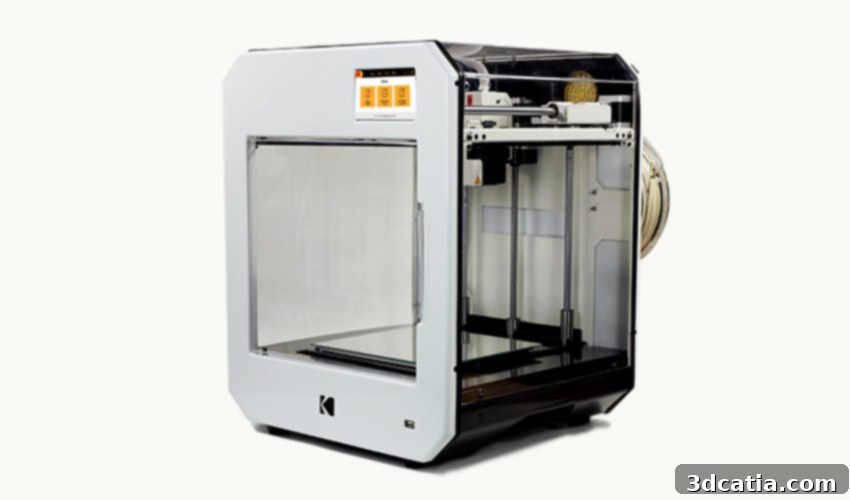
KODAK Portrait 3D Printer Review: Unveiling a Premium Desktop FDM Experience
KODAK, a name synonymous with imaging innovation and consumer electronics, made a significant strategic entry into the additive manufacturing market in 2018. With the launch of the KODAK Portrait, the company officially stepped into the competitive arena of desktop FDM 3D printers. This venture is a testament to KODAK’s commitment to leveraging its brand legacy in new technological frontiers, specifically through a fruitful collaboration with Smart International. Together, they engineered a sophisticated dual extrusion 3D printer, meticulously designed to expertly handle a wide array of standard and demanding engineering thermoplastics available today. Beyond its robust hardware, KODAK distinguishes the Portrait by introducing its own comprehensive material ecosystem and an integrated, dedicated cloud-based software platform, aiming to provide a seamless and professional 3D printing experience.
The KODAK Portrait, showcased with its full suite of included accessories, highlighting its readiness for immediate use.
At 3Dnatives, we’ve had the privilege of observing the KODAK Portrait at various industry events, admiring its sleek design and promised capabilities. Now, we’ve had the invaluable opportunity to bring this innovative machine into our lab for an extensive hands-on review. Our aim is to meticulously evaluate its performance and user-friendliness. What are the standout features that truly set it apart? How intuitive is it for both novice and experienced users? What specific materials can it proficiently process, and for whom is this advanced desktop FDM 3D printer ideally suited? Crucially, does its performance and feature set justify the approximately €3,000 investment? Join us as we delve into our comprehensive review of the KODAK Portrait, providing you with all the insights you need to make an informed decision.
1. Unboxing the KODAK Portrait: First Impressions and Included Essentials
The KODAK Portrait arrives in packaging that immediately conveys a sense of premium quality and thoughtful design. Weighing in at over 25 kg (55 lbs), its substantial build suggests durability, and we recommend two people for safe unboxing. Upon opening, the printer is almost entirely pre-assembled, minimizing setup time and allowing users to begin printing with minimal delay. Every component is securely nestled within protective foam, ensuring delicate parts, such as the glass build plates, are perfectly protected in their own dedicated covers. This meticulous attention to packaging details speaks volumes about the manufacturer’s commitment to product integrity.
The box contains a comprehensive suite of accessories essential for a smooth 3D printing experience. These include a power cable, two robust glass build plates (one spare, a welcome addition for continuous operation), two spool holders, and two transparent spool cases designed to protect filaments from humidity. An efficient air filter blower is also included, along with a meticulously organized toolbox. This toolbox is a treasure trove of necessities: a spatula for print removal, precision tweezers, needle-nosed pliers for intricate tasks, an unclogging needle for maintenance, a calibration card for accuracy, grease and oil for rod lubrication, a soft cloth dust cover to protect the printer, and a specialized adhesive for optimal build plate adhesion. This complete package ensures users have everything required from the moment of unboxing.
A particular highlight of the unboxing experience was the generous inclusion of KODAK-branded filament spools. Beyond the standard two 750g spools of PLA+ and PLA tough, we also received spools of ABS, Nylon 6, Flex 98, PETG, and PVA. This diverse selection immediately signals the KODAK Portrait’s versatility and its readiness to tackle a broad spectrum of applications, from standard prototyping to more demanding engineering projects requiring advanced materials.
From a design perspective, the KODAK Portrait makes an impressive visual statement. Encased in durable plastic walls, its build quality feels robust and engineered for longevity. The front panel features a vibrant, multi-color touchscreen, serving as the central hub for printer control and offering an intuitive user interface. A conveniently placed USB slot allows for straightforward file transfers. At the rear, in addition to the air filter blower and filament spool mounts, you’ll find the power socket and a LAN port for network connectivity. The transparent side panels are a thoughtful touch, providing an unobstructed view of the printing process and allowing for easy monitoring. Internally, the printer continues to impress with a sophisticated dual extrusion system, a built-in camera for remote monitoring, a magnetically attached build plate for effortless removal, and multiple light signals that clearly indicate the current printing status. These design elements collectively contribute to a highly functional and aesthetically pleasing device.
Nylon 6 and ABS filament spools neatly housed within their transparent, protective plastic cases, emphasizing material care.
Safety is paramount in the design of the KODAK Portrait. Its fully enclosed chamber, coupled with an integrated air filtration system, effectively prevents the escape of potentially toxic particles or unwanted odors, creating a safer and more pleasant operating environment. Furthermore, the design ensures that users’ fingers remain safely away from any hot or moving parts during operation, making the printer highly suitable for diverse environments, including offices, schools, and homes. With a generous building volume of 215 x 210 x 235 mm (8.5 x 8.3 x 9.3”), the Portrait is capable of producing decent-sized objects, catering to a broad range of project requirements. The heated build plate can reach an impressive 120°C (248°F), while the nozzles can attain temperatures up to 295ºC (560°F). These high-temperature capabilities are critical for successfully handling challenging engineering-grade materials like PETG and Nylon, allowing for advanced applications that many desktop FDM printers struggle with.
2. Effortless Installation and Intuitive User Experience
Setting up the KODAK Portrait is remarkably straightforward, building on its “almost ready-to-use” promise. After the minimal assembly of screwing on the air filter and spool holders – a task that genuinely takes less than two minutes – the next step involves attaching the build plate. This process is made incredibly simple by its magnetic attachment system, allowing it to snap securely into place with ease. Upon its initial power-up, the Portrait greets the user with a prompt on its vibrant touchscreen to select a preferred language, immediately showcasing its user-centric design.
Our initial attempt to connect the printer to our Wi-Fi network encountered some minor difficulties. However, after a few attempts and reaching out to KODAK’s responsive customer service support, we successfully established a connection and promptly updated its firmware. This experience, while a slight hiccup, ultimately highlighted KODAK’s commitment to customer satisfaction and the importance of ensuring the device operates with the latest software enhancements. Loading filaments is equally user-friendly; simply lifting a mechanism on the rear of the machine and gently pushing the filament into the designated slot suffices. The touchscreen then guides the user with a clear “Load filament” button, and the printer intelligently manages the rest of the process, heating up and feeding the filament automatically.
Once the filaments are correctly loaded, the user can proceed with calibrating the machine. The KODAK Portrait features intuitive guided calibrations for the X-Y and Z axes, ensuring precise printhead movement and layer adhesion. To further verify accuracy, we printed the pre-installed “Z axis test” design and used the provided calibration card to fine-tune the nozzle height, if necessary. This methodical approach to calibration, coupled with the printer’s intelligent features, meant we were ready to commence printing in no time, confident in the machine’s foundational setup.
A close-up view of the KODAK Portrait’s printhead, clearly displaying its advanced dual extrusion system.
In terms of hardware, the KODAK Portrait is an exemplary piece of engineering. It consistently performs its intended functions with precision and reliability, all while maintaining a remarkably sharp and professional aesthetic. The multi-color touchscreen proved to be one of our favorite features, significantly enhancing the user experience by simplifying navigation and control. The transparent filament cases are a particularly clever addition, not only ensuring that spools are correctly positioned and feed smoothly but also crucially protecting sensitive filaments from environmental factors like condensation and dust, which can degrade print quality. Regarding the printer’s overall build quality, KODAK has clearly prioritized performance and longevity. The integration of high-quality components such as Capricorn Bowden tubes, renowned for their low friction and consistent filament delivery, and the famous E3D hotends, celebrated for their reliability and high-temperature capabilities, demonstrates KODAK’s commitment to setting a high standard for desktop FDM printers. While we didn’t have exceptionally high expectations for the quality of the built-in camera, its video output was generally adequate for remote monitoring, though its availability was occasionally intermittent.
Our printing workflow was streamlined and efficient. We utilized KODAK’s proprietary slicer software to prepare our 3D models, then effortlessly uploaded them to the KODAK 3D Cloud. While a USB transfer option is available, the cloud service offers unparalleled simplicity, speed, and a hassle-free experience for managing print jobs remotely. Before initiating any print, we diligently applied the special two-part adhesive to the heated build plate – a crucial step for optimal print adhesion, especially with advanced materials. (Pro tip: always ensure you shake the adhesive well for 20-30 seconds before use to ensure proper mixing). With all preparations complete, we were ready to commence printing with confidence.
3. The KODAK 3D Slicer Software and Cloud Ecosystem
For its critical slicing and software component, KODAK made a strategic and intelligent decision: to base its “KODAK 3D Slicer” on the widely recognized and highly reliable Cura software. This adaptation leverages Cura’s robust capabilities while tailoring the interface and functionalities specifically to meet the unique needs of KODAK Portrait users. The software is readily accessible from KODAK’s online platform, allowing for quick download and installation. Once installed, users can easily upload their 3D models, intuitively adjust them within the software’s virtual build plate, slice them, and then seamlessly upload the prepared G-code to the KODAK 3D Cloud. A significant advantage of this slicer is its flexibility, enabling users to create and save custom printing profiles, which is invaluable for fine-tuning results with different materials and geometries. While comprehensive instructions are provided, the software is remarkably user-friendly, particularly for those already familiar with Cura, making the transition effortless. The user experience is consistently enjoyable, even when tackling more complex tasks such as dual-color prints that necessitate precise coordination of both nozzles.
An overview of the KODAK 3D Slicer interface, showcasing its intuitive design for preparing 3D models.
During our testing, while the parts were flawlessly sliced within the software, we initially encountered some connectivity issues between the cloud and the printer. Promptly, we engaged with KODAK’s customer service, whose department proved exceptionally helpful. They quickly identified the root cause as a specific geographic network anomaly related to our location in France – an issue that KODAK confirmed has since been resolved in subsequent firmware updates. After performing a full firmware update, our cloud connection was stable, allowing us to resume slicing parts for various materials and uploading them seamlessly to the cloud. This experience underscored KODAK’s responsive support and commitment to continually refining their product’s performance.
The KODAK 3D Slicer offers extensive control, allowing users to fine-tune numerous parameters such as infill percentage, print speed, and temperature. However, for those who prefer simplicity, the software intelligently automates many of these settings based on the selected material profile. KODAK’s proprietary material ecosystem truly shines here, with every filament, from the ubiquitous PLA to the water-soluble PVA and the flexible Flex 98 plastic, possessing its own meticulously optimized material profile within the slicer. This integration ensures consistent and high-quality results across a diverse range of thermoplastics. The slicer is incredibly precise, granting users all the freedom they might require for advanced customization while maintaining a user-friendly and approachable interface. We particularly valued the KODAK 3D Cloud service, powered by 3DprinterOS, which allowed us to effortlessly and rapidly upload designs and initiate prints remotely with just the touch of a button. This remote capability significantly enhances workflow efficiency, particularly for professional environments.
The clear and responsive 5-inch touchscreen integrated into the top right of the KODAK Portrait, providing intuitive control.
Once a 3D model is sliced and successfully uploaded to the “KODAK 3D Cloud,” the power of remote operation truly comes to the forefront. Users can dispatch the “print” command directly from Smart International’s dedicated website, enabling printing to commence from virtually anywhere in the world. This cloud platform emerged as one of the most impactful features of the entire KODAK Portrait printing experience. All initiated prints are meticulously cataloged and conveniently accessible within the cloud interface. A notable advantage for businesses or educational institutions is the ability to add and manage multiple printers simultaneously under the “Printers” section, making it an ideal solution for setting up and overseeing a print farm. The “Dashboard” also deserves special mention; it provides users with insightful statistics about their printer usage, offering valuable data for tracking productivity and material consumption. For instance, our testing period revealed we completed 73 prints, accumulating a total of 130 operational hours. Finally, KODAK extends its value proposition through “Design services,” allowing users to submit their project concepts to a team of professional designers and receive the finished 3D design delivered directly to them, bridging the gap for those without in-house design capabilities.
During active printing, we frequently utilized the website’s monitoring features, finding them exceptionally useful. The platform provides real-time data on the exact temperature of the build plate, the internal chamber, and each individual nozzle, ensuring optimal printing conditions are maintained. Users can also track the estimated remaining print time, facilitating better project management. While the live streaming of the printing process through the integrated camera was a highly anticipated feature, it did occasionally experience minor connectivity issues. Despite this, the website retains a comprehensive record of all previous prints, complete with detailed information and a sped-up video of each job, offering a valuable resource for review and allowing users to easily reprint successful models.
4. Outstanding First 3D Prints, Especially with Engineering Materials
Providing a dual-nozzle 3D printing solution is inherently complex, and the challenge is further amplified when the system is designed to handle a diverse range of materials, each with unique thermal and mechanical characteristics. This is precisely where KODAK’s strategic decision to develop its own integrated software and material ecosystem becomes a profound advantage. Initially, our expectations were set for excellent results with common thermoplastics like PLA and ABS, and perhaps more moderate outcomes with the notoriously challenging PETG and Nylon. Surprisingly, the results inverted our assumptions.
The KODAK Portrait showcased remarkable proficiency with engineering materials. For example, it managed to print intricate Nylon wind turbines to near perfection using standard parameters, demonstrating exceptional reliability and quality. Conversely, we often found ourselves needing to experiment slightly more with the slicer settings to achieve optimal results for more conventional materials such as PLA or ABS. This counterintuitive finding highlights the printer’s robust design and KODAK’s optimized profiles specifically for advanced materials, making it a compelling choice for technical applications.
As clearly illustrated in the accompanying photographs, classic benchmark prints like the “torture test” and the beloved “benchy” boat model emerged with impressive quality, requiring no significant adjustments to the slicer parameters on our part. This out-of-the-box performance for standard prints is a strong indicator of the printer’s fundamental accuracy and calibration. Furthermore, we were genuinely impressed by the superior quality achieved with engineering materials, including ABS, Nylon PA6, and PETG. The PETG vase, for instance, was printed with impeccable precision and a smooth finish, while the Nylon wind turbines exhibited excellent detail and flexibility, truly showcasing the machine’s capabilities. Finally, leveraging the Portrait’s dual extrusion system, we successfully printed single objects in two distinct colors, demonstrating its versatility for functional prototypes and visually appealing designs.
For comprehensive technical specifications and further details on the KODAK Portrait, please click HERE.
In summary, the KODAK Portrait emerges as a highly capable and thoughtfully engineered desktop FDM 3D printer. Its robust hardware, combined with an intelligent software ecosystem and a strong emphasis on handling engineering-grade materials, positions it as a compelling option for professionals, educators, and advanced hobbyists seeking reliability and versatility. While the initial investment of approximately €3,000 is significant, the printer’s performance, user-friendly features, and integrated cloud services offer considerable value for those requiring high-quality, consistent results across a broad material palette.
Below, you’ll find a visual summary of our print results. What are your thoughts on the KODAK Portrait 3D printer? We invite you to share your comments below or engage with us on our Facebook and Twitter pages!
The iconic ‘benchy’ benchmark model, meticulously 3D printed in PLA, showcasing the KODAK Portrait’s precision.
A challenging torture test model, successfully printed in PLA, demonstrating the printer’s capability to handle intricate geometries.
Two remarkably flexible wind turbines, precisely 3D printed using Nylon (PA6), highlighting the printer’s strength with engineering materials.
A striking vase, printed to perfection with PETG, demonstrating exceptional surface finish and structural integrity.
Several intricate dual-color designs, expertly 3D printed in PLA, showcasing the KODAK Portrait’s advanced dual extrusion system.
A series of hollow cube designs, 3D printed with various materials (from left to right: ABS, PETG, PLAtough, PLA+, Nylon 6), illustrating the printer’s material versatility.