
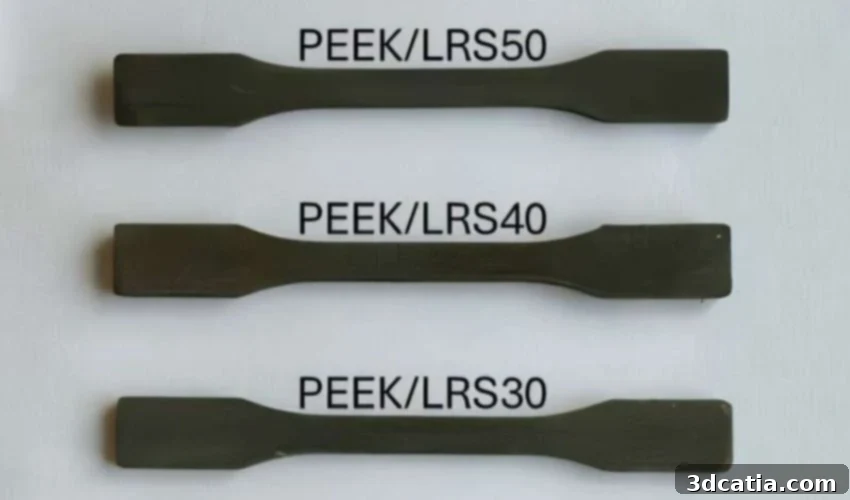
Building Lunar Future: Pioneering 3D Printing with Regolith-PEEK Composites for Sustainable Space Habitats
Humanity’s ambitious dream of establishing a permanent presence on the Moon is rapidly transitioning from science fiction to tangible reality. Central to this monumental undertaking is NASA’s Artemis program, a visionary initiative aimed at returning humans to the lunar surface and paving the way for sustainable long-term exploration. However, achieving this goal presents an array of unprecedented challenges, chief among them being the formidable logistics of constructing infrastructure in an extraterrestrial environment. Relying solely on materials transported from Earth would be prohibitively expensive and logistically complex, underscoring the critical need for innovative solutions. This pressing demand for on-site resource utilization has spurred numerous proposals, with one of the most promising and recent emerging from Concordia University in Canada. Their groundbreaking study proposes a revolutionary approach: leveraging lunar regolith – the loose dust and rock found on the Moon’s surface – as the primary raw material for future lunar construction, specifically through advanced 3D printing techniques.
The detailed scientific findings underpinning this innovative solution were recently made public in the prestigious arXiv repository. The research showcases how scientists are meticulously exploring the creation of a sophisticated 3D printing material, fundamentally based on PEEK (polyetheretherketone). This high-performance thermoplastic polymer is reinforced with a carefully developed lunar regolith simulant. The strategic integration of PEEK with lunar regolith could revolutionize space manufacturing, enabling the direct production of essential parts, durable tools, and even foundational infrastructure directly on the lunar surface. This method capitalizes on the abundant local resources available, significantly reducing the reliance on costly and resource-intensive shipments from Earth and marking a crucial step towards true extraterrestrial sustainability.

Example of the developed filament with some thickness inconsistencies. (Credit: arXiv)
Overcoming the Unique Challenges of Lunar Additive Manufacturing
The prospect of implementing 3D printing on the Moon is fraught with unique and severe environmental challenges that demand innovative engineering solutions. Factors such as the extreme temperature fluctuations, pervasive radiation exposure, and significantly lower gravity – approximately one-sixth of Earth’s – profoundly impact material processing and structural integrity. Previous endeavors to combine regolith with PEEK polymer in 3D printing had encountered substantial difficulties, primarily stemming from extrusion complications. The abrasive and inherently hard nature of regolith particles proved detrimental, dramatically increasing the torque (rotational force) required within conventional extruders. This mechanical strain severely limited the mineral content that could be effectively incorporated, capping it at a maximum of 30% without causing significant equipment failure or material degradation. Moreover, the resulting printed parts often exhibited increased porosity, which unfortunately led to a noticeable reduction in vital mechanical properties such as tensile strength, making them more fragile and less suitable for structural applications in harsh lunar conditions. These initial setbacks highlighted the need for a radical rethinking of both material composition and extrusion technology to unlock the full potential of lunar in-situ manufacturing.
Innovations in Extrusion and Adhesion: A Dual-Nozzle Approach
To systematically address these complex challenges and push the boundaries of lunar additive manufacturing, the dedicated research team led by Mohammad Azami introduced two pivotal innovations. The first was the conceptualization and development of a novel twin-screw extruder design. Unlike single-screw systems, this advanced extruder is engineered to achieve a far more homogeneous and consistent mixing of PEEK with a significantly higher proportion of regolith simulant, successfully increasing the mineral content to an impressive 50%. The twin-screw mechanism provides enhanced shearing and mixing capabilities, ensuring that the abrasive regolith particles are evenly dispersed within the polymer matrix, thereby mitigating the torque issues and improving overall material flow during extrusion. This breakthrough in extruder technology is fundamental to producing a robust and consistent composite filament.
The second critical innovation focused on optimizing the printing process itself, particularly tackling issues of warping and adhesion – common hurdles in high-performance polymer 3D printing. The team ingeniously incorporated the use of a special PEKK (polyether-ketone-ketone) interlayer “raft.” This PEKK layer, known for its superior mechanical properties and thermal stability, is precisely deposited with a second nozzle directly onto the build plate before the main PEEK-regolith composite is printed. This strategic interlayer acts as a sacrificial adhesion layer, effectively reducing the internal stresses that cause warping in the cooling print and ensuring excellent adhesion of the printed part to the build platform. By combining this dual-nozzle, multi-material approach, the researchers dramatically improved the reliability and dimensional accuracy of the lunar regolith composites, laying the groundwork for more complex and stable structures.
Optimizing Mechanical Properties: The Role of Annealing and Material Ratios
Following the successful optimization of the 3D printing process, including the enhanced extrusion and superior build plate adhesion, the researchers embarked on a crucial post-processing step: annealing the printed parts at a controlled temperature of 300°C. This thermal treatment is a well-established method in polymer science, designed to enhance crystallinity, reduce residual stresses, and subsequently improve certain mechanical properties of the material. For the PEEK-regolith composites, annealing proved beneficial in refining structural integrity, although its advantages were observed to be somewhat limited in mixtures exceeding 40% regolith content, suggesting a threshold where the filler material’s dominance begins to impact the polymer’s ability to fully reorient and strengthen. The comprehensive evaluation of the annealed parts yielded significant insights into the material’s performance under potential lunar conditions.
The experimental results unequivocally demonstrated that the incorporation of lunar material substantially increased the stiffness of the printed parts, with an impressive improvement of up to 41%. This enhanced stiffness is a critical property for structural components that must withstand compressive loads and maintain shape in the low-gravity, vacuum environment of the Moon. Furthermore, the innovative printing process, coupled with the PEKK interlayer, significantly reduced warping during printing, a common issue that can lead to part deformation and failure. This reduction in warping translated directly into greater dimensional accuracy, ensuring that printed components conform precisely to their intended designs – a non-negotiable requirement for precise construction. However, the study also revealed a trade-off: while stiffness improved, tensile strength – the material’s resistance to breaking under tension – saw a reduction. Specifically, it decreased from 107 MPa for pure PEEK to 90 MPa for parts containing 40% regolith, and further to approximately 70 MPa for those with 50% regolith content. Concurrently, the fragility of the material increased, indicated by a lower capacity for elongation before fracture. This means the composite materials became more brittle, a characteristic that needs careful consideration for applications requiring ductility or impact resistance.
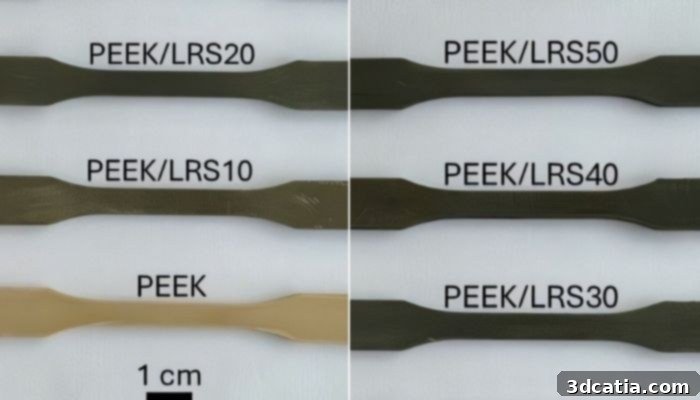
Representative examples of printed replicas, ranging from pure PEEK to PEEK with 50% regolith by weight, showcasing material consistency.
Establishing a Benchmark for Lunar Additive Manufacturing
In light of these detailed findings, the research compellingly concludes that an optimal balance between material properties and resource conservation is achieved with a mix comprising approximately 60% PEEK and 40% lunar regolith. This specific ratio represents a crucial sweet spot, allowing for a substantial reduction in the amount of terrestrial material that needs to be transported to the Moon, without excessively compromising the vital mechanical properties required for functional structures. By minimizing the reliance on Earth-sourced polymers, this approach not only offers significant cost savings but also aligns perfectly with the principles of sustainable space exploration and in-situ resource utilization (ISRU). The robust results from this study establish a practical and invaluable benchmark for future additive manufacturing projects in space, providing a foundational understanding for engineers and material scientists developing the next generation of lunar habitats and infrastructure. This research validates the potential of using lunar soil as a key ingredient for future off-world construction, moving us closer to a self-sufficient lunar outpost.
Future Horizons: Expanding Beyond Initial Success
The Concordia University researchers, while celebrating their significant progress, emphasize that this study represents merely an initial, albeit crucial, step in a much broader scientific journey. Their immediate and ambitious next goal is to subject these advanced 3D printing techniques and PEEK-regolith composites to rigorous testing in highly simulated lunar environments. This will involve recreating the harsh conditions of the Moon, including the extreme vacuum, the challenging low-gravity environment, the intense and rapidly fluctuating thermal cycles (ranging from scorching lunar days to frigid nights), and constant exposure to harmful cosmic and solar radiation. Such comprehensive testing is essential to validate the material’s long-term durability and performance under authentic lunar conditions, ensuring its reliability for actual space applications. Furthermore, the team plans to broaden their research scope by experimenting with other high-performance polymers, exploring diverse material combinations that might offer even greater resilience, ductility, or specialized properties. This diversification will potentially open up new avenues for materials selection depending on specific structural requirements. Looking even further ahead, a pivotal objective is to scale the entire process from laboratory prototypes to large-format robotic printing systems. These advanced robotic systems would be capable of autonomously manufacturing complete, large-scale structures – such as habitats, shelters, and landing pads – directly on the lunar surface, marking a paradigm shift in off-world construction and enabling humanity’s long-term sustainable presence beyond Earth. For those keen to delve deeper into the specifics of this pioneering project, the comprehensive scientific publication is available for consultation HERE.
What are your thoughts on this groundbreaking material combining lunar regolith and PEEK for future space construction? Share your insights and comments with us below, or connect with our community on our LinkedIn or Facebook pages! Don’t miss out on the latest advancements in additive manufacturing – subscribe to our free weekly Newsletter to receive cutting-edge 3D printing news directly in your inbox. You can also explore our extensive video library on our YouTube channel for visual insights into the world of 3D printing. For more specialized news and articles pertaining to 3D printing in the aerospace and defense sectors, be sure to visit our dedicated page HERE.
*Cover Photo: Illustrative representations of the PEEK-regolith composite material with varying percentages of lunar regolith. Credits: arXiv