
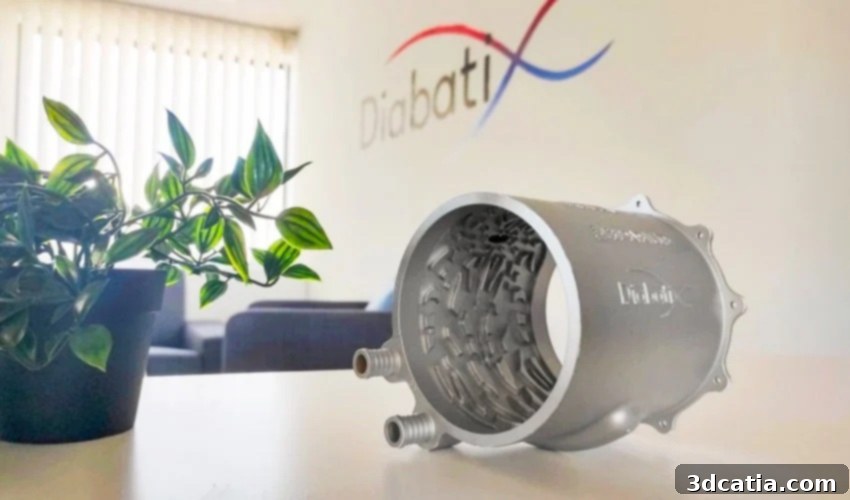
Diabatix ColdStream: Revolutionizing Thermal Management with Generative Design and 3D Printing
In industries where precision and reliability are paramount, such as aerospace, automotive, and advanced electronics, the design and manufacturing of components demand an exceptionally high level of quality control. Ensuring that parts are fit for their intended purpose often involves rigorous testing and meticulous design processes. One of the most critical factors influencing component performance and longevity is thermal management – specifically, the efficient cooling of parts. Modern manufacturing frequently requires the integration of complex cooling channels to prevent overheating, which can lead to material degradation, reduced efficiency, and catastrophic failures. This necessity is even more pronounced when leveraging cutting-edge production methods like 3D printing, especially with metallic materials known for their specific thermal properties. Recognizing this growing need, the innovative Belgian startup Diabatix has developed the ColdStream platform. This groundbreaking solution harnesses the power of generative design to significantly enhance the cooling capabilities of components, including those produced through additive manufacturing. We recently had the opportunity to speak with the Diabatix team to gain deeper insights into their burgeoning company and its transformative impact on the additive manufacturing landscape.
3DN: Could you introduce yourself and your connection to 3D printing?
I am Lieven Vervecken, the founder and CEO of Diabatix. My academic journey provided a robust technical foundation, culminating in two master’s degrees in engineering and a PhD in fluid mechanics, all from the prestigious University of Leuven in Belgium. This intensive background in fluid dynamics and engineering principles laid the groundwork for my entrepreneurial endeavors. Immediately after successfully defending my PhD in 2015, I embarked on the journey of founding Diabatix. In the initial years, my primary focus was dedicated to the intricate development of our core technology and software. As Diabatix experienced growth and expanded its operations, my role naturally evolved to encompass business development and the overarching management of the company. Today, I am supported by a highly capable management team, including a Head of R&D and a Head of Product & Operations, who proficiently oversee all technical facets of the company, allowing me to concentrate on strategic growth and vision.

Lieven Vervecken, CEO and founder of Diabatix
My very first encounter with the revolutionary world of 3D printing dates back to the summer holidays of my first year at university in 2005. I was fortunate enough to secure a student position at Materialise for several weeks, an experience that proved invaluable. During this time, I served as the ‘assistant’ to the R&D engineer who was at the forefront of developing their Mammoth 3D printers – cutting-edge machines for large-scale additive manufacturing. This role placed me directly at the heart of 3D printer development, offering an unparalleled, hands-on perspective. What started as a summer job transformed into a five-year continuous engagement, deepening my understanding and appreciation for additive manufacturing technologies. Consequently, by the time Diabatix was conceived and launched, I possessed a profound awareness of 3D printing’s capabilities and, crucially, the immense value our specialized technology could bring if tailored to this advanced manufacturing process. This early and prolonged exposure was instrumental in shaping Diabatix’s strategic direction towards integrating generative design with additive manufacturing for optimal thermal performance.
3DN: What is Diabatix? How did the idea to create the company come about?
Diabatix is a Belgian technology company dedicated to addressing one of the most persistent challenges in product development: the effective design of thermal management solutions. We began our journey as an engineering consultancy firm, a strategic move that allowed us to immerse ourselves in various industries and thoroughly understand the precise challenges and unmet needs related to cooling design. During this initial phase, a critical gap became strikingly evident: the approach to designing cooling components for new products had remained fundamentally unchanged for decades. It heavily relied on a laborious, inefficient, and often costly trial-and-error cycle. This traditional method invariably led to significant delays in design time and, perhaps more critically, often resulted in suboptimal thermal performance, hindering overall product efficiency and reliability. Recognizing this profound inefficiency, we identified a monumental opportunity to innovate. We took on the ambitious challenge of pioneering ‘generative design’ specifically for thermal components, aiming to provide an effective alternative that dramatically accelerates the design process while simultaneously achieving superior thermal performance. Our vision was to move beyond conventional iterative design loops and empower engineers with tools that could automatically generate optimal cooling structures.
After two intensive years of dedicated research and development, we successfully delivered our first proof-of-concept, validating the potential of our generative design approach. This milestone marked a pivotal moment for Diabatix. We transitioned our business model to a project-based engineering service, utilizing our proprietary software exclusively in-house to deliver high-performance cooling designs to our clients. This period allowed us to further refine and validate our software in real-world applications, gathering invaluable feedback and insights. By 2021, having rigorously tested and iterated upon our solution, we confidently judged our software as sufficiently mature, robust, and user-ready. It was at this point that we proudly released it as an accessible online platform, christened ColdStream, making our advanced generative design capabilities available to a global audience.
3DN: What is ColdStream?
ColdStream stands as our flagship product, embodying the culmination of years of expertise in thermal engineering and generative design. It is a sophisticated, cloud-native engineering platform meticulously engineered to support the entire cooling design workflow, from initial thermal analysis to the final optimized thermal design. What truly sets ColdStream apart and makes it unique in the market is its unparalleled ability to apply generative design principles to complex thermal and fluid flow problems. Unlike traditional CAD tools or simulation software, ColdStream intelligently explores a vast design space, generating innovative cooling geometries that would be virtually impossible to conceive through manual design. As a cloud-native platform, ColdStream offers exceptional accessibility and convenience. Users require no installation of additional software, nor do they need any specialized, high-performance hardware on their end. All computational heavy lifting, including complex simulations, is managed securely and efficiently in the cloud. The platform integrates state-of-the-art simulation methods, which are continuously updated and refined to ensure accuracy and leverage the latest advancements in computational fluid dynamics (CFD) and heat transfer. Furthermore, ColdStream provides access to extensive libraries of materials and design templates, along with a comprehensive suite of features that facilitate convenient case and project management. Our unwavering commitment is to ensure the most intuitive and optimal user experience possible, streamlining the design process for engineers worldwide. Since its launch in 2021, the platform has gained significant traction and is actively utilized by a diverse clientele across the globe, literally spanning from major technology hubs in Tokyo, Japan, to the innovation epicenters of Silicon Valley, USA, underscoring its universal appeal and effectiveness.
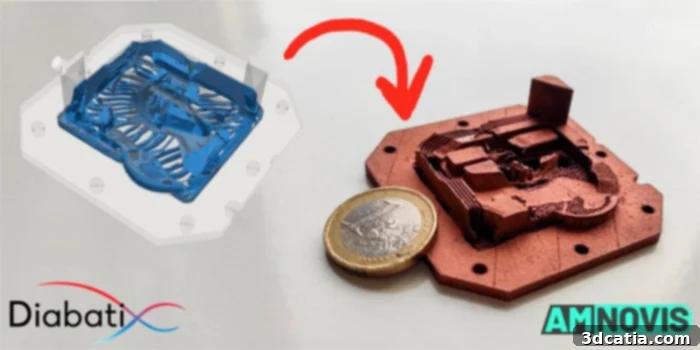
Photo Credits: Diabatix
3DN: What are the benefits of this platform for additive manufacturing? Are there limitations?
One of the most powerful and distinctive aspects of our generative design technology is its inherent flexibility concerning manufacturing techniques. Unlike design tools that are rigid and optimized for a single production method, ColdStream offers users the freedom to select their preferred manufacturing process right at the outset of a design run. This intelligence allows the software to automatically generate designs that strictly adhere to the specific geometric and structural boundaries imposed by the chosen manufacturing technique. For example, if a user selects die-casting, the software will automatically produce a design optimized for a two-dimensional mold geometry. Similarly, a design intended for sheet-metal forming will inherently respect curvature constraints and bend radii. This adaptability ensures that the generated design is not just theoretically optimal, but also practically manufacturable. Of course, designing specifically for additive manufacturing is where ColdStream truly shines and unlocks unprecedented design freedom. When 3D printing is selected, the platform meticulously takes into account crucial additive manufacturing parameters, including overhang angles to minimize support structures, minimal and maximal feature sizes to ensure printability and structural integrity, and even printing orientation to optimize build time and part quality. What I find particularly exciting about designing for 3D printing with ColdStream is its capability to fully exploit the expanded design freedom that additive manufacturing offers. This synergy directly translates into significantly higher thermal performance compared to components manufactured using any other traditional technique, as 3D printing allows for the creation of intricate, organic, and highly efficient internal cooling channels that are impossible with conventional methods.
We recently conducted a compelling case study that vividly demonstrates the synergistic value of combining generative design with 3D printing for thermal management. In this study, we aimed to replace a commercially available CPU cooling heatsink with one designed by ColdStream and produced using copper 3D printing – a material renowned for its excellent thermal conductivity. Our process was remarkably straightforward: we purchased a standard off-the-shelf cooling unit to serve as our baseline. As input for ColdStream, we defined the nominal operating conditions of the CPU, established the volume of the original heatsink as the design envelope, and specified the preferred 3D printing parameters for copper. Crucially, no initial guess or manual pre-design for the heatsink’s geometry was required; the user input was literally minimal. ColdStream took these inputs and generated an optimized copper heatsink design. The results were outstanding: the 3D printed heatsink achieved an astounding 55% lower thermal resistance compared to the commercial product, all while maintaining the same pressure drop across the cooling system. This dramatic improvement in thermal efficiency, with minimal user intervention, unequivocally proved the immense value proposition of integrating generative design with additive manufacturing. It highlights how Diabatix empowers engineers to push the boundaries of performance in thermal management, creating components that are not only lighter and more efficient but also tailored to specific, demanding applications.
3DN: How do you see the future of generative design in 3D printing?
I see the future of generative design in 3D printing as exceptionally bright and transformative. Over the past few years, I have observed a truly exciting and rapid evolution within the field of additive manufacturing. Initially, the primary drivers for industries to adopt 3D printing were predominantly focused on reducing the complexity of assembly processes and enabling the rapid production of prototypes. While these benefits remain significant, the emergence and maturation of generative design tools have introduced a powerful new catalyst: a functional driver. Essentially, generative design allows engineers to now design components specifically for a dedicated, optimized function. By leveraging advanced algorithms and computational power, these tools can explore design spaces far beyond human intuition, generating intricate geometries that are inherently superior in performance. Because of the inherent capabilities of these generative design methods, the resulting components most often significantly outperform human-based designs by a large margin, especially in complex applications like thermal management. Therefore, thanks to generative design, there is now an unprecedented possibility to truly design for what is *manufacturable* rather than being limited by what is conventionally designable. Given the incredible design freedom and geometric complexity afforded by 3D printing, this means we can now create parts that extend well beyond what was previously imaginable, pushing the boundaries of engineering innovation.
Naturally, I am incredibly proud and happy that Diabatix is taking up a pioneering role in the development of these advanced generative design tools, particularly within the crucial context of thermal management for additive manufacturing. We have witnessed numerous real-world use cases where the implementation of an effective thermal design, achieved through our platform, can fundamentally shift the economical balance, making additive manufacturing a more viable and superior option compared to traditional manufacturing processes. This paradigm shift is only poised to accelerate further, especially now that copper, an excellent material for its superior thermal conductivity, is rapidly becoming a mainstream and increasingly accessible material for 3D printing. The combination of Diabatix’s generative design capabilities, the geometric freedom of 3D printing, and the availability of high-performance materials like copper creates an incredibly potent ecosystem for engineers to innovate and solve complex thermal challenges across all sectors.
3DN: Any last words for our readers?
Thank you sincerely for taking the time to read about Diabatix and our vision for advanced thermal management. If you are intrigued and wish to delve deeper into our technology, discover more about generative design, or explore the profound impact of additive manufacturing on thermal solutions, please do not hesitate to visit our official website HERE. Our website is a rich repository of resources, case studies, and detailed information related to both additive manufacturing and our cutting-edge design capabilities. Moreover, we actively encourage you to experience the power of our ColdStream platform firsthand by trying it out yourself. This direct interaction will provide you with a clearer understanding of how our generative design tools can optimize your cooling solutions. Of course, I am always open to professional connections; feel free to reach out to me directly via LinkedIn. We look forward to connecting with you and exploring how Diabatix can help you push the boundaries of thermal performance in your next project.
What are your thoughts on Diabatix and the transformative potential of its generative design platform for thermal management? We eagerly await your insights! Share your comments below or engage with us on our vibrant social media channels: LinkedIn, Facebook, and Twitter pages! To stay ahead with the very latest news and developments in the rapidly evolving world of 3D printing, don’t forget to sign up for our free weekly Newsletter here – delivered directly to your inbox. You can also explore all our insightful videos and content on our dedicated YouTube channel for more visual demonstrations and expert discussions.
*Cover Photo Credits: Diabatix