
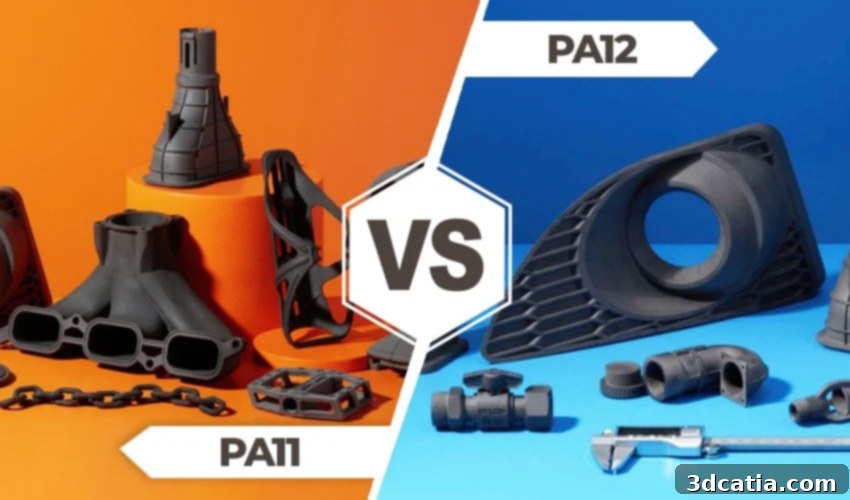
PA11 vs. PA12: A Comprehensive Guide to Nylon Polyamide 3D Printing Materials and Their Applications
Nylon, scientifically known as polyamide (PA), represents a crucial family of thermoplastic polymers widely embraced across various industries, especially within the realm of 3D printing. This versatile material is highly valued for its exceptional ability to withstand significant mechanical stress, its inherent resistance to heat, tearing, and abrasion. These robust properties make nylon an ideal choice for manufacturing heavy-duty parts that demand high performance and durability. Consequently, it finds extensive application in critical sectors such as automotive, aerospace, and medical, where component reliability is paramount.
The landscape of 3D printing utilizes numerous types of nylon, each distinguished by a numerical suffix indicating the number of carbon atoms in its molecular structure. For instance, PA6 is a common choice for Fused Deposition Modeling (FDM) technology, primarily due to its balance of strength and ease of processing. In contrast, PA11 and PA12 are predominantly employed in powder-based additive manufacturing processes, where their unique thermal and mechanical characteristics shine. While PA11 and PA12 often serve similar application areas, a closer examination reveals notable differences in their fundamental properties, origins, printing requirements, and ultimately, their suitability for specific applications and associated costs. This article delves into a detailed comparison of these two prominent nylon variants, exploring their distinct attributes to help clarify their optimal use in additive manufacturing.
Origin, Manufacturing, and Mechanical Properties
Polyamides are systematically categorized by nomenclature, where the number following the “PA” prefix signifies the count of carbon atoms within their monomer chains. This numerical proximity might suggest that PA11 and PA12 are quite similar, yet they diverge significantly in several aspects, beginning with their origins and manufacturing processes.
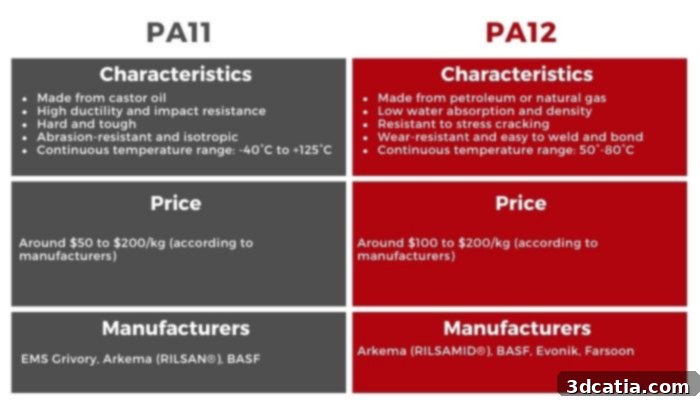
PA12 is a semi-crystalline, linear thermoplastic polymer derived from petro-based sources, specifically natural gas or petroleum. Its production involves intricate chemical processes to obtain laurin lactam, which serves as the foundational monomer for PA12 synthesis. The material was first introduced in 1963 by Chemische Werke Hüls AG, in collaboration with Emser Werke in Domat, marking its entry into industrial applications. As a homopolymer, comprising a single monomer component, PA12 has since been utilized in a vast array of products. However, its petroleum-dependent origin increasingly places PA12 at the center of discussions regarding its environmental footprint and long-term sustainability in an era demanding greener manufacturing solutions.

PA11 is obtained from castor oil and is therefore considered a more environmentally-friendly alternative to PA12 (photo credits: Jellypipe)
In response to the growing demand for more sustainable practices and materials with comparable performance, industries are increasingly exploring alternatives to traditional fossil-fuel-derived plastics. This quest has significantly contributed to the rise of PA11, a polyamide with a distinctly biological origin. PA11 is manufactured from renewable raw materials, primarily derived from plant sources. Typically, castor oil is utilized, extracted by pressing the seeds of the “Ricinus communis,” also known as the African miracle tree. This castor oil undergoes a synthesis process to convert it into the amino acid 11-aminoundecanoic acid. Subsequent polymerization of these monomers then yields PA11.
The bio-based origin of PA11 aligns more closely with PA6 than with PA12, setting it apart as a more sustainable choice. While PA11 is lauded for its biosourced nature and reduced reliance on fossil fuels, it is crucial to note that it is not inherently biodegradable. Like other polyamides, PA11 requires proper disposal through specialized collection and recycling systems to minimize its environmental impact, emphasizing the importance of circular economy principles even for “greener” materials.
Despite their contrasting origins, PA11 and PA12 share remarkably similar mechanical properties, which explains their frequent use for comparable industrial applications. Both materials are renowned for being exceptionally robust, strong, and highly resistant to friction, wear, and various chemicals. These shared attributes make them invaluable in demanding environments. However, subtle differences distinguish their performance profiles. PA12 stands out as the lightest among all polyamide plastics, characterized by a lower concentration of amide groups. Furthermore, PA12 exhibits superior performance over other polyamides regarding its very low water absorption and density, making it dimensionally stable in humid conditions.
While PA11 also boasts relatively low water absorption for a polyamide, it generally cannot match PA12 in this specific property. PA11’s advantages lie predominantly in its enhanced mechanical properties, which often surpass those of PA12 in critical areas. PA11 is notably more ductile, offering excellent impact resistance and demonstrating superior resistance to abrasion and fatigue. Parts produced with PA11 often exhibit higher isotropy, meaning their mechanical properties are more consistent regardless of the direction of stress. It can withstand intermittent temperatures of up to 190°C, with continuous operating temperatures ranging from -40°C to 125°C. Finished PA11 parts are characterized by a combination of strength and flexibility, exceptional durability, and an appealing opaque matte surface. PA12 parts share similar aesthetic and tactile qualities. Both materials also readily accept coloration through various post-processing techniques.
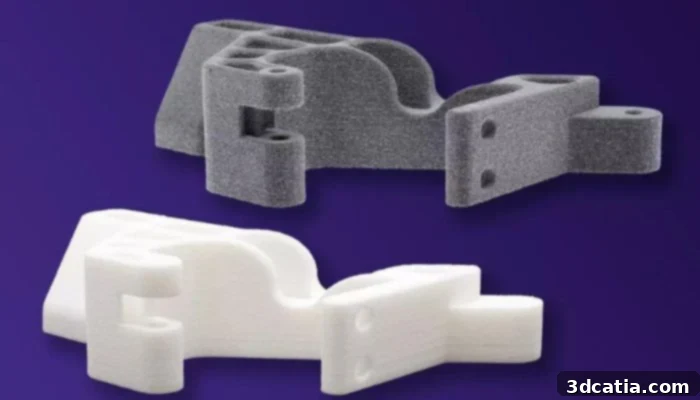
PA 12 (white) is the lightest type of nylon, while PA 11 (grey) has better mechanical properties. (photo credits: Jellypipe)
In terms of operating temperature, PA12 exhibits a broader extreme range, capable of enduring temperatures from -50°C to 150°C. However, its continuous operating temperature is somewhat narrower, typically between 50-80°C, which is less than PA11’s continuous range. Like PA11, PA12 also demonstrates impressive resistance to abrasion and fatigue. Its chemical inertness makes it highly resistant to fats, oils, solvents, alkalis, and salt solutions, rendering PA12 parts exceptionally wear-resistant and easy to weld and bond. A notable advantage of PA12 is not just its status as the lightest polyamide but also its superior resistance to stress cracking, a critical factor for parts subjected to constant pressure or environmental strain.
While PA12 offers very good impact resistance, it generally does not quite reach the levels demonstrated by PA11. In a direct comparison, PA12 also tends to fall slightly short in terms of overall strength and hardness when unreinforced. To compensate for these minor shortcomings, PA12 is frequently enhanced with various additives, such as glass or carbon fibers, which significantly boost its mechanical properties, making it suitable for even more demanding structural applications.
Both PA11 and PA12 materials are generally compatible with various fabrics and are deemed suitable for contact with human skin, which is crucial for applications like wearables, medical devices, and personal protective equipment. It is important to highlight, however, that the suitability for food contact can vary. Some manufacturers’ PA12 formulations are approved for direct food contact, a characteristic not universally shared by all PA11 varieties. Nevertheless, specific PA11 powders, such as APC-Tec’s PA11 Blue, have successfully achieved FDA clearance for food contact applications, broadening its utility in this sensitive sector.
3D Printing Using PA11 and PA12
In the dynamic field of 3D printing, polyamides (PA) are predominantly utilized in filament and powder forms. While PA6 is the most common nylon filament for FDM printers and is available to a limited extent as a powder, PA11 and PA12 truly excel in powder-based additive manufacturing processes. This preference stems from their excellent thermoplastic properties, which allow nylon to be shaped and fused effectively using heat, a fundamental principle behind these advanced printing technologies. Key powder-based processes that leverage PA11 and PA12 include Selective Laser Sintering (SLS), Multi Jet Fusion (MJF), Selective Absorption Fusion (SAF), and High Speed Sintering (HSS). These technologies are renowned for their high productivity, ability to create complex geometries without support structures, and the significant advantage of recycling unused powder, contributing to material efficiency and reduced waste.
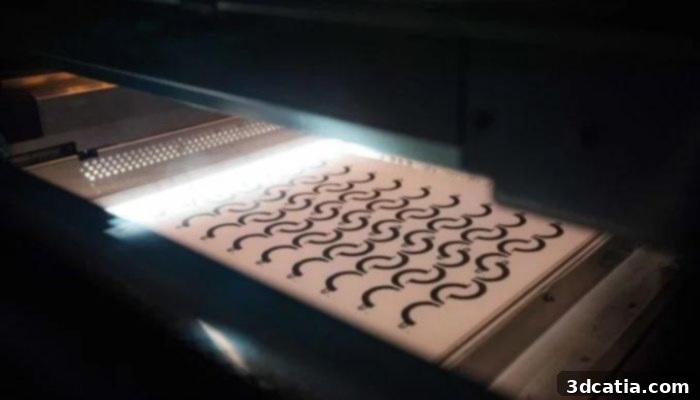
The MJF process (photo credits: Hubs)
Historically, PA12 has been more frequently adopted in additive manufacturing compared to PA11. This trend can be attributed to several factors, including its earlier commercial availability and, critically, its lower melting point. PA12 typically melts at temperatures ranging from 175-180°C (depending on the specific manufacturer’s formulation), whereas PA11 requires a higher temperature, melting at approximately 200°C. These distinct melting temperature requirements are fundamental to the printing process and underscore why PA11 and PA12 powders cannot be indiscriminately mixed for the same print job. Managing these thermal differences presents a significant engineering challenge for 3D printing systems. However, most leading additive manufacturing equipment manufacturers offer specialized “Build Unit” solutions tailored to each material, ensuring optimal processing conditions and consistent part quality.
Post-Processing for PA11 and PA12 Parts
Regardless of whether PA11 or PA12 is chosen for a 3D printing project, post-processing remains an absolutely essential and integral step in the overall additive manufacturing workflow. For both PA11 and PA12 parts produced via powder-based methods, the post-processing phase is largely identical, exhibiting no significant differences between the two materials. This stage encompasses a series of steps, some of which are mandatory for all parts, while others are optional and chosen to achieve specific aesthetic or functional enhancements.
The initial and mandatory step for components made from either PA11 or PA12 is depowdering. This critical process involves carefully removing the newly printed parts from the surrounding unsintered powder cake. Following extraction, residual powder adhering to the parts must be thoroughly removed from all surfaces, both internal and external. A significant advantage of powder-based systems is that a substantial portion of this unused powder can be collected, sieved, and recycled into subsequent printing processes, significantly reducing material waste and improving cost-efficiency. After depowdering, various advanced cleaning processes are employed to ensure the complete removal of any remaining fine powder particles and to achieve an improved surface finish.
Examples of common post-processing methods used to refine PA11 and PA12 parts include water jet blasting, which uses high-pressure water to clean surfaces; air jet blasting for lighter debris removal; and bead blasting, which employs abrasive media to smooth or texture the surface. For achieving an exceptionally smooth and sealed surface, chemical smoothing techniques can be applied, while drum polishing offers a cost-effective way to enhance surface aesthetics for larger batches of parts. In addition to these surface treatments, both PA11 and PA12 parts can undergo further aesthetic customization through painting or dyeing, allowing for a wide range of color options and finishes to meet specific design and branding requirements.
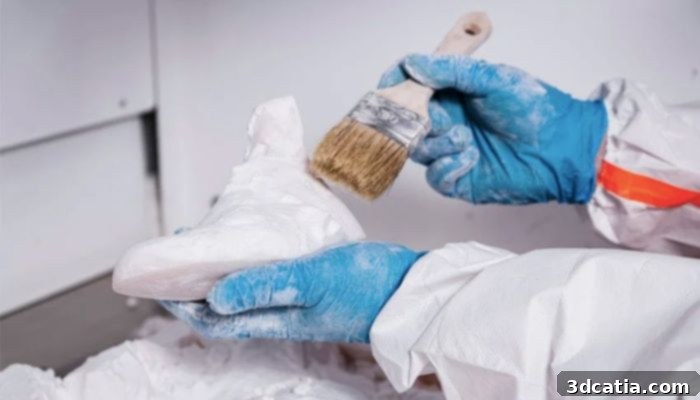
An important step in all powder-based processes is post-processing (photo credits: Protiq)
PA11 and PA12 Applications Across Industries
As both PA11 and PA12 belong to the same overarching group of polyamide plastics, it is entirely understandable that they are utilized in a multitude of 3D printing applications, leading to significant overlaps in their fields of use. However, their nuanced differences often dictate which material is ultimately preferred for specific functional requirements within these overlapping sectors.
In the critical medical field, both PA11 and PA12 powders are extensively employed, provided they meet the stringent biocompatibility standards set by their respective manufacturers. They are indispensable in the fabrication of custom prostheses, orthoses, and various medical devices and instruments, offering precision and durability. Within this sector, PA11 is often favored for its superior biocompatibility and inherent flexibility, making it ideal for applications requiring comfort and dynamic movement, such as flexible orthotic components. Conversely, PA12, generally known for its greater strength and rigidity, is often chosen for more structural medical devices where robustness is paramount.
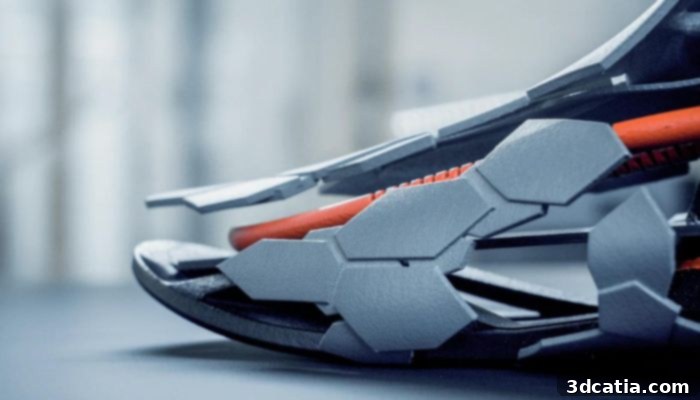
PA11 and PA12 are often used for prosthetics and orthotics (photo credits: EOS)
The automotive industry also leverages both materials extensively. PA11 is particularly popular for rapid prototyping of vehicle parts and has increasingly found its way into serial production due to its impressive impact and chemical resistance. This makes it suitable for critical collision-absorbing components, both internal (where PA11’s crack resistance is vital) and external, as well as for durable gaskets, engine components, and protective coatings. PA12 also plays a significant role in automotive 3D printing, especially for manufacturing precision hoses and tubes, including robust, pressure- and impact-resistant fuel lines that must operate reliably under demanding conditions.
Similarly, in aeronautics, PA11 is valued for its excellent impact resistance and lightweight properties, making it an ideal choice for components such as aircraft fairings and internal structural parts that contribute to overall weight reduction. The light nature of PA11 parts directly translates into improved energy efficiency for aircraft. PA12, on the other hand, is equally crucial for manufacturing precision hoses and tubes in aircraft, particularly for high-pressure and impact-resistant fuel lines that demand unwavering performance and reliability. In both the automotive and aerospace sectors, the choice between PA11 and PA12 often comes down to a trade-off: PA11 for its contribution to lighter, more energy-efficient parts, and PA12 for its inherent rigidity and hardness, making it suitable for parts requiring superior structural strength.
The sports industry also benefits significantly from the unique characteristics of both materials. PA11 is favored for its exceptional abrasion resistance, finding applications in components like ski linings and the soles of sports cleats, where durability against wear and tear is paramount. Its superior flexibility also makes it suitable for parts that require a degree of pliability. PA12, conversely, is widely used in winter sports equipment, such as alpine and cross-country ski boots and ski bindings. Its particular mechanical resistance at low temperatures ensures consistent performance and safety even in extreme cold environments.

PA11 and PA12 are also used in sports (photo credits: Prodways/Salomon)
Beyond these specific sectors, both materials find extensive utility in general mechanical engineering, electrical engineering, electronics, and the packaging industry. In these broad applications, PA11 is particularly valued for its extended longevity and high fatigue resistance, making it ideal for parts that undergo repeated stress cycles. PA12, meanwhile, is appreciated for its high toughness and stiffness, providing structural integrity in various components.
Expanding on its applications, PA12 is frequently chosen for the production of precision hoses and tubes, especially for pressure- and impact-resistant fuel lines where reliability is non-negotiable. It is also a preferred material for drive elements operating in wet environments or for underwater transmission parts that demand high dimensional accuracy and resistance to water ingress. Furthermore, in mechanical engineering, PA12 is used for components such as hinges and gears, as well as for manufacturing insulating films due to its electrical properties.
In parallel, within electrical engineering and electronics, PA11 serves as an excellent insulating and protective material for sensitive components like cables, connectors, and the housings of electronic devices, guarding them against environmental factors and electrical interference. Given its exceptionally long service life and robust mechanical profile, PA11 is generally well-suited for a wide array of highly technical applications that require sustained performance over extended periods.
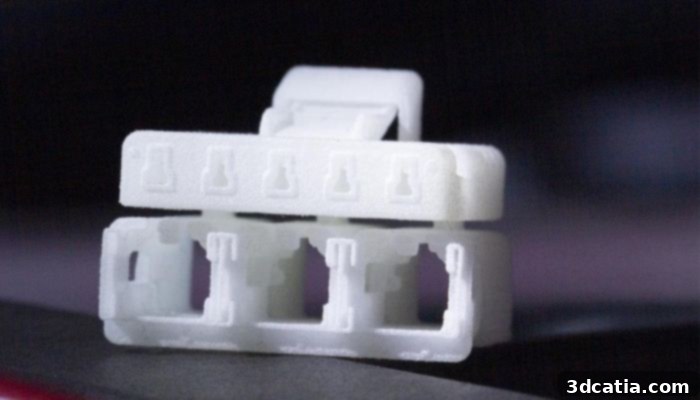
A nylon connector (photo credits: EOS)
PA11 and PA12 Manufacturers and Price Considerations
When considering the economics of these advanced materials, PA12 is generally observed to be more expensive than PA11, a pricing dynamic largely influenced by current market demand and supply chains, with PA11’s demand still maturing in some regions. The cost of PA11 can vary significantly, with some manufacturers offering it for as low as $50/kg, while others price it closer to $200/kg. These price fluctuations for the same type of powder often depend on whether it is a standard grade or a reinforced variant containing additives. A comparative analysis of finished parts made from these two materials reveals that mass-produced components crafted from PA11 can be considerably more economical than those made from PA12, potentially by as much as 30% depending on the production volume. Conversely, for the manufacturing of single, highly customized parts or very low volumes, PA12 can sometimes present a more cost-effective option due to specific processing efficiencies or material availability.
Both PA11 and PA12 are widely available from a diverse range of reputable manufacturers globally. Among the most recognized producers of PA11 are EMS-Grivory and the French chemical giant Arkema, which markets its PA11 under the well-known trade name RILSAN® PA11. Arkema also offers PA12, initially under a similar branding, but now distinctively named RILSAMID® to clearly differentiate it from PA11. PA12 is also frequently sold in the market under proprietary names such as VESTAMID® or VESTOSINT®. Leading chemical companies like BASF are significant suppliers of both PA12 and PA11 in powder form. Additionally, specialized 3D printing manufacturers such as Evonik, 3DSystems, and Farsoon provide their own PA12 powders, often developed through strategic collaborations with chemical companies, though these material development partnerships are typically kept confidential.
Beyond the inherent sustainability advantages of bio-sourced PA11, an increasing number of manufacturers are actively investing in making PA12 production more environmentally friendly and organic. For instance, German equipment and materials supplier EOS offers PA12 as a high-performance alternative to traditional injection molding plastics like ABS or PA6. EOS has made continuous strides in enhancing the production efficiency of this material, notably by reducing its carbon footprint through the integration of renewable energy sources in their manufacturing processes, demonstrating a commitment to greener additive manufacturing.
The market also features advanced polyamide powders enriched with various additives to enhance specific properties. These include formulations incorporating Kevlar for increased strength, carbon fibers for superior stiffness and lightness, or glass beads for improved rigidity and dimensional stability. HP, for example, offers a thermoplastic PA12 material infused with 40% glass beads, known as HP 3D High Reusability PA12 Glass Beads, which also boasts an impressive recycling rate. Recently, HP further expanded its portfolio by launching a new PA12 powder, HP 3D HR PA 12 S, developed in collaboration with Arkema. This innovative material stands out with a high reusability rate of up to 85%, significantly contributing to waste reduction and promoting a more sustainable approach to 3D printing.
In conclusion, both PA11 and PA12 are incredibly valuable materials in additive manufacturing, each offering distinct advantages that make them suitable for a wide range of demanding applications. While PA11 stands out for its bio-based origin, superior ductility, and impact resistance, PA12 is lauded for its excellent stress cracking resistance, lower water absorption, and established presence in the market. The choice between these two advanced nylons ultimately depends on the specific requirements of the application, balancing factors such as mechanical performance, environmental considerations, and cost. Understanding these nuances is key to leveraging the full potential of nylon in 3D printing.
Do you use PA11 or PA12 for additive manufacturing? Let us know in a comment below or on our LinkedIn, Facebook, and Twitter pages! Don’t forget to sign up for our free weekly newsletter here for the latest 3D printing news straight to your inbox! You can also find all our videos on our YouTube channel.