
Revolutionizing Ankle Replacement: The Transformative Power of 3D Printed Implants in Orthopedic Surgery
The landscape of modern medicine is undergoing a profound transformation, largely driven by technological advancements. Among these, 3D printing, or additive manufacturing, has emerged as a particularly disruptive force, ushering in an era of unprecedented personalization and precision in healthcare. Its integration into the medical sector has been nothing short of revolutionary, impacting a wide array of fields. From crafting bespoke prostheses and orthoses perfectly tailored to individual anatomies, to enabling the precise personalization of drug treatments, this innovative technology is fundamentally reshaping patient care. Today, we delve into one of the most exciting frontiers: the development and application of 3D-printed implants, particularly in complex orthopedic procedures like ankle replacement surgery.
In a significant leap forward for orthopedic innovation, international medical technology company Exactech recently announced the successful completion of the first ankle replacement operations utilizing their cutting-edge Ankle 3D and 3D+ tibial implants. What makes these implants truly remarkable is their design and fabrication through advanced 3D printing technology, allowing for features and customization previously unattainable with traditional manufacturing methods. Last week, Dr. James Lachman of St. Luke’s University Health Network led one of these pioneering surgeries in Pennsylvania, USA, marking a pivotal moment for both Exactech and the future of ankle arthroplasty. This development not only highlights the growing maturity of 3D printing in clinical settings but also underscores its potential to address complex surgical challenges and enhance patient outcomes significantly.
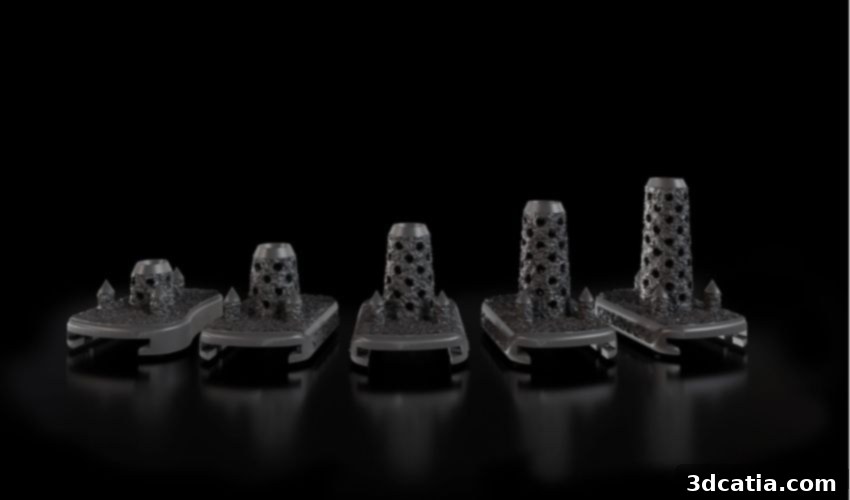
Exactech’s innovative 3D-printed tibial implants, transforming ankle replacement.
A New Horizon in Ankle Surgery: Unpacking the Innovations of 3D Printing
The successful implementation of Exactech’s new 3D-printed tibial implants represents a monumental step forward in ankle replacement surgery. Dr. James Lachman MD, a distinguished surgeon at St. Luke’s University Health Network, had the distinct honor of performing the inaugural ankle procedure using these advanced components. Expressing his enthusiasm for the breakthrough, Dr. Lachman commented, “It is exciting to be the first to implant Exactech’s latest ankle products and provide my patients with their differentiating benefits.” His statement reflects a broader sentiment within the orthopedic community regarding the potential of additive manufacturing to solve long-standing challenges in implant design and surgical technique.
These cutting-edge implants, specifically Exactech’s Vantage Ankle 3D and 3D+ tibial implants, stand out due to several innovative characteristics. Firstly, their remarkable adaptability allows them to address a significantly wider range of pathologies and anatomical variations than traditional implants. This enhanced flexibility means that surgeons can cater to more complex cases, offering a personalized solution where a generic, off-the-shelf implant might fall short. Secondly, the design of these implants contributes to making surgical instruments simpler and more intuitive to use, potentially reducing operative time and improving overall surgical precision. The implants are available with stem heights ranging from 10 to 30 mm, providing surgeons with crucial versatility to match various patient anatomies and surgical requirements.
Perhaps the most significant differentiating feature, enabled directly by 3D printing technology, is the unique surface architecture of these implants. They are meticulously designed to reproduce the natural structure of bone, a critical factor for successful biological integration. This biomimetic design promotes osseointegration – the direct structural and functional connection between living bone and the surface of a load-bearing artificial implant – leading to stronger, more stable fixation and potentially reducing the risk of implant loosening over time. This level of intricate design and precision simply isn’t feasible with conventional manufacturing methods like casting or machining, highlighting the distinct advantages of additive manufacturing in creating truly advanced medical devices.
Advancing Total Ankle Arthroplasty (TAA) with Additive Manufacturing
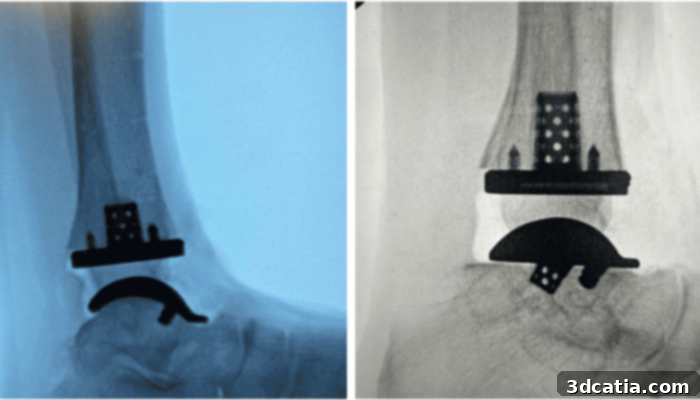
The impact of these innovations was further demonstrated through two total ankle arthroplasties performed at Duke Regional Hospital by a collaborative team including Dr. Jim Nunley and Exactech Design Team Surgeon Mark Easley, MD. Total Ankle Arthroplasty (TAA) is a sophisticated surgical procedure aimed at restoring joint mobility and alleviating pain for patients suffering from end-stage ankle arthritis or other debilitating conditions. The procedure involves replacing the damaged ankle joint surfaces with artificial components, establishing a new, functional joint space. Historically, TAA has presented significant challenges, including ensuring optimal implant fit, stability, and long-term durability, often due to the complex biomechanics of the ankle and the variability of patient anatomy.
The Exactech 3D-printed tibial components directly address many of these long-standing TAA challenges. Dr. Easley, a key figure in the design team, reflected on the development process and clinical outcomes: “After several years of developing the 3D+ tibial component with the outstanding Exactech engineers and other design team surgeons, James Lachman and I are pleased how the new tibial components and instrumentation seamlessly melded with the existing talar component options.” This seamless integration is crucial for surgical efficiency and optimal joint mechanics post-operation. Furthermore, Dr. Easley emphasized the biomechanical advantages conferred by additive manufacturing, stating, “The additive manufacturing, and the press-fit pegs and augmented central cage afford satisfying initial tibial component stability.”
These technical details are vital. “Press-fit pegs” refer to design elements that allow the implant to be securely seated into the bone without the need for additional screws, promoting immediate stability and potentially reducing micro-motion that can impede healing. The “augmented central cage” provides enhanced structural support and surface area for bone ingrowth, further contributing to robust initial fixation and long-term stability. While specific manufacturing techniques for these proprietary implants have not yet been publicly disclosed, the benefits of additive manufacturing are clear: it allows for the creation of intricate internal and external geometries that enhance bone integration, reduce stress shielding, and improve the overall biomechanical compatibility of the implant with the patient’s anatomy. This level of engineering sophistication offers surgeons optimized, patient-centric solutions for managing complex ankle pathologies.
Exactech’s Comprehensive Approach to Foot and Ankle Innovation
The introduction of these revolutionary 3D-printed tibial implants is part of a broader strategy by Exactech to innovate across its foot and ankle care portfolio. The company consistently strives to push the boundaries of medical technology, and these new products join a robust line-up of recent launches designed to enhance patient outcomes and surgical efficiency. Earlier this year, Exactech launched Activit-E, a cutting-edge polyethylene insert. This insert is uniquely enriched with vitamin E, a potent antioxidant, which helps to mitigate material degradation and oxidative stress. The inclusion of vitamin E is expected to significantly improve the longevity and wear resistance of the polyethylene component, thereby potentially extending the lifespan of the ankle replacement and reducing the need for revision surgeries.
Further demonstrating its commitment to precision and personalization, Exactech has also forged a powerful collaboration with 3D Systems, a global leader in additive manufacturing solutions. This partnership has resulted in the development of customized cutting guides, which are fully compatible with Exactech’s new 3D-printed implants. These patient-specific cutting guides are pre-operatively designed using advanced imaging data (such as CT scans) to precisely match the unique anatomy of each patient. During surgery, these guides ensure that bone resections are performed with unparalleled accuracy, leading to optimal implant positioning and alignment. This level of precision is critical for the long-term success of the ankle arthroplasty, contributing to better joint mechanics, reduced risk of complications, and ultimately, superior functional outcomes for patients. The synergy between custom implants and custom surgical instrumentation exemplifies the holistic benefits that 3D printing brings to modern orthopedic surgery.
To delve deeper into Exactech’s latest advancements and their comprehensive approach to foot and ankle care, interested readers are encouraged to review their official press release, available here. This document provides additional details on their groundbreaking work and the future direction of their orthopedic innovations.
The Broader Impact: 3D Printing and the Future of Orthopedic Surgery
The success of Exactech’s 3D-printed ankle implants is more than just an isolated achievement; it’s a powerful indicator of the trajectory of orthopedic surgery. 3D printing is not just a tool for creating parts; it’s a paradigm shift towards truly personalized medicine. The ability to craft implants with complex internal lattices, porous structures, and patient-specific contours directly translates to several crucial benefits. These include enhanced biocompatibility through optimized surface topography for cell adhesion and bone ingrowth, superior biomechanical matching that reduces stress shielding and implant-related pain, and the potential for reduced manufacturing lead times for customized solutions. As the technology matures, we can anticipate further advancements in materials science, allowing for the printing of implants with bioactive properties or integrated sensors for real-time monitoring.
Furthermore, the integration of 3D printing with advanced surgical planning software and intraoperative navigation systems creates a powerful ecosystem for precision surgery. Surgeons can virtually plan complex procedures, practice difficult steps, and then execute them with the help of custom guides and implants that perfectly match their plan. This holistic approach can lead to reduced surgical time, minimize invasiveness, accelerate patient recovery, and ultimately, improve the overall quality of life for individuals suffering from debilitating musculoskeletal conditions. While cost-effectiveness remains a consideration, the long-term benefits of custom, durable implants — potentially leading to fewer revision surgeries and improved functional outcomes — suggest a strong return on investment for healthcare systems and, most importantly, for patients. Exactech’s foray into 3D-printed ankle implants is a testament to this evolving future, positioning additive manufacturing as an indispensable component of orthopedic innovation for decades to come.
What are your thoughts on Exactech’s groundbreaking 3D-printed implants and their potential to transform orthopedic surgery? Share your insights in a comment below or connect with us on our Facebook and Twitter pages! Don’t miss out on the latest advancements in additive manufacturing—be sure to sign up for our free weekly Newsletter, delivering all the essential 3D printing news directly to your inbox!
*All Photo Credits: Exactech