
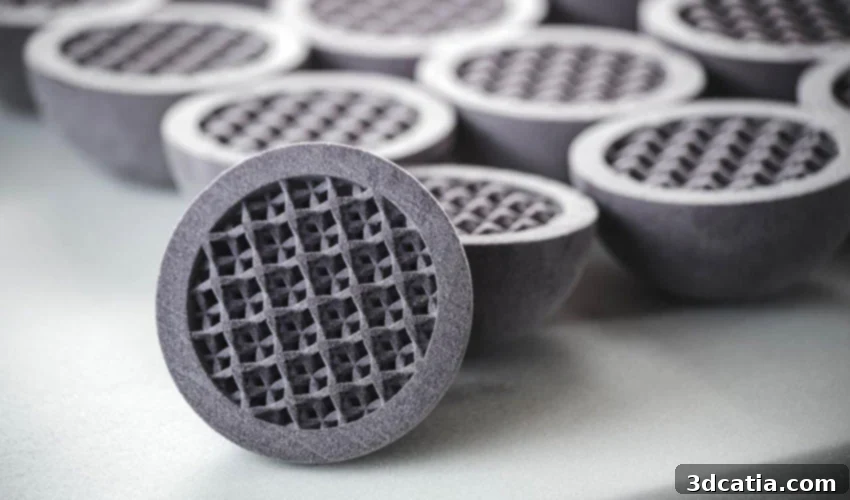
Binder Jetting 3D Printing: A Comprehensive Guide to Technology, Materials, and Industrial Applications
In the rapidly evolving landscape of additive manufacturing technologies, binder jetting stands out as a versatile and powerful method for creating complex parts. Unlike many other 3D printing processes that rely on heat or light to solidify material, binder jetting uses a liquid binding agent to selectively join powder particles, layer by layer. This unique approach allows for compatibility with an exceptionally broad range of materials, including advanced ceramics, various types of sand, polymers, and a growing spectrum of metal powders. Its capabilities extend from producing intricate metal components for aerospace and automotive industries to fabricating large-scale sand molds for foundries, and even creating full-color prototypes. This comprehensive guide will delve into the intricacies of binder jet 3D printing, exploring its operational mechanics, the diverse materials it accommodates, the leading manufacturers driving its innovation, and the latest trends shaping its future. Join us as we uncover how binder jetting is revolutionizing design and production across numerous sectors.
The History and Development of Binder Jetting Technology
The foundational principles of binder jetting 3D printing were first established in 1993 at the Massachusetts Institute of Technology (MIT). Initially, this groundbreaking technology was conceived to work primarily with ceramic materials, offering a new pathway for producing intricate ceramic components. Recognizing its immense potential, the rights to this innovative process were swiftly acquired just two years later by Z Corporation. Z Corporation played a pivotal role in commercializing the technology, especially for polymer and sand-based applications, before it was eventually acquired by additive manufacturing giant 3D Systems in 2012, further integrating binder jetting into the mainstream 3D printing industry.
Parallel to the developments at MIT and Z Corporation, the application of binder jetting for metals saw significant advancements. The American company ExOne, a pioneering name in industrial additive manufacturing, developed and patented metal binder jetting technology in 1996. This marked a crucial turning point, opening the door for the production of functional metal parts with complex geometries. Since these early innovations, binder jetting has undergone numerous technological advances, leading to increased speed, improved part quality, and expanded material compatibility. Its growing capabilities have captured the attention of major industrial players and investors, including formidable companies like HP and Desktop Metal. These industry leaders have since launched their own advanced binder jetting solutions, significantly enhancing the technology’s performance, capacity, and overall appeal for high-volume production applications. Today, binder jetting continues to evolve as a key additive manufacturing process, bridging the gap between prototyping and mass production.
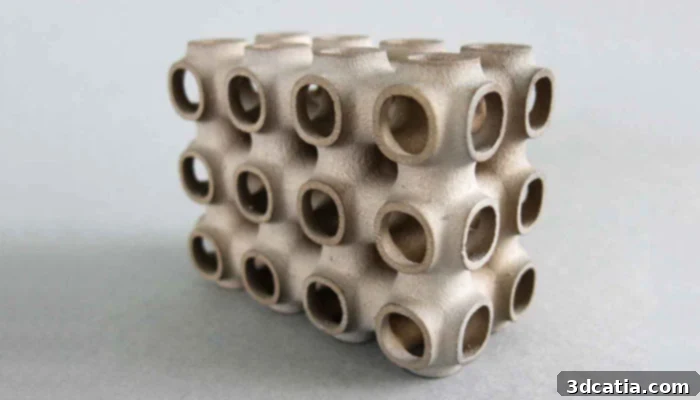
3D printed part sprayed with metal binder (photo credits: Sculpteo)
Unraveling the Binder Jetting Process: How It Transforms Powder into Parts
At its core, binder jetting is an additive manufacturing process that builds objects layer by layer using a powder bed and a liquid binder. The journey from a digital design to a physical part begins with the creation of the desired object using Computer-Aided Design (CAD) software. Once the 3D model is finalized, it is then exported to a specialized software called a slicer. The slicer digitally divides the 3D model into hundreds or thousands of thin cross-sectional layers, generating detailed instructions, often in the form of G-Code, which are subsequently sent to the binder jetting machine. These instructions dictate the precise movements of the print head and the application of the binder for each individual layer.
The actual printing process commences within the machine’s build chamber. A build plate is initially positioned at the bottom of this chamber. A fresh layer of powdered material is meticulously spread across the build plate using a recoater blade or a rolling cylinder, ensuring a uniform and precise thickness, typically ranging from tens to hundreds of micrometers. Following the powder spreading, an industrial inkjet print head, strikingly similar to those found in conventional 2D paper printers, traverses over the powder bed. This print head selectively jets tiny droplets of a liquid binder, often around 80 µm in diameter, onto the powder particles according to the cross-sectional data of the part for that specific layer. Where the binder is deposited, it chemically bonds the powder particles together, forming a solid cross-section of the object. The unbound powder surrounding these solidified areas remains loose, acting as a natural support structure for the part as it builds vertically.
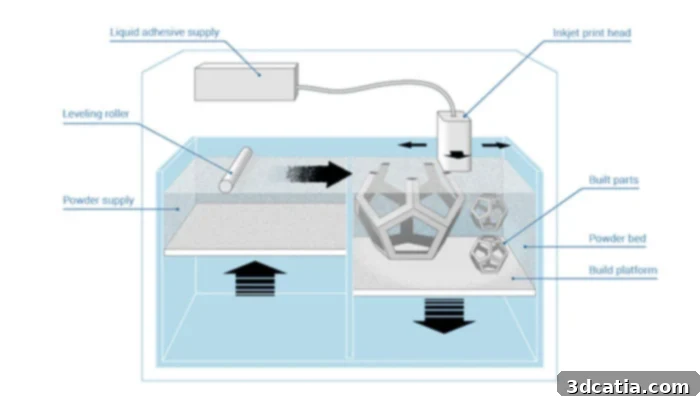
How binder jetting works (photo credits: Additvely)
After a layer is completed, the build plate slightly lowers, and a new layer of powder is spread across the surface. The inkjet print head then applies binder to the next cross-section, adhering to the layer below. This iterative process continues, building the object layer by layer, until the entire 3D model is complete. One remarkable capability of binder jetting, particularly with certain materials and binder systems, is the ability to create full-color models. By utilizing multiple inkjet print heads, each dispensing a binder with a different color pigment, the technology can produce parts with vibrant and intricate color patterns, much like a conventional color inkjet printer. This feature is especially valuable for architectural models, medical teaching aids, and artistic applications where visual fidelity is crucial.
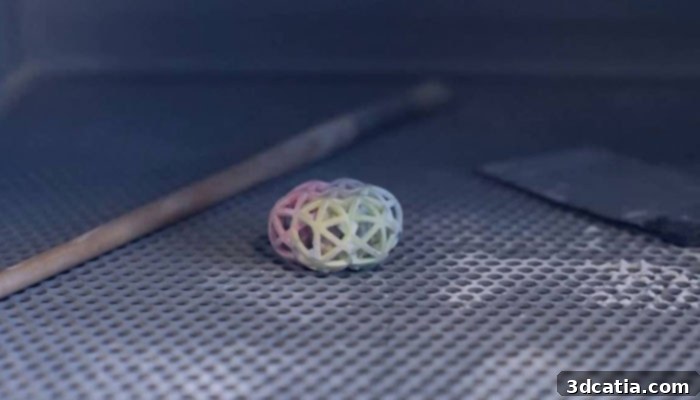
After printing, excess powder must be removed (photo credits: 3D Hubs).
Key Advantages and Versatile Materials of Binder Jetting
Binder jet 3D printing offers several compelling advantages that distinguish it from other additive manufacturing processes, particularly those involving powder beds. One of its most significant benefits is its remarkably broad material compatibility. Unlike technologies that rely on laser sintering or melting, binder jetting does not require the powder particles to be fusible at high temperatures during the printing phase. This expands the range of printable materials significantly, encompassing metals, ceramics, sands, and even some polymers. This flexibility allows for the creation of parts with diverse properties, catering to a wide array of industrial demands.
Furthermore, binder jetting is often lauded for its high production speed and cost-effectiveness, especially for large print volumes. The printing process itself is generally faster than laser-based powder bed fusion methods because the inkjet heads can cover a large area rapidly. Since the unbound powder acts as a natural support structure, complex geometries can be printed without the need for additional, time-consuming support removal processes post-printing, a considerable benefit for intricate designs. This also means that multiple parts can be densely nested within the build volume, maximizing throughput and efficiency. Moreover, the lack of thermal stress during printing minimizes warping and residual stress in the “green” (unprocessed) parts, contributing to higher dimensional accuracy.
The technology is compatible with a wide range of materials, each selected for specific applications and often requiring a tailored binder formulation. For metal 3D printing, binder jetting can process various metal alloys, including commonly used materials like stainless steel (e.g., 17-4 PH, 316L), titanium, high-performance superalloys such as Inconel, and highly conductive materials like copper. These metals enable the production of functional components for demanding industries like aerospace, automotive, and medical. For ceramics, binder jetting allows for the creation of intricate ceramic parts with high precision. In the case of sand, a chemical binder is typically used to create robust and highly detailed molds or foundry cores, essential for traditional metal casting processes. This versatility in material choice, combined with the other inherent benefits of the technology, positions binder jetting as a powerful tool for modern manufacturing. However, it’s worth noting that initial “green” parts are fragile and require significant post-processing to achieve final mechanical properties, which can sometimes introduce challenges like shrinkage and surface finish requirements.
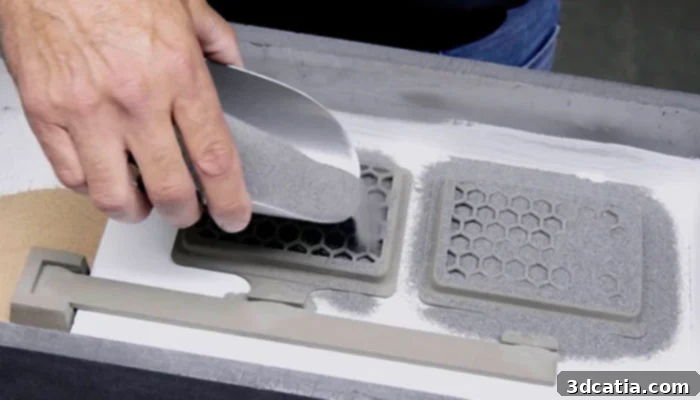
Binder jetting has wide range of compatible materials (photo credits: ExOne)
Mastering the Final Stage: Essential Post-Processing in Binder Jetting
While binder jetting efficiently creates intricate “green” parts layer by layer, the components are initially fragile and composed of loosely bound powder particles. Therefore, a critical series of post-processing steps is essential to transform these green parts into dense, strong, and functional final products. After the printing process is complete, the parts are typically embedded within a surrounding mass of unbound powder, often referred to as a “powder cake.” The first crucial step is depowdering, where excess, unbonded powder is carefully removed from around and within the printed parts. This often involves brushes, compressed air, or specialized depowdering stations to meticulously clean the delicate green parts without damaging them.
Following depowdering, the primary post-processing methods used to reinforce the structure, increase density, and reduce porosity of the prints are sintering and infiltration. The choice between these two processes largely depends on the material used and the desired final properties of the component. Sintering is a heat treatment process where the green part is heated in a controlled furnace environment to a temperature below the material’s melting point. During sintering, the individual powder particles fuse together, densifying the material and significantly improving its mechanical strength, hardness, and wear resistance. This process causes the part to shrink, a factor that must be carefully accounted for during the initial design phase. Sintering is predominantly employed for metal parts, yielding dense, strong, and resistant components suitable for high-performance applications. Modern binder jetting systems for metals are highly integrated, offering sophisticated sintering profiles that manage shrinkage and achieve optimal material properties.
Alternatively, infiltration involves injecting a molten fluid, typically a lower-melting-point metal or a resin, into the porous network of the green part. This infiltrant fills the interstitial spaces and pores between the originally bound powder particles, thereby reinforcing the structure and increasing the overall density and strength. For instance, bronze is a common infiltrant for stainless steel parts, creating a composite material with enhanced properties. Infiltration is generally favored for certain ceramic or plastic parts where high density is required without the extreme temperatures or significant shrinkage associated with full sintering. This method produces parts that are stronger and more watertight, making them suitable for applications where hermeticity or specific mechanical attributes are paramount. The careful selection of the post-processing technique is vital to ensure that the final binder-jetted part meets the stringent performance requirements of its intended application.
Leading Manufacturers and Expansive Applications of Binder Jetting Technology
Binder jet 3D printing offers a compelling proposition for industries seeking to produce intricate metal parts or vibrant, full-color prototypes at a potentially lower cost compared to other additive manufacturing processes like Direct Metal Laser Sintering (DMLS) or material jetting. While the inherent porosity of certain binder jetted parts can sometimes influence their mechanical properties if not fully densified through post-processing, the technology excels in producing high volumes of components. Its capacity for large build envelopes and efficient powder recycling makes it particularly attractive for mass production and batch manufacturing of complex designs, offering unprecedented design freedom.
In the realm of ceramic and polymer-compatible binder jetting, 3D Systems remains a dominant force, particularly with its ColorJet Printing (CJP) technology, which allows for the creation of detailed, multi-color models. Other notable players include Germany’s Voxeljet AG, renowned for its large-format binder jetting systems primarily for sand and polymer materials used in casting and prototyping. The Netherlands-based CONCR3DE is pushing boundaries with its binder jetting solutions for various materials, including natural stones and geopolymers. For accessible, desktop-oriented binder jetting 3D printers, Taiwan’s ComeTrue provides compact and capable machines. When it comes to metal-compatible binder jetting, Desktop Metal has emerged as a clear leader, significantly bolstering its market position through the strategic acquisition of ExOne in 2021, a long-standing pioneer in industrial metal binder jetting. Following Desktop Metal, Sweden’s Höganäs previously held a strong presence with its Digital Metal brand, which has since been acquired by the American composite 3D printing specialist Markforged in 2022, further diversifying the market. Meanwhile, major technology players like HP have made significant inroads into the binder jetting market, launching their innovative Metal Jet technology in 2018, aimed at high-volume metal parts production. These advancements from HP and Desktop Metal are continuously expanding the possibilities in metal additive manufacturing, driving significant partnerships with industrial giants such as Volkswagen, GKN, Parmatech, Ford, BMW, Google, and Adidas, who are exploring and integrating binder jetting into their manufacturing workflows for various applications, from automotive parts to consumer goods.
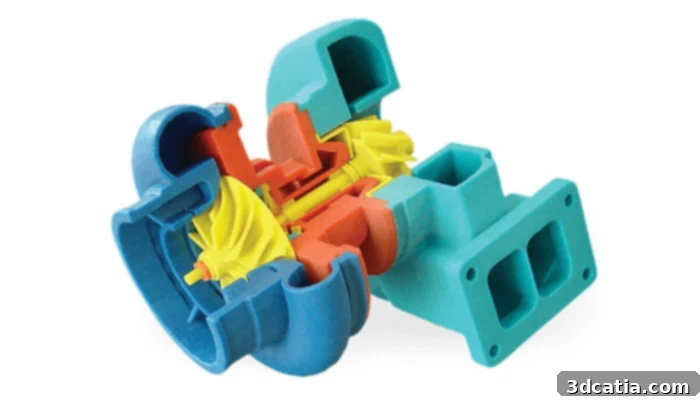
A part printed with ColorJet Printing technology (photo credits: 3D Systems)
The expansive capabilities and material versatility of binder jetting translate into a wide array of applications across numerous high-value sectors. In the **automotive industry**, it enables the rapid production of complex, lightweight components, prototypes, and tooling. For **aerospace**, the ability to create intricate, high-performance metal parts with reduced weight is invaluable for engine components and structural elements. In **healthcare**, binder jetting facilitates the manufacture of customized dental prostheses, biocompatible bone implants, and surgical guides. The **luxury goods** sector benefits from the technology’s precision for creating bespoke jewelry, watch components, and intricate decorative items. The **foundry industry** relies heavily on binder jetting for producing highly detailed sand molds and cores, significantly reducing lead times and enabling complex cast part designs. Furthermore, the technology finds uses in **architecture** for detailed scale models and custom building elements, as well as in **art** for creating sculptures and unique artistic pieces with great design freedom. Beyond these, binder jetting offers environmental benefits by minimizing material waste through efficient powder recycling and allowing for the production of lighter components, which can lead to reduced energy consumption in end-use applications. This breadth of application underscores binder jetting’s critical role in the future of advanced manufacturing.
Find out more about the different 3D printing technologies HERE
Do you use binder jetting in your projects or business? We’d love to hear about your experiences and insights! Let us know in a comment below or on our LinkedIn, Facebook, and Twitter pages! Don’t forget to sign up for our free weekly newsletter here, to receive the latest 3D printing news straight to your inbox! You can also find all our videos and expert interviews on our YouTube channel.
*Cover Photo Credits: ExOne