
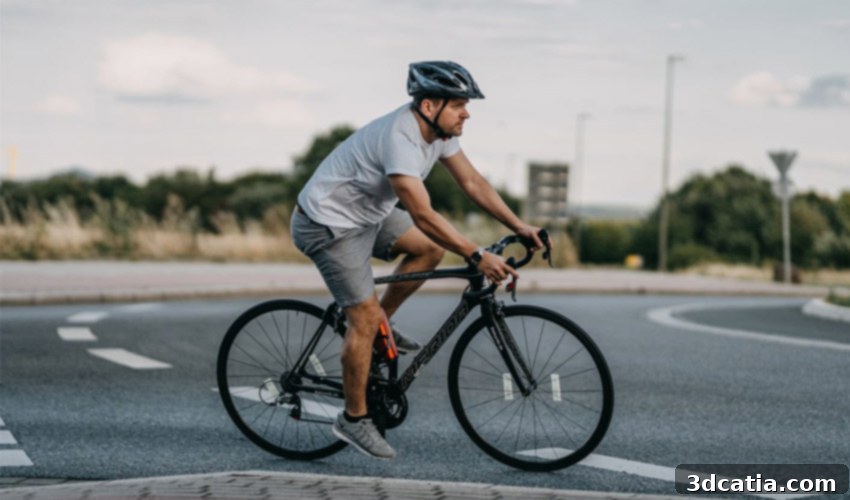
Freicycle: Dennis Freiburg’s 3D-Printed Electric Bike Sets New World Record for Lightness
In a remarkable feat of engineering and design, Dennis Freiburg has etched his name into the Guinness World Records by creating the world’s lightest electrically assisted bicycle (EAB). This groundbreaking achievement, culminating in a bicycle weighing a mere 6.872 kilograms (15.15 lb), represents a significant milestone in lightweight vehicle design and a powerful testament to the capabilities of modern manufacturing technologies. This German engineer dedicated over a year to bringing his vision to life, demonstrating an innovative approach that heavily leveraged advanced techniques, most notably additive manufacturing. His project stands out not just for its record-breaking weight but also for its pioneering use of 3D printing, especially with composite materials, to fabricate components that simply did not exist on the commercial market. Despite the integration of such cutting-edge technologies and an intense development phase, the entire endeavor carried a substantial cost, exceeding 10,000 euros.
The popularity of electric bicycles has surged dramatically in recent years, transforming urban commutes and recreational cycling. However, a common trade-off for the convenience of electric assist has always been increased weight compared to traditional bicycles, primarily due to the integrated motor, battery pack, and associated wiring. This added heft can impact handling, reduce agility, and make transporting the bike more challenging. Recognizing these limitations, a growing number of manufacturers and innovators are intensely focused on reducing E-bike weight to enhance rider comfort, improve performance, and expand the overall appeal of electric cycling. It is in this context that Dennis Freiburg’s Freicycle emerges as a true marvel, weighing less than 7 kilograms – an astonishing three times lighter than the average electric bicycle currently available on the market.
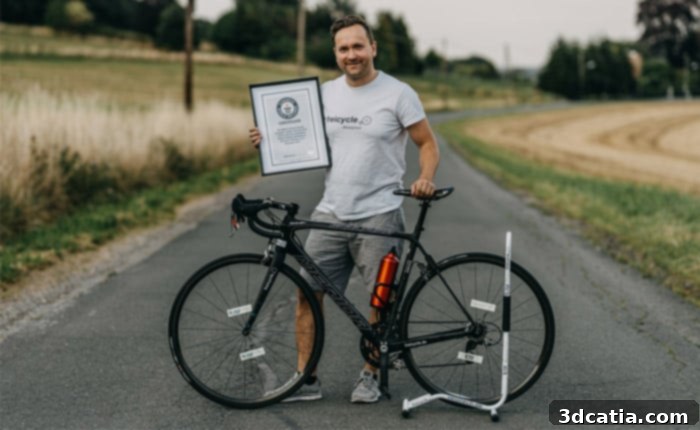
Dennis Freiburg proudly showcases the world’s lightest electric bike, the Freicycle.
The Quest for Unprecedented Lightness: How Additive Manufacturing Made it Possible
Freiburg’s ambitious project, aptly named Freicycle – derived from “frei,” the German word for “freedom” – pushes the boundaries of what’s achievable in bicycle design. The bike’s foundation is an existing high-performance model, the carbon Merida Scultura, celebrated for its exceptionally lightweight frame. However, Freiburg embarked on a journey of extensive modification, meticulously altering numerous parameters and components to strip away every possible gram. His strategy involved significantly enhancing the presence of carbon fiber in critical, high-stress areas such as the crankset, wheels, and fork, maximizing strength-to-weight ratios where it mattered most.
Central to the Freicycle’s record-breaking weight is the strategic integration of additive manufacturing, commonly known as 3D printing. This technology offered unparalleled design freedom and customization capabilities that traditional manufacturing methods simply couldn’t match. For various components, including the pedals, Freiburg turned to 3D printing. While he has been discreet about the specific processes and materials employed, he emphasizes that this method was indispensable for conceptualizing and producing parts that were otherwise unobtainable. Many of these custom-designed components simply didn’t exist on the commercial market, making 3D printing the sole viable path to their creation. This capability allowed him to transcend existing limitations, crafting bespoke solutions perfectly tailored to his lightweight objectives.
Additive Manufacturing: A Catalyst for Innovation in Lightweight E-Bike Design
The choice of 3D printing was not merely a convenience but a strategic enabler for the Freicycle project. Additive manufacturing offers several distinct advantages crucial for achieving extreme lightness and structural integrity:
- Unprecedented Design Freedom: 3D printing allows for the creation of complex geometries and intricate internal structures that are impossible with conventional manufacturing. This includes topology optimization, where material is placed only where structurally necessary, leading to significantly lighter parts that maintain or even exceed required strength.
- Rapid Prototyping and Iteration: The ability to quickly print and test multiple design iterations was vital for Freiburg. If a component broke or needed refinement during testing, he could simply re-design and re-print it in a matter of hours or days, dramatically accelerating the development cycle and perfecting the final design.
- Customization and Bespoke Parts: As Freiburg highlighted, 3D printing enabled him to produce parts that were not commercially available. This bespoke approach is critical for a world-record attempt, where off-the-shelf components might not meet the stringent weight and performance targets.
- Material Optimization with Composites: While Freiburg remained private about the exact materials, the use of composite materials in conjunction with 3D printing is a powerful combination. 3D printable composites, such as carbon fiber reinforced polymers, offer exceptional strength-to-weight ratios, allowing for robust yet incredibly light parts.
Beyond pedals, it is highly probable that other custom mounts, brackets, internal cable routing guides, and minor structural elements also benefited from 3D printing. This holistic approach to component design and manufacturing was fundamental to shedding every gram possible without compromising the bike’s functionality or safety. The fusion of traditional high-performance carbon components with custom 3D-printed parts created a synergy that defined the Freicycle’s innovative edge.
Ingenious Engineering: The Freicycle’s Hidden Secrets
The mechanical aspects of the Freicycle are as meticulously engineered as its structure. Initially, the bike was conceptualized with the potential for immense power, capable of housing a remote-controlled helicopter engine delivering a staggering 600W. However, to comply with European regulatory standards for electrically assisted bicycles, the motor’s output had to be limited to 250W. Despite this limitation, the Freicycle effortlessly reaches speeds of 25 km/h, which is the legal limit for EABs without requiring a license or registration in many regions. Intriguingly, Dennis reveals that if unleashed to its full potential, the bike is capable of achieving exhilarating speeds of up to 48 km/h, showcasing the inherent power of its design.
Perhaps one of the most ingenious design elements of the Freicycle is its battery concealment. Riders and onlookers might search for a long time without spotting it, as it is expertly camouflaged within the bike’s sleek profile. The battery is cleverly disguised as an ultralight alloy water bottle and securely housed within a custom-designed, 3D-printed bottle holder. This integration not only contributes to the bike’s aesthetic appeal but also saves precious grams by removing the need for separate battery housing and mounting mechanisms. To activate the electric assist, one simply needs to press on the “bottle cap,” a minimalist and elegant solution that aligns perfectly with the bike’s streamlined design and functionality.
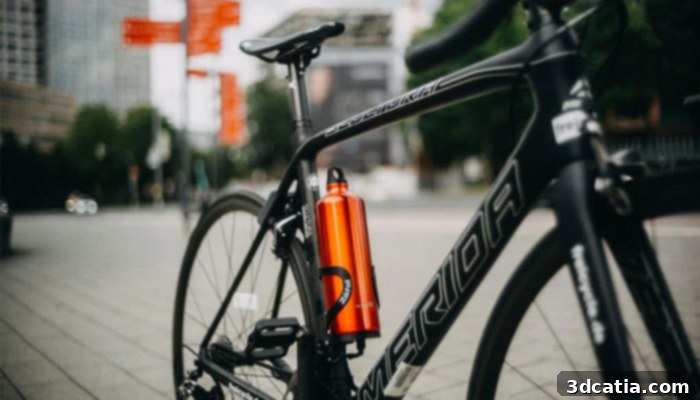
The Freicycle features an innovative, hidden battery designed as an alloy bottle, secured by a custom 3D-printed holder.
The Journey and Its Future: A Testament to Passion and Innovation
The development of the Freicycle was more than just a hobby project; it forms a critical part of Dennis Freiburg’s doctorate studies, underscoring the deep research and technical rigor involved. This academic context explains the intense focus on innovation, problem-solving, and pushing the boundaries of existing technology. The significant investment of time, over a year of dedicated effort, combined with the extensive use of specialized materials and custom additive manufacturing processes, naturally led to a substantial financial outlay. The final prototype’s cost, exceeding 10,000 euros, reflects the cutting-edge nature of the research and development, the bespoke components, and the sheer dedication required to achieve such an unprecedented result.
For the moment, this ultralight electric bicycle is not slated for commercialization. Its primary purpose is to serve as a demonstrator of what is technically achievable and to contribute to Freiburg’s academic work. However, the implications of the Freicycle extend far beyond a single prototype. It serves as a powerful proof-of-concept for the future of E-bike design and manufacturing. The principles and techniques employed – particularly the sophisticated integration of additive manufacturing and advanced composite materials for extreme weight reduction and component innovation – could pave the way for a new generation of electric bicycles that are lighter, more efficient, and offer enhanced riding experiences. This project highlights the potential for mass customization and the creation of highly specialized components, which could revolutionize not only the bicycle industry but also other sectors striving for lightweight and high-performance designs.
Conclusion: Setting a New Benchmark for E-Bike Innovation
Dennis Freiburg’s Freicycle is more than just the world’s lightest electric bicycle; it is a profound statement on the future of mobility and manufacturing. By meticulously combining existing high-performance components with revolutionary 3D-printed parts and ingeniously integrated systems, he has demonstrated that the perceived limitations of E-bike weight can be overcome through innovative engineering. This Guinness World Record-holding EAB stands as a beacon of what dedicated research, passion, and the strategic application of advanced technologies like additive manufacturing can achieve. It’s an inspiring example for future designers and engineers, proving that with enough ingenuity, even the most challenging goals, like creating an electric bike weighing less than a standard road bike, are within reach. The Freicycle truly offers a glimpse into a lighter, more agile, and ultimately freer future for electric cycling.
What are your thoughts on Dennis Freiburg’s incredible achievement and the role of 3D printing in creating the world’s lightest E-bike? We’d love to hear your insights in the comments below or on our Facebook and Twitter pages! Don’t forget to sign up for our free weekly Newsletter to get all the latest news in 3D printing delivered straight to your inbox!