
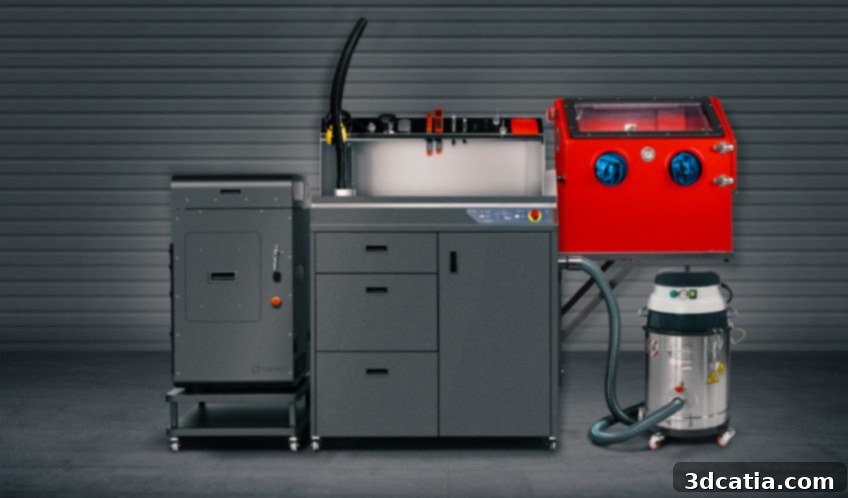
Sinterit’s Powder Handling Station (PHS): Revolutionizing Cleanliness and Efficiency in Benchtop SLS 3D Printing
Sinterit, a pioneer in accessible Selective Laser Sintering (SLS) 3D printing technology, continues its mission to democratize advanced additive manufacturing with the highly anticipated launch of its innovative Powder Handling Station (PHS). This cutting-edge device is meticulously designed as a crucial accompaniment to Sinterit’s acclaimed range of SLS printers, including popular models like the Lisa PRO. The PHS directly addresses one of the most critical and often challenging aspects of powder-based 3D printing: post-processing and powder recovery. Traditionally, these stages could be messy, time-consuming, and demand significant manual labor, often requiring dedicated space and specialized personnel. Sinterit’s PHS dramatically transforms this workflow, making it as clean, efficient, and user-friendly as possible. This integrated solution empowers additive manufacturing professionals, enabling a single operator to manage the entire SLS 3D printing process from print preparation to final part cleanup with unprecedented ease and consistency. By centralizing operations and optimizing powder management, the PHS reinforces Sinterit’s commitment to delivering comprehensive, high-performance, and truly accessible 3D printing solutions for a diverse range of industrial and professional applications.
Since its establishment in 2014, the Polish company Sinterit has consistently championed the creation of advanced yet affordable 3D printing solutions. Their journey began with the groundbreaking introduction of benchtop SLS technology, a strategic move that significantly lowered the barrier to entry for businesses, researchers, and educational institutions seeking high-quality, functional prototypes and end-use parts. Over the years, Sinterit has not only delivered two high-quality SLS 3D printers but has also developed proprietary software and an extensive suite of auxiliary devices. This comprehensive ecosystem is meticulously designed to cater to the evolving needs of additive manufacturing professionals, ensuring a seamless and productive user experience across all stages of the printing process. Earlier this year, Sinterit took significant strides toward offering an even more holistic solution with the release of its ATEX Vacuum Cleaner, featuring a dedicated powder separator, specialized powder tools, and a new, larger Sandblaster for efficient post-processing of printed parts. The integration of these components underscored Sinterit’s dedication to optimizing every stage of the 3D printing workflow for safety and precision. Now, with the strategic addition of the Powder Handling Station, Sinterit proudly offers what is arguably the most complete and robust benchtop SLS ecosystem available on the market today, setting new benchmarks for accessibility, efficiency, and safety in professional additive manufacturing. This holistic approach ensures that users have all the necessary tools for streamlined operations, from initial design and printing to final part production, all within a compact and manageable footprint.
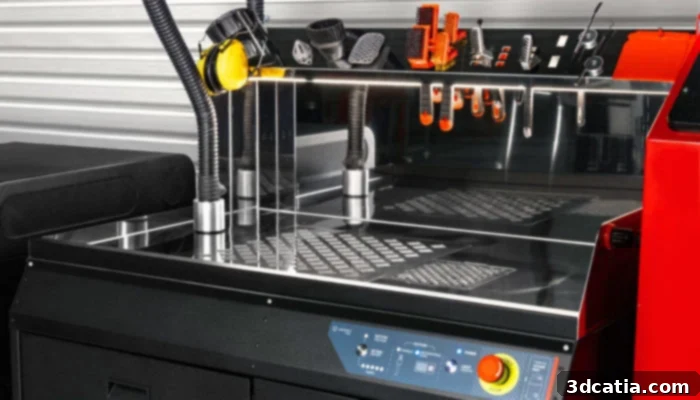
Close up of the Powder Handling Station, Photo Credit: Sinterit
At the very core of Sinterit’s development philosophy lies an unwavering commitment to exceptional customer experience. This principle guided the meticulous design of the PHS, ensuring it is not only functional and high-performing but also exceptionally user-friendly and ergonomically optimized for daily use. The station intelligently consolidates all critical processes – from print preparation and precise depowdering to thorough post-processing, efficient powder refresh, and intelligent recovery – into a single, intuitive workspace. This centralization dramatically enhances operational efficiency, allowing tasks to be completed more swiftly and with significantly less effort compared to traditional, often fragmented and labor-intensive workflows. The PHS worktop is intelligently equipped with a strategically placed suction hole, specifically engineered to accelerate the depowdering process, efficiently removing loose, unsintered powder from printed objects. Complementing this, a detachable two-meter long suction hose connects directly to the ATEX vacuum cleaner, drastically reducing the time required to clean the entire workspace, including tools and surrounding areas. This integrated cleaning system ensures a consistently tidy, safe, and productive environment, which is crucial for effectively managing fine polymer powders.
Furthermore, a key innovation of the PHS is its automated powder recovery system: during the crucial post-processing stage, any unsintered powder that is brushed off or falls from the printed parts is seamlessly and automatically transported into a sophisticated sieving module located directly beneath the worktop. This integrated module efficiently filters and prepares the recovered powder for future use, significantly reducing material waste and lowering overall operational costs associated with additive manufacturing. The design thoughtfulness extends to every detail of the PHS, from the optimized height of the worktop and the intuitive placement of controls to the robust construction, all engineered to minimize operator fatigue and maximize productivity throughout the workday. This comprehensive and thoughtful integration of features makes the PHS an indispensable tool for anyone engaged in professional benchtop SLS 3D printing, elevating both the quality of the final output and the overall operational efficiency and safety within any workshop or laboratory environment.
The integration of a dedicated powder handling system like the PHS is not merely about convenience; it fundamentally addresses critical aspects of safety and material economics inherent in SLS 3D printing. Handling fine polymer powders manually can pose significant health risks to operators, primarily through inhalation of airborne particles, and often contributes to a perpetually dusty and less productive work environment. The PHS’s enclosed design, coupled with its powerful ATEX-certified vacuum system, significantly minimizes airborne powder particles, safeguarding operator health and maintaining a cleaner, more professional facility. This adherence to stringent safety standards, particularly ATEX certification for explosive atmospheres, ensures compliance with robust industrial regulations, making the PHS suitable for a wider range of professional settings, including those with strict health and safety protocols.
Beyond safety, the automated powder recovery and sieving capabilities of the PHS offer substantial economic benefits. By efficiently refreshing and recycling unsintered powder, the PHS drastically reduces material consumption by allowing up to 100% of unused powder to be recovered and reused with fresh powder. This not only lowers the ongoing cost of materials, which can be a significant expenditure in additive manufacturing, but also contributes to more sustainable manufacturing practices by minimizing waste and environmental impact. The ability to precisely manage and reuse powder also ensures consistent material quality for subsequent print jobs, leading to more reliable and repeatable part production—a critical factor for industrial applications. This holistic approach to powder management underscores Sinterit’s dedication to providing solutions that are not only advanced in technology but also responsible in their environmental and health considerations, offering a truly comprehensive value proposition to its users.
Sinterit’s core expertise lies in Selective Laser Sintering (SLS), an additive manufacturing technology renowned for its exceptional capabilities and widespread adoption across numerous industries. SLS operates by using a high-power laser to selectively fuse small particles of polymer powder into a solid structure, layer by layer, within a heated build chamber. Unlike other popular 3D printing methods such as stereolithography (SLA), which cures liquid resins with UV light, or fused deposition modeling (FDM), which extrudes molten thermoplastic filaments, SLS offers distinct advantages. While SLS print times can sometimes be longer than those of FDM or SLA for certain geometries and part densities, its numerous benefits often outweigh this consideration, especially when producing complex, functional parts requiring superior mechanical properties. A primary and highly significant advantage of SLS printers is their ability to produce high-precision, geometrically complex, and movable parts *without the need for any support structures*. This is because the surrounding unsintered powder acts as a natural, self-supporting medium for the printed object, completely eliminating the tedious, time-consuming, and often damaging post-processing step of support removal common in FDM and SLA. This structural freedom allows for the creation of incredibly intricate designs, highly functional interlocking parts, and internal channels that would be impossible or extremely difficult and costly to achieve with other additive manufacturing technologies.
The applications of SLS technology are remarkably extensive and diverse, far surpassing the typical capabilities of SLA and FDM in terms of material properties, functional performance, and design complexity. SLS printed parts are well-known for their excellent mechanical properties, including high strength, superior durability, and near-isotropy, meaning their strength is consistent in all directions. This makes them ideally suited for a vast array of demanding uses, ranging from functional, movable prototypes that can undergo rigorous and realistic testing in environments such as wind tunnels or withstand other experimental stresses, to the direct production of robust final components in low to moderate volumes. Specific applications further highlight its unparalleled versatility across various sectors: SLS parts are frequently used for precise fit parts in complex mechanical assemblies, highly robust snap fits and durable hinges that can withstand repeated cycles, and the rapid creation of tooling components for injection molding or other manufacturing processes. In more specialized fields, SLS is invaluable for producing intricate patterns, cores, and molds for various casting and molding processes, significantly accelerating product development cycles and reducing lead times. Furthermore, SLS is a go-to technology for producing highly accurate product concept models that not only represent final product aesthetics but also replicate functional behavior. Its biocompatibility with certain materials makes it suitable for advanced medical and dental implants, custom prosthetics, and precision surgical guides, revolutionizing patient-specific solutions. Beyond industrial and medical applications, SLS technology also serves critical education needs, empowering both researchers and academics to teach students about advanced manufacturing processes, rapid prototyping, and material science, thereby fostering the next generation of engineers, designers, and innovators. The capability to print with a wide range of advanced materials, including various polyamides (nylons) and highly flexible thermoplastics like TPE, further expands its utility across almost every industry. Due to its extensive and diverse applications, coupled with Sinterit’s dedication to making it relatively affordable and accessible, SLS is perfectly suited to Sinterit’s ongoing endeavor to provide professional-grade benchtop 3D printing solutions that meet the rigorous demands of modern manufacturing and innovation.
The choice of materials available for SLS printing further underscores its immense versatility. Sinterit’s machines, for instance, are compatible with a broad range of high-performance sinterable polymers, including various grades of Nylon such as PA12 and PA11, as well as Thermoplastic Polyurethane (TPU) and Thermoplastic Elastomers (TPE). Nylon 12 (PA12) is particularly popular due to its excellent balance of mechanical properties, superior chemical resistance, and high thermal stability, making it an ideal choice for demanding engineering applications that require both strength and long-term durability. Nylon 11 (PA11), often derived from renewable resources, offers enhanced ductility, superior impact resistance, and flexibility, expanding its use in areas requiring more dynamic performance. Thermoplastic Polyurethane (TPU) and Thermoplastic Elastomers (TPE) enable the production of highly flexible, elastic, and durable parts, opening up a myriad of possibilities for applications such as seals, gaskets, custom grippers, flexible conduits, and wearable components. This broad material flexibility means that product developers and engineers are not limited to rigid prototypes but can create parts with specific mechanical properties that accurately mimic the characteristics of end-use products, facilitating more accurate testing and faster development cycles.
The inherent advantages of SLS technology – particularly the complete absence of support structures and the remarkable ability to pack multiple parts efficiently within the build chamber (a technique known as nesting) – ultimately lead to significantly higher production throughput compared to other additive manufacturing technologies. This high density of parts in a single build translates directly to a lower cost per part, making SLS an economically viable and highly attractive option for small-batch production, custom manufacturing, and on-demand parts fabrication. For industries that frequently require short runs of specialized components, such as automotive, aerospace, consumer electronics, or medical devices, SLS offers an agile and cost-effective manufacturing alternative to traditional methods like injection molding, which often involve prohibitively high tooling costs and lengthy lead times. Sinterit’s dedicated focus on developing and refining benchtop SLS solutions brings these powerful industrial advantages into a more accessible and compact format, effectively making high-quality additive manufacturing capabilities available to a broader market segment, from small design studios and agile R&D departments to advanced educational institutions and dynamic small-to-medium enterprises (SMEs). The introduction of the PHS significantly enhances this accessibility by comprehensively addressing and removing the historical bottleneck of post-processing, making the entire SLS workflow as professional, efficient, and seamless as the printing process itself.
The launch of Sinterit’s Powder Handling Station represents a pivotal moment in the ongoing evolution of benchtop SLS 3D printing. By meticulously addressing the critical aspects of post-processing and powder management, Sinterit has not only dramatically enhanced the cleanliness, safety, and efficiency of the SLS workflow but has also significantly reinforced its position as a leading innovator in democratizing advanced additive manufacturing. The PHS, as an integral and indispensable part of Sinterit’s comprehensive ecosystem, empowers users to achieve professional-grade results with greater ease, enhanced safety, and superior material efficiency. It signifies a crucial step towards making the entire SLS process more accessible, more sustainable, and more user-friendly for a wider audience of professionals, ranging from engineers and industrial designers to researchers and educators. This continuous commitment to innovation ensures that Sinterit’s solutions remain at the forefront of the industry, enabling users to push the boundaries of what’s truly possible with advanced 3D printing technology.
What are your thoughts on Sinterit’s new Powder Handling Station and its potential impact on the future of SLS 3D printing? We invite you to share your valuable insights and experiences with our community! Let us know in a comment below, or join the conversation on our Facebook and Twitter pages. To stay completely up-to-date with all the latest advancements, groundbreaking innovations, and essential news in the dynamic world of 3D printing, be sure to sign up for our free weekly Newsletter, delivering all the crucial updates straight to your inbox.