
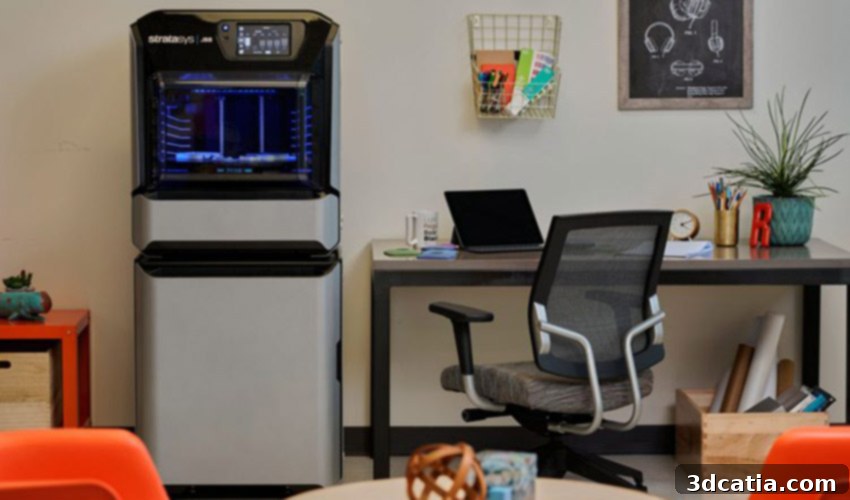
Stratasys J55: Unleashing Design Innovation with Accessible Multi-Color, Multi-Material PolyJet 3D Printing
The landscape of product design and rapid prototyping has just witnessed a significant evolution with the introduction of the Stratasys J55, the latest addition to their renowned PolyJet 3D printer lineup. This groundbreaking machine is poised to redefine accessibility for designers worldwide, offering a sophisticated yet compact solution tailored to bring intricate designs to life with unprecedented ease. Marking a strategic shift towards democratizing advanced additive manufacturing, the J55 consolidates Stratasys’s cutting-edge multi-material and multi-color capabilities into a footprint suitable for virtually any design studio, office, or educational environment. It boasts the remarkable ability to print with up to five different materials simultaneously, excluding the crucial support material, and can reproduce an astonishing palette of over 500,000 Pantone validated colors. This expansive color gamut, combined with its multi-material dexterity, empowers designers to create ultra-realistic prototypes that closely mimic the final product’s aesthetics and feel. Crucially, the J55 stands out for its exceptional affordability, being available at approximately one-third the price point of its industrial-grade PolyJet counterparts, such as the high-performance J850. Engineered with an innovative rotary table and a stationary print head, it offers a generous printing surface of up to 1,174 cm², ensuring ample space for complex models and multiple parts.
Material jetting technology, epitomized by PolyJet, has long been a cornerstone for designers and engineers aiming to swiftly produce highly visual and aesthetically precise prototypes. Its inherent advantages—particularly its unparalleled capacity for multi-color printing, the attainment of exquisitely smooth surfaces, and the exceptional resolution it delivers—make it an indispensable tool in the product development lifecycle. This technology facilitates rapid validation of concepts and ideas, drastically shortening iteration cycles and accelerating time-to-market. Historically, PolyJet machines represented a substantial investment, often requiring specialized installation, dedicated space, and highly skilled operators, limiting their adoption primarily to large enterprises and specialized service bureaus. Recognizing this barrier, Stratasys embarked on a mission to democratize the power of PolyJet technology. Following the successful paradigm set by their FDM technology with the accessible F120 series, the J55 emerges as a desktop-friendly model. It’s designed for ease of handling, requiring minimal training, and is significantly more affordable, thereby extending the transformative benefits of high-fidelity prototyping to a much broader audience of creative professionals and educational institutions.
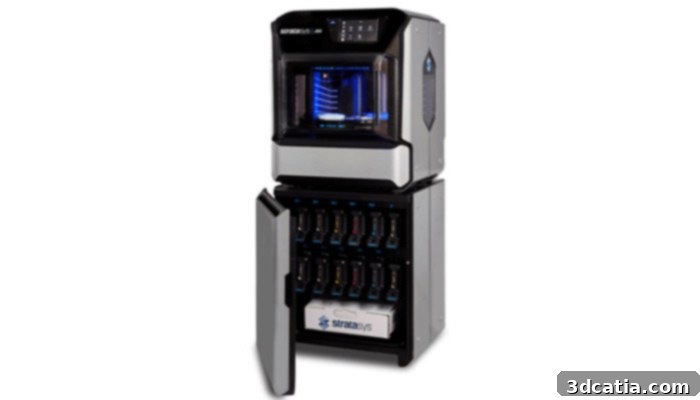
The Stratasys J55 is more compact and office-friendly.
Unpacking the Advanced Technical Specifications of the Stratasys J55
Delving into the J55’s technical attributes reveals a meticulously engineered system designed for optimal performance within a compact form factor. The machine itself measures a streamlined 651 x 661 x 1,551 mm (25.6 x 26 x 61 inches). A key differentiator from its larger industrial siblings is the absence of an external material cabinet. This clever design choice significantly reduces the overall operational footprint, making the 3D printer far more adaptable to space-constrained environments such as bustling design offices, boutique studios, or vibrant classrooms where every square inch counts. Beyond its physical dimensions, the J55 is engineered for seamless integration into everyday workspaces. According to Stratasys, it operates with remarkable quietness, generating noise levels comparable to that of a typical refrigerator. Furthermore, it is designed to be virtually odorless, a critical factor for maintaining a comfortable and productive indoor atmosphere. These characteristics make the J55 an ideal candidate for environments where industrial-grade noise and fumes would be disruptive. Omer Krieger, Executive Vice President of Products at Stratasys, passionately articulates the vision behind this innovation: “We developed this innovative 3D printer to truly transform the product development process for designers and engineers around the world. Not only is the J55 affordable for virtually any product design team, but the quality of the parts it 3D prints is exceptional. It’s also so simple that anyone can set it up and use it, and so quiet that you’ll forget it’s even running.” Krieger’s statement underscores the trifecta of value the J55 delivers: unparalleled accessibility, uncompromising print quality, and an effortless user experience, all designed to accelerate and enhance creative workflows.
Innovative Printing Architecture and Material Versatility
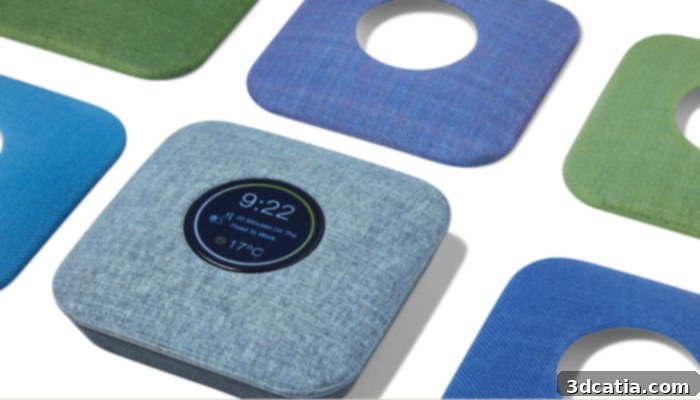
One of the most notable engineering feats within the J55 is the revolutionary integration of a rotating print table coupled with a fixed print head – a first-of-its-kind configuration for the Stratasys PolyJet range. This ingenious design significantly optimizes the printing process by allowing the print heads to remain stationary while the build platform rotates beneath them. This innovation translates directly into shorter, more efficient print paths, which in turn dramatically increases print speed without compromising precision. The result is superior final part quality, characterized by enhanced surface finish and dimensional accuracy, critical for high-fidelity prototyping. When it comes to materials, the J55 truly excels, offering unparalleled versatility. It can simultaneously print with up to five distinct photopolymer materials, excluding the soluble support material, opening up vast possibilities for complex, multi-functional prototypes. Furthermore, its ability to render over 500,000 Pantone validated colors, alongside the capability to create intricate textures and varying levels of transparency, means designers can produce prototypes that are not just visually identical to the final product, but also functionally and tactilely representative. This level of realism significantly reduces the need for costly and time-consuming post-processing steps like painting or assembly. The J55 is seamlessly integrated with GrabCAD Print software, a powerful and intuitive platform that streamlines the entire 3D printing workflow. Crucially, GrabCAD Print is capable of supporting advanced 3MF format files, which preserve color and texture data more effectively than traditional STL files. Additionally, it offers broad compatibility with industry-standard CAD files from leading software packages such as Solidworks, Siemens NX, and CATIA, ensuring a smooth transition from design to print for a vast array of professionals.

The 3D printer is equipped with a rotating platform, a key innovation for speed and quality.
Real-World Impact and Future of Design Prototyping
The impact of the Stratasys J55 is already being felt in the design community, with early adopters praising its transformative capabilities. Among them is the American industrial design and product development firm, Kinetic Vision, which put the J55 through its paces. Tony Guard, their esteemed Director of Innovation and Industrial Design, shared his profound insights: “There is no way to validate a 2D design without a realistic 3D model: it’s just not possible. When I saw what the machine could do, I was stunned. We can validate our products faster, with their shape, colors, finishes, design, everything! We can present our customers with tangible 3D printed models, representing the final product, faster than ever before. I would like the J55 to remain our secret strategic advantage, but I’m afraid that won’t be the case for long.” Guard’s testimonial highlights a universal truth in design: the critical need for tangible, high-fidelity prototypes to accurately assess form, fit, and aesthetic appeal. The J55’s ability to produce incredibly realistic models with precise color matching and diverse material properties empowers design teams like Kinetic Vision to accelerate their validation processes, significantly reduce design iterations, and present clients with physical representations that truly embody the final product, fostering quicker decisions and greater confidence. His candid remark about the J55 being a “secret strategic advantage” speaks volumes about its competitive edge in a rapidly evolving market, suggesting that its advanced capabilities will quickly become a benchmark for accessible, professional-grade prototyping. For those eager to leverage this revolutionary technology, the J55 is already available for order, with initial deliveries having commenced in July 2020. Further comprehensive information regarding the Stratasys J55 and its specifications can be explored HERE.
What are your thoughts on the game-changing Stratasys J55 PolyJet 3D printer? Share your insights and expectations in the comments section below, or join the conversation on our Facebook and Twitter pages!