

Navigating Intellectual Property Rights in the World of 3D Printing: A Comprehensive Guide
The rapid advancements in 3D printing technology have revolutionized manufacturing, design, and personal creativity, making it easier than ever for individuals to bring their digital designs into the physical world. However, this accessibility also introduces a complex and often confusing landscape concerning Intellectual Property (IP) rights. For designers keen to share or sell their 3D-printed models, and for consumers looking to utilize them, understanding these rights is paramount. This article aims to demystify the intricacies of IP in 3D printing, exploring potential issues for designers, consumers, and industry professionals, to help you better understand your rights and responsibilities in this evolving domain. Whether you’re a hobbyist or a professional, safeguarding your creations and respecting others’ IP is crucial for a thriving and ethical 3D printing community. We will delve into specific challenges, examine various licensing models, and discuss dispute resolution mechanisms, offering a holistic view of IP in the additive manufacturing space.
The Digital Marketplace for 3D Models: Opportunities and Challenges
The internet hosts a plethora of platforms dedicated to sharing and distributing 3D model files, serving a diverse community ranging from individual enthusiasts to large commercial entities. These platforms vary widely, from free-only repositories like Thingiverse, where creators generously share their designs, to marketplaces such as Shapeways, where designers can sell their models. Additionally, services like 3DHubs and Freelabster facilitate the printing of designs, whether they are your own or sourced from others. While these platforms foster innovation, collaboration, and democratize access to design, they also open the door to a variety of intellectual property challenges. The ease with which digital files can be copied, downloaded, and reproduced can lead to unauthorized use, making it crucial for all parties to understand the legal frameworks and ethical considerations in place.
Two primary concerns frequently arise for designers operating in this digital ecosystem: Firstly, a design might be directly copied and resold without any alterations, bypassing the original creator entirely. This blatant infringement deprives the original designer of due credit, potential earnings, and control over their work’s distribution. Secondly, individuals could potentially download original designs, make minor or even significant modifications, and then present the altered work as their own original creation, claiming copyright. This practice, often termed ‘remixing’ or ‘derivative works,’ blurs the lines of ownership and can lead to disputes over attribution and commercial rights. Both scenarios underscore the critical need for robust protection mechanisms and clear guidelines for usage, which we will examine in detail throughout this guide.
Understanding Creative Commons Licenses in 3D Printing
At the heart of many online sharing communities, including those for 3D models, are Creative Commons (CC) licenses. These licenses provide a standardized, publicly available way for creators to grant permission for others to use their work under specific conditions, without requiring direct negotiation or complex legal agreements. They are a flexible alternative to traditional “all rights reserved” copyright, empowering creators to choose how their work can be used, modified, and distributed globally. For 3D designers, understanding Creative Commons is fundamental to protecting their designs while also fostering a spirit of open collaboration and community sharing. There are six main types of Creative Commons licenses, built upon two core categories: commercial use and modification.
The first key distinction is whether commercial use of the work is permitted. Some licenses expressly allow others to profit from the design (e.g., by selling 3D prints of it), while others strictly prohibit it. The second distinction concerns modifications: some licenses allow users to adapt, remix, or build upon the original work (often requiring that derivative works carry the same license), while others require the work to remain unchanged in its original form. By combining these categories with the mandatory “Attribution” (BY) clause – which always requires users to credit the original creator – Creative Commons offers a spectrum of options. These range from highly permissive licenses that encourage wide dissemination and adaptation (e.g., CC BY), to more restrictive ones that prioritize the creator’s control over commercial exploitation and modifications (e.g., CC BY-NC-ND). Designers must carefully select the license that aligns with their intentions for their 3D models, balancing the desire for broad reach and community engagement with the need to protect their creative investment and potential revenue streams.
Protecting Your Creations: Guidance for 3D Designers
For 3D designers, the choice of a Creative Commons license is a crucial step in defining how their intellectual property will be used once it’s uploaded to a platform. Each license carries distinct implications for the modification, distribution, and commercial exploitation of the model. For instance, a designer might opt for a license that permits users to modify, remix, and redistribute their model, provided that the original creator is explicitly credited. This encourages derivative works and community engagement, expanding the reach of the original design and potentially fostering new innovations based on it. Such an approach can be beneficial for designers who prioritize community contributions and visibility over strict commercial control.
Conversely, another designer might wish to allow commercial use of their model, enabling others to print and sell it, perhaps generating revenue for the original creator through licensing agreements or simply promoting their work globally. The inverse, a “Non-Commercial” (NC) clause, would prevent any commercial exploitation without direct permission. Similarly, a “No Derivatives” (ND) clause would disallow modifications, ensuring the integrity of the original design. The key is for designers to clearly understand their own objectives and values: do they want to encourage modifications? Do they want to allow commercial profit from their work, or restrict it? Once these fundamental questions are answered, selecting the appropriate Creative Commons license becomes a strategic decision. It’s not merely a technicality but a critical part of a designer’s IP strategy, ensuring that their creative output is respected and used in accordance with their wishes, while also clearly communicating these terms to potential users.
The Complexities of Fan Art and Copyright Infringement
The realm of fan art, particularly in 3D printing, exemplifies the complexities and ambiguities of intellectual property law. Consider the compelling case of Steve Solomon, a retired artist passionate about 3D printing, whose work often falls into the category of “fan-art.” Solomon meticulously creates models based on popular fictional characters but explicitly states that he does not sell them, viewing his work as a labor of love and a creative outlet rather than a commercial venture. His situation highlights a significant grey area where artistic expression meets established copyright law.
Steve Solomon has created models such as these for the characters of The Flintstones
As Solomon himself articulates, “Fan-art in itself is not a clearly defined area.” Despite his non-commercial intent, he has experienced DMCA (Digital Millennium Copyright Act) takedown notifications, which he promptly complied with, demonstrating his respect for the rights of original creators. He emphasizes his commitment to not interfering with someone’s intellectual property but also believes there should be a space for non-monetized 3D printed fan art. This sentiment resonates with many creators who engage in fan art purely for artistic expression and community sharing, without seeking financial gain. However, legal precedent often holds that creating derivative works based on copyrighted characters, even without selling them, can still constitute copyright infringement. Major rights holders, protective of their valuable brands and characters (such as Charlie Brown or Barney Rubble from ‘The Flintstones’), frequently issue takedown requests even for non-commercial fan art. This demonstrates the strict interpretation of copyright law, which often prioritizes the rights holder’s control over creative works, regardless of the fan artist’s intentions or profit motive. What Steve is doing is harmless fun, but it technically still constitutes breaking copyright law even if he doesn’t sell his creations, simply by reproducing them.
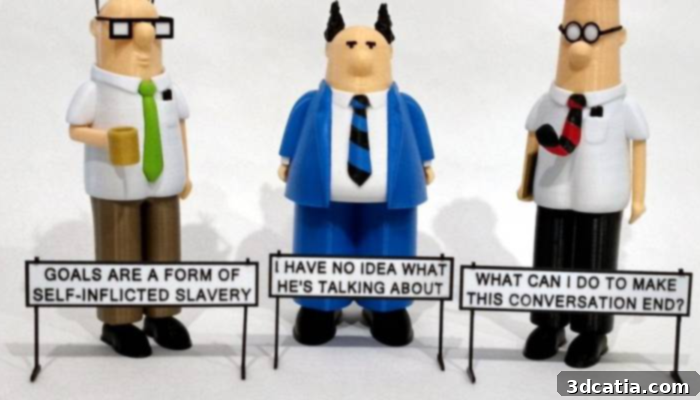
Another example of Steve Solomon’s work
Navigating IP as a Consumer of 3D Models
For consumers, the concern often revolves around confidently downloading and using 3D models without inadvertently infringing on intellectual property rights. Understanding consumer responsibilities is just as vital as designer obligations. Christopher J. Higgins, Senior Associate at Orrick and an expert in 3D printing rights, provides valuable insights on this front. He notes that “Reputable websites include files that are subject to Creative Commons licenses, which makes them free to use subject to certain conditions.” Provided these conditions are meticulously met – meaning the consumer reads and adheres to the specific terms of the license – consumers typically don’t need to worry about potential infringement. When purchasing a design file from a legitimate source, and assuming the website has legally acquired and distributed the file, the consumer generally gains the rights to download and utilize that file for its intended purpose, as defined by the purchase agreement or associated license.
This means that when you download files, whether free or paid, you are generally safe as long as you adhere to the stipulated license. Crucially, if a license restricts commercial use or modification, you are legally bound by those terms. For example, using a non-commercial model for profit, or significantly altering a “No Derivatives” model and then distributing it, would constitute infringement. Therefore, designers bear the responsibility of clearly displaying the Creative Commons license or copyright notice associated with their work, making it easily understandable. Higgins emphasizes this point, stating, “A simple way to prevent some cases of potential infringement is to clearly label the file with a copyright notice and potentially register the file with the copyright office.” Consumers, in turn, must exercise due diligence by carefully reviewing these licenses before downloading, printing, modifying, or distributing any 3D model. Ignorance of the license terms is rarely a valid defense in cases of infringement.
IP Disputes in the Professional Sphere: The Shapeways Case Study
The professional landscape of 3D printing, particularly on large-scale platforms, brings IP concerns into sharper focus, often involving complex legal and operational challenges. We delved into this with Michael Weinberg, General Counsel at Shapeways, a prominent 3D printing service provider that has grown significantly since its beginnings as a Dutch startup to an international company with offices in New York. Shapeways, like many large-scale platforms that host user-generated content, frequently deals with copyright disputes and infringement claims. Weinberg revealed a staggering statistic: Shapeways vendors collectively receive a substantial number of DMCA (Digital Millennium Copyright Act) takedown requests—between 1000 and 2000 annually—highlighting the ongoing and pervasive challenge of copyright infringement in the digital fabrication space. This volume underscores the constant vigilance required by platforms and designers alike.
Addressing Copyright Infringement: Shapeways’ DMCA Process
When a designer discovers their original work being sold or displayed without permission on a platform like Shapeways, the Digital Millennium Copyright Act (DMCA) provides a structured legal framework for redress. Weinberg explained Shapeways’ specific procedure for handling such claims, which is designed to be compliant with federal law. The process begins with the rights holder (the complainant) sending a formal notice that must contain five key elements, as explicitly stipulated by the DMCA. This includes the complainant’s name and contact information, the URL of the allegedly infringing model, and a declaration of good faith belief that the product infringes on their intellectual property. Crucially, this declaration must be made “under penalty of perjury,” underscoring the legal weight and seriousness of the claim and deterring frivolous or false accusations.
How the DMCA Takedown System Works on Platforms
Shapeways operates under what is known as the “Safe Harbor” provisions of the DMCA. This framework is crucial for online service providers, as it protects them from liability for copyright infringement committed by their users, provided they establish and follow a clear, accessible procedure for handling infringement claims. According to Shapeways’ Terms of Service, users implicitly promise they own the rights to any image or model they upload to the platform. The platform initially assumes this to be true and acts in good faith. However, upon receiving a valid DMCA takedown request—a formal email from a rights holder asserting infringement and swearing to its truthfulness under penalty of perjury—Shapeways acts swiftly. If the complainant is prepared to legally stand by their claim, the model in question is promptly taken down from the platform. The store owner who uploaded the model is then immediately notified of the DMCA takedown request, providing them an opportunity to respond.
The store owner has options: they can accept the takedown and remove the model, or they can challenge it by submitting a counter-notice. This counter-notice also requires a declaration under penalty of perjury, asserting their good faith belief that they are not infringing copyright. Shapeways then forwards this counter-notice to the original complainer. If the original complainer does not initiate legal action within ten to fourteen business days (as specified by the DMCA), the model will be reinstated on the platform. If they choose to pursue the matter further, they must then take it to court. Shapeways, in this scenario, explicitly states that it does not evaluate the legal merits or strength of either party’s case; its role is strictly to facilitate the interaction between the two parties and comply with legal mandates, acting as a neutral intermediary rather than a judge or legal arbiter.
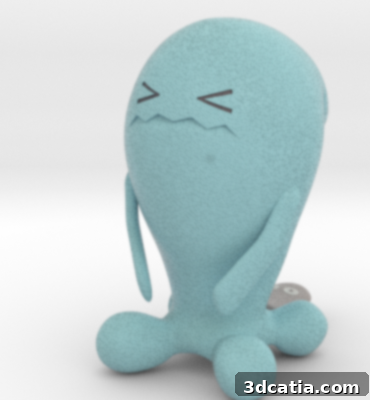
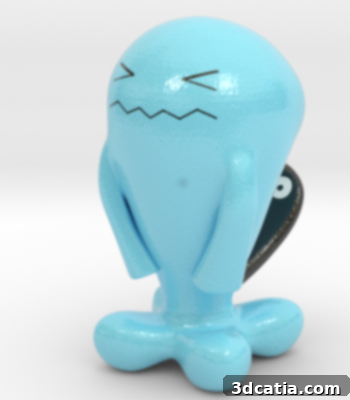
Left: Pokemon’s official “Wobbuffet” model, costing €125. Right: A fan-made version, costing €24. This comparison highlights the potential for market disruption and pricing differences between official and unofficial models, illustrating the direct impact of IP issues on commercial value and consumer choice.
Implications for Consumers and Small Designers
Shapeways’ system, while legally sound under DMCA’s Safe Harbor provisions, means the platform itself largely remains insulated from legal fault and direct involvement in content disputes. As Michael Weinberg confirmed, Shapeways does not intervene in the merits of disputes, even stating, “Never. If parties are still in conflict after this interaction, they can take their dispute to court. We then comply with the outcome of the court.” This contrasts sharply with the more active mediation systems seen on platforms like eBay, where the platform might play a more direct role in dispute resolution, often favoring the consumer. For consumers, this means that while the platform ensures compliance with legal procedures, the ultimate resolution of a contested IP claim falls to the involved parties.
This system, however, poses a significant challenge for amateur designers or smaller professionals who lack substantial financial resources. While a designer can successfully initiate a takedown notice if their original design is found on Shapeways, the situation escalates considerably if the alleged infringer submits a counter-notice, claiming they legitimately possess the rights or that the claim is invalid. At this critical juncture, the original designer’s only recourse for permanent removal of the model and legal validation of their rights is to pursue legal action in court. The harsh reality is that not all creators have the financial capacity or the willingness to invest the considerable time, effort, and money required for litigation, especially for a single design or a relatively small infringement. This often creates a legal stalemate, where the party with deeper pockets has a distinct advantage, effectively making the pursuit of justice and the enforcement of IP rights difficult for independent creators and small businesses. It highlights a systemic imbalance where access to justice is often dictated by financial capability.
Conclusion: The Future of IP Protection in 3D Printing
The current intellectual property landscape in 3D printing frequently presents a legal stalemate that disproportionately favors large rights holders and entities with extensive legal budgets. While Michael Weinberg of Shapeways noted that the platform sometimes “pushes back on behalf of the shop owners” when large rights holders file DMCA requests over trademarks, this intervention is often limited. The system’s fundamental structure, built on the premise of self-policing and court-based resolution for contested claims, still leans heavily towards those with greater financial and legal leverage. This disparity underscores a critical need for more accessible and equitable protection mechanisms for individual creators and smaller businesses operating in the 3D printing space.
Despite these systemic challenges, innovative solutions are steadily emerging. Some startups are actively developing sophisticated digital watermarks designed to be embedded directly within 3D models. Unlike external tags or metadata, these watermarks are integrated into the fine layers of the model’s geometry, making them highly resistant to editing, removal, or circumvention by unauthorized users or “bootleggers.” Such advancements promise a more robust, intrinsic layer of protection against unauthorized reproduction and modification. As these and other digital forensics technologies mature and become more widely adopted, they could significantly empower designers to protect their intellectual property more effectively and prove ownership. For the time being, designers must remain exceptionally vigilant: carefully select and clearly communicate their licenses, thoroughly document their original designs with timestamps and version control, and be prepared to take appropriate action—including formal DMCA notices—if they discover their models being modified, sold, or used without explicit permission. Staying informed about evolving legal frameworks, best practices, and technological solutions will be paramount for navigating the dynamic and complex world of 3D printing IP successfully.
Did this article on intellectual property in 3D printing help clarify your understanding? We welcome your thoughts and experiences! Let us know in a comment below or connect with us on our Facebook and Twitter pages. For the latest news, expert insights, and updates in the ever-evolving 3D printing industry, don’t forget to sign up for our free weekly Newsletter, delivered straight to your inbox!