
Revolutionizing Nuclear Power: AI-Powered Inspection for 3D-Printed Components and Fuels
For many years, the Oak Ridge National Laboratory (ORNL) in the United States has stood as a vanguard in the realm of additive manufacturing, particularly as it applies to the critically important field of nuclear energy. Their groundbreaking contributions have consistently pushed the boundaries of what’s possible, from designing innovative components to pioneering new inspection methods. A significant milestone was achieved in 2020 when ORNL captured international attention for developing the first prototype of a 3D-printed nuclear reactor. This achievement showcased the immense potential of additive manufacturing to create complex, high-performance parts vital for advanced nuclear systems. Since then, their efforts have broadened to include the fabrication of various nuclear reactor components using advanced 3D printing techniques. Recognizing the paramount importance of quality assurance in such sensitive applications, ORNL researchers further innovated in 2022 by introducing a sophisticated deep-learning framework. This advanced artificial intelligence (AI) system is designed to inspect additively manufactured nuclear parts with unprecedented speed and accuracy. In a pivotal collaboration with the Idaho National Laboratory (INL), these two leading research institutions have significantly accelerated the inspection process for 3D-printed nuclear components, and their ambitious efforts are now expanding to encompass the rigorous inspection of nuclear fuels themselves, paving the way for a safer, more efficient nuclear future.
At the heart of this transformative research lies the deep-learning framework, an ingenious software algorithm developed by ORNL and aptly named Simurgh. This powerful tool is engineered to meticulously check for structural flaws and anomalies within additively manufactured parts. Its ability to accurately identify imperfections is crucial for validating the integrity of materials destined for the next generation of nuclear reactors. Traditionally, the verification of new materials and manufacturing methods for nuclear reactor components is an arduous and time-consuming process, often spanning decades due to the stringent safety requirements and the complexity of nuclear environments. The collaboration between ORNL and INL, powered by Simurgh, is poised to dramatically accelerate this validation process, significantly reducing the timeline for integrating cutting-edge materials and designs into operational nuclear facilities. By streamlining material qualification, Simurgh not only enhances safety but also reduces development costs and speeds up the deployment of advanced reactor technologies.
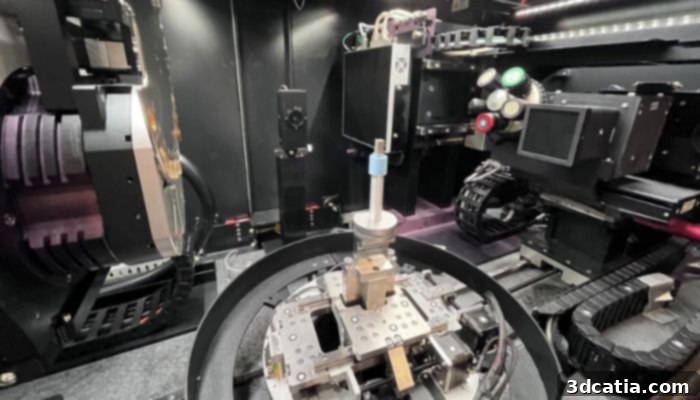
A 3D-printed part is scanned and analyzed using the ORNL software. (Photo credits: ORNL)
Simurgh leverages the power of X-ray computed tomography (CT), a non-destructive testing technique analogous to a medical CT scan, to meticulously examine the internal quality of 3D-printed objects without causing any damage. By compiling a series of precise X-ray images taken from multiple angles, Simurgh is able to construct a detailed three-dimensional view of a 3D-printed part’s internal structure. This comprehensive internal mapping is critical for identifying subtle weaknesses, voids, cracks, or printing errors that would be impossible to detect through surface inspection alone. In conventional X-ray CT scanning, the process of acquiring sufficient data to create a high-resolution internal image is inherently time-consuming and expensive. Each part must be scanned from numerous angles, often requiring extensive repositioning and repeated exposures, making it a bottleneck in the development and qualification of advanced materials for demanding applications like nuclear energy.
Simurgh, however, represents a revolutionary leap forward, significantly ameliorating this laborious process. Instead of relying solely on a large number of physical CT scans, it employs a sophisticated approach that combines realistic training data with a deep neural network. This network is “taught” to understand the intricacies of internal structures and potential defects. Furthermore, Simurgh integrates physics-based simulations directly with computer-aided design (CAD) models. This innovative fusion allows the algorithm to reconstruct highly accurate internal images using significantly fewer CT scans than traditional methods require. By intelligently filling in data gaps and optimizing the reconstruction process, Simurgh can complete scans for dense materials up to twelve times faster. More impressively, this accelerated process doesn’t compromise accuracy; it boasts a fourfold greater ability to detect critical defects, ensuring higher quality and reliability for nuclear components. This means that parts can be moved through the inspection pipeline much faster, accelerating R&D cycles and material qualification while simultaneously improving the safety and performance of the final products.
Developing and Expanding the Advanced Inspection Algorithm
The advanced Simurgh technology was initially conceived and developed under the auspices of the Department of Energy’s (DOE) Advanced Materials & Manufacturing Technologies Office (AMMTO). Its initial application was focused on enhancing the inspection of 3D-printed metal parts, a crucial area given the increasing use of additive manufacturing in various industrial sectors. However, the versatility and proven efficacy of Simurgh quickly led to its expansion into other critical areas. The algorithm is now being actively developed and applied under the Advanced Materials and Manufacturing Technologies (AMMT) program, specifically within the DOE’s Office of Nuclear Energy. This strategic expansion underscores the profound impact Simurgh is expected to have on nuclear technology development. By making this cutting-edge material inspection tool available and adaptable across multiple DOE offices and programs, both ORNL and INL are reaping substantial benefits. This collaborative approach fosters a synergistic environment, opening up a plethora of opportunities for new and diverse applications of the technology, ultimately accelerating innovation across the board.
Ryan Dehoff, who serves as the director of DOE’s Manufacturing Demonstration Facility (MDF) at ORNL, eloquently highlighted the rigorous standards and inherent challenges of the nuclear sector. He stated, “Nuclear is a high-cost environment with extremely high standards for precision, materials and safety. The fact we’re using this tool suite in the nuclear sphere speaks to the quality and reliability of the technology.” His remarks emphasize that Simurgh’s adoption in nuclear applications is a testament to its exceptional quality, accuracy, and robust reliability, demonstrating its capability to meet and exceed the industry’s demanding requirements. The inherent complexities of nuclear component fabrication, often involving novel alloys and intricate designs produced through additive manufacturing, necessitate inspection technologies that are both highly efficient and impeccably precise. Simurgh directly addresses these needs, proving its value in an environment where compromise is not an option.
The Idaho National Laboratory (INL) recognized the transformative potential of Simurgh when confronted with a significant logistical challenge in their research. The lab was engaged in critical work attempting to correlate specific manufacturing defects in 3D-printed components with their originating printing parameters. To accurately identify these patterns and establish robust links, a substantial dataset was required, necessitating the scanning of more than 30 individual samples. The primary impediment to this vital research was the sheer time commitment: each scan using conventional methods consumed approximately 30 hours. Faced with such a bottleneck, Bill Chuirazzi, an instrument scientist and the distinguished leader of INL’s Diffraction and Imaging group, proactively sought expertise from ORNL before proceeding with their extensive data collection effort. This crucial consultation led him to license ORNL’s groundbreaking Simurgh algorithm, offering a viable path to collect the necessary data with vastly improved efficiency. Chuirazzi confirmed the dramatic improvement, stating, “Including prep, it now takes about 15% of the time it did to scan something with our setup. We can do three scans in the amount of time it took us to complete one.” This remarkable acceleration not only saved thousands of hours but also significantly expedited INL’s research progress, demonstrating Simurgh’s immediate, tangible benefits.
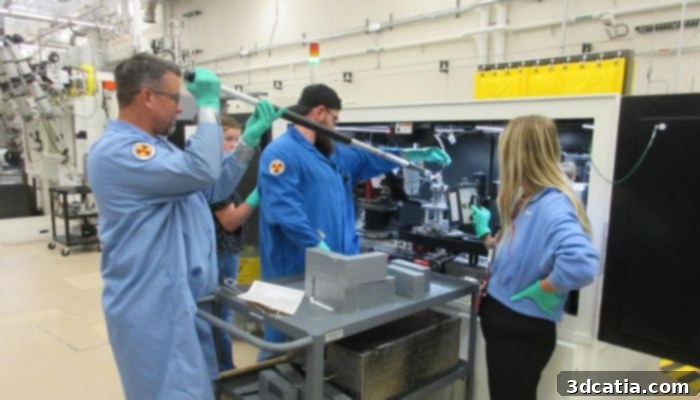
INL technicians (Photo Credits: Bill Chuirazzi/INL, U.S. Dept. of Energy)
The utility of Simurgh, however, extended even further beyond its initial application. Chuirazzi, with keen foresight, quickly recognized that this innovative technology held immense potential for another vital federal program focusing on nuclear fuels: INL’s Irradiated Materials Characterization Lab. This specialized facility is dedicated to the intricate task of scanning highly radioactive nuclear fuels and materials, a process fraught with unique challenges. Every movement of these intensely radioactive substances within the lab necessitates extreme precautions and robust shielding, ensuring the safety of personnel. Consequently, researchers often face considerable delays in examining materials recently removed from a nuclear reactor, as they must wait for the radioactivity to dissipate to levels deemed safe for lab technicians. Moreover, the accumulated radiation dose incurred during repeated, prolonged scans can severely impact the detector components, progressively limiting their operational lifespan and degrading image accuracy over time. Simurgh, by permitting significantly shorter scan times, addresses these critical issues head-on. Reduced scan duration translates directly into less radiation exposure per scan for both personnel and equipment, minimizing waiting periods and accelerating data acquisition. Crucially, these faster scans do not compromise data quality; instead, Simurgh delivers higher-quality data and enables faster feedback loops, which are essential for the rapid development and qualification of advanced nuclear fuels.
Accelerating Nuclear Reactor Development for a Safer Future
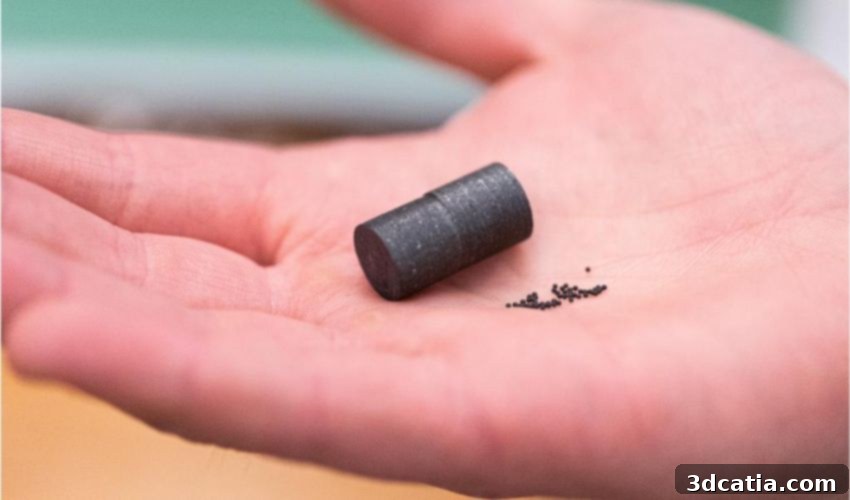
According to a recent press release from ORNL, the Simurgh technology possesses immense potential to revolutionize the development and characterization of both structural materials and fuels for a new generation of advanced or high-temperature gas reactors, molten salt reactors, and small modular reactors (SMRs). These advanced reactor designs are crucial for meeting future energy demands efficiently and sustainably. One of the most promising and extensively researched fuels for these novel reactor designs is the Tri-structural ISOtropic particle fuel, commonly known as TRISO. These innovative fuel particles are characterized by a tiny fuel kernel, typically uranium, meticulously encapsulated within multiple layers of carbon- and ceramic-based materials. This unique layered structure provides exceptional containment of fission products, enhancing safety and performance under extreme operating conditions.
The INL team is currently focused on an exciting new application: training the Simurgh algorithm to inspect the ceramic casings of irradiated nuclear fuel, such as TRISO particles. By applying the Simurgh program to these critical components, researchers can accurately detect various irradiation-induced phenomena. These include swelling of the fuel or cladding, the formation of microscopic cracks, and any potential separation of the outer protective layers—all vital indicators of material degradation that could impact reactor safety and efficiency. Looking ahead, this powerful inspection capability can be further extended to test other irradiated metal components, such as the 3D-printed fuel brackets created by ORNL’s Manufacturing Demonstration Facility. The ability to quickly and accurately assess the structural integrity of these components after exposure to high radiation environments is paramount for qualifying new designs and materials, ensuring their reliability and safe operation throughout a reactor’s lifespan.
The strategic partnership between INL and ORNL, driven by the innovative Simurgh algorithm, is unequivocally set to accelerate the development of cutting-edge nuclear fuel designs and significantly expedite the material qualification process for 3D-printed nuclear components. This synergy between advanced manufacturing and AI-powered inspection is a game-changer for the nuclear industry. As Bill Chuirazzi eloquently summarized, “If we use this algorithm to reduce the scan time for radioactive fuels by 90%, it will increase worker safety and the rate we can evaluate new materials.” This dramatic reduction in scan time translates directly into enhanced safety protocols, minimizing human exposure to radioactive materials, and substantially speeding up the iterative design and testing cycles for new materials. He further elaborated on the long-term vision: “Down the road, it enables us to expedite the life cycle of new nuclear ideas from conception to implementation in the power grid.” This partnership is not just about incremental improvements; it’s about fundamentally transforming the pace and safety of nuclear innovation, bringing advanced nuclear power closer to widespread deployment. To delve deeper into the specifics of this groundbreaking collaboration and its implications, the full press release from ORNL is available for review HERE.
What are your thoughts on the groundbreaking partnership between ORNL and INL, and its potential to accelerate nuclear energy development through AI-enhanced additive manufacturing inspection? We invite you to share your insights in the comments section below, or engage with us on our social media platforms: LinkedIn, Facebook, and Twitter pages! Don’t miss out on the latest advancements in 3D printing; remember to sign up for our free weekly Newsletter here, delivering the most current 3D printing news directly to your inbox. You can also explore all our informative videos and content on our dedicated YouTube channel.
*Cover Photo: TRISO nuclear fuel resembles the tiny grains seen here, highlighting its unique particle structure. Photo Credit: Mark Richardson/INL, U.S. Dept. of Energy