
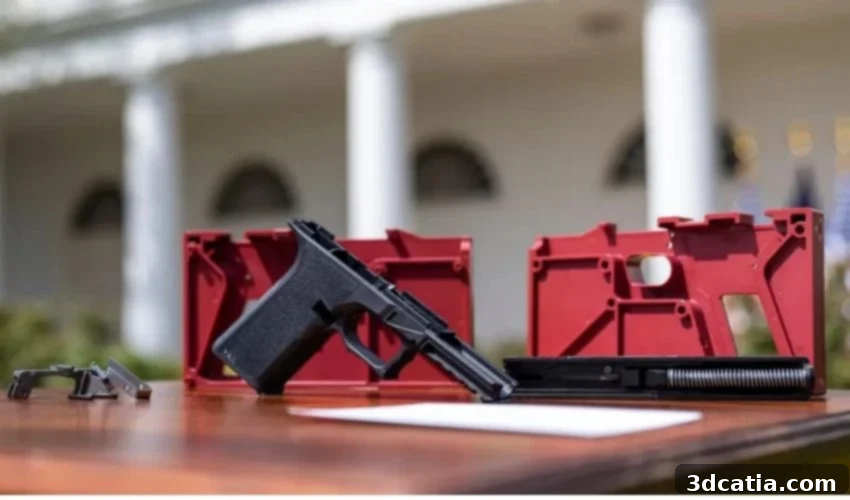
New York’s Bold Move: Mandating Background Checks for 3D Printer Purchases to Combat Ghost Guns
In a significant legislative development that has garnered national and international attention, New York lawmakers have introduced a groundbreaking bill aimed at curbing the proliferation of “ghost guns.” This proposed legislation, emerging after a series of high-profile busts across New York City that uncovered numerous caches of untraceable firearms, seeks to impose criminal background checks on individuals purchasing consumer desktop 3D printers. These ghost guns, often fabricated from easily accessible weapon components produced by 3D printers, pose a formidable challenge to law enforcement agencies due to their lack of serial numbers and, consequently, their untraceable nature. While the bill currently awaits discussion within the state senate, its very proposal underscores a burgeoning international and national trend. Governments worldwide are increasingly looking for proactive measures to protect the public from the escalating threat posed by these clandestine firearms, making New York’s move a potential harbinger of future regulations.
Understanding New York’s Proposed Legislation: Bill AB A8132
The bill, officially designated as AB A8132, introduces a stringent requirement: a compulsory criminal background check for anyone intending to acquire a 3D printer explicitly defined as ‘capable of fabricating a firearm.’ Furthermore, the legislation strictly prohibits the sale of such printers to individuals who possess a criminal background that would disqualify them from legally owning traditional firearms. While the specifics regarding particular makes or models of 3D printers that would fall under this purview are yet to be delineated, the bill adopts a broad definition, characterizing a 3D printer as a “device capable of producing a three-dimensional object from a digital model.” This expansive definition effectively categorizes a wide range of commercially available 3D printers under the same regulatory umbrella for the time being, prompting discussions about its potential impact on hobbyists, educators, and various industries utilizing additive manufacturing.
This move signifies a proactive approach by New York lawmakers to address a rapidly evolving technological challenge. The legislative intent is clear: to create a significant barrier to entry for individuals who might exploit readily available 3D printing technology to circumvent existing gun control laws. By focusing on the initial purchase of the hardware itself, the state aims to intervene upstream in the supply chain of untraceable firearms, rather than solely reacting to their discovery post-fabrication. The implications of such a broad definition could be far-reaching, potentially requiring a re-evaluation of how consumer-grade 3D printers are marketed, sold, and regulated across the state. This legislative step also highlights the complex interplay between technological innovation and public safety, pushing the boundaries of traditional firearm regulation into the digital and manufacturing realms.
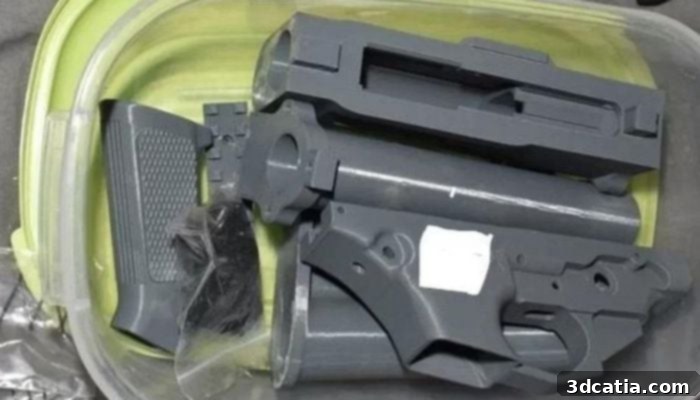
A box of 3D printed weapon components found by the Met Police in a similar raid in 2022 in the UK. (Photo credits: Metropolitan Police)
The Escalating “Ghost Gun Controversy” and Public Safety Concerns
The proposal for AB A8132, championed by New York State Representative Jenifer Rajkumar, gains significant urgency and context in the aftermath of a disturbing discovery: a cache of 3D printed firearms found in a New York daycare facility. This incident immediately ignited profound safety concerns, particularly regarding the vulnerability of young children and the troubling ease with which minors might gain access to digital resources for 3D printed weapons online. The alarming statistics further underscore the gravity of the situation. Over the past two years alone, the New York Police Department has reported a staggering 60% increase in the number of seized ghost guns, demonstrating a clear upward trend in their illicit presence within communities. Complementing this local data, a comprehensive nationwide report from the Bureau of Alcohol, Tobacco, Firearms and Explosives (ATF) revealed that law enforcement officials recovered an astounding 20,000 ghost guns during various criminal investigations across the United States, cementing the issue as a national crisis.
This dramatic rise in ghost gun seizures reflects a disturbing trend where individuals prohibited from purchasing traditional firearms are turning to readily available 3D printing technology to bypass gun control measures. The ability to manufacture untraceable weapons at home, often with minimal technical skill and materials, presents a significant loophole in existing legislation designed to keep firearms out of the hands of dangerous individuals. The inherent anonymity of these weapons, lacking serial numbers and often made from non-metallic components that can evade conventional metal detectors, poses severe challenges for law enforcement in tracking their origins and holding perpetrators accountable. The controversy extends beyond mere legality; it delves into fundamental questions of public safety, the responsible use of technology, and the urgent need for legislative frameworks that can adapt to rapid technological advancements to protect citizens.
A Growing International and National Push Against Untraceable Firearms
With the issue of 3D printed ghost guns now firmly entrenched in the spotlight of lawmakers, media outlets, and public discourse, it is highly probable that New York’s bill is just one of many anticipated legislative attempts to curb access to these untraceable weapons. The concern is not confined to state lines; it’s a global phenomenon. Internationally, countries like the UK and Australia have also confronted the emergence of 3D printed firearms, leading to police raids and calls for stricter regulations. These international examples highlight a shared understanding that the digital dissemination of weapon blueprints transcends borders, necessitating a coordinated global response or at least consistent national strategies.
Within the United States, proactive legal efforts are already underway in no fewer than 13 different states, including New York, demonstrating a broad, bipartisan recognition of the threat. These varied state-level initiatives encompass a spectrum of regulatory approaches. Some states are pushing for mandatory serial numbers on all 3D printed weapons, a measure designed to restore traceability and accountability. Others are exploring requirements for background checks on the component parts used to assemble these firearms, aiming to control access to the raw materials necessary for their creation. Yet another legislative angle involves compelling individuals to report all 3D printed firearms to official authorities, ensuring a comprehensive registry and oversight. These diverse approaches reflect the complex nature of the problem, where different jurisdictions are experimenting with various strategies to find the most effective means of integrating modern additive manufacturing capabilities into existing firearm regulations, all with the overarching goal of enhancing public safety.
Law Enforcement’s Stance and the Future of Gun Control
As debates surrounding the New York bill and similar legislative efforts continue through the intricate legislative process, the unwavering stance from law enforcement on the ground is unequivocally clear. NYPD Commissioner Edward Caban, speaking at a press conference following the recent seizure of ghost guns from the New York daycare, articulated this sentiment sharply: “To those who think printing 3D guns is the way of the future: you are wrong.” This forceful statement encapsulates the determination of police forces to confront and dismantle the illicit trade and use of 3D printed weapons. Across the country and indeed around the world, law enforcement agencies are intensifying their crackdown on this dangerous practice. They are actively seeking, developing, and implementing innovative strategies to keep 3D printed weapons out of the hands of minors, off the streets, and away from those who would use them to commit crimes. This includes enhancing intelligence gathering, improving forensic analysis techniques for 3D printed materials, and collaborating with federal and international partners to disrupt the supply chains of digital blueprints and physical components.
The future of gun control is undeniably being shaped by advancements in technology. The advent of accessible 3D printing has presented both a challenge and an opportunity for lawmakers to re-evaluate and fortify existing regulations. New York’s proposed bill, by targeting the point of printer acquisition, represents a significant step towards pre-emptive control. However, the path forward will undoubtedly involve ongoing legal challenges, technological adaptations by illicit manufacturers, and continuous public debate about individual rights versus collective safety. The legislative journey of AB A8132 will be closely watched, as its outcome could set a precedent for how governments worldwide grapple with the complex implications of readily available additive manufacturing technologies for public security. You can find the full text of the proposed bill HERE.
What are your thoughts on this landmark bill that proposes background checks for 3D printer purchases in New York? Do you believe it’s a necessary step for public safety, or does it represent an overreach? Share your perspectives in a comment below or join the discussion on our LinkedIn, Facebook, and Twitter pages! Don’t forget to sign up for our free weekly Newsletter here to receive the latest 3D printing news straight to your inbox! You can also find all our engaging videos and more insights on our YouTube channel.
*Cover Photo Credits: Drew Angerer (Getty Images)