
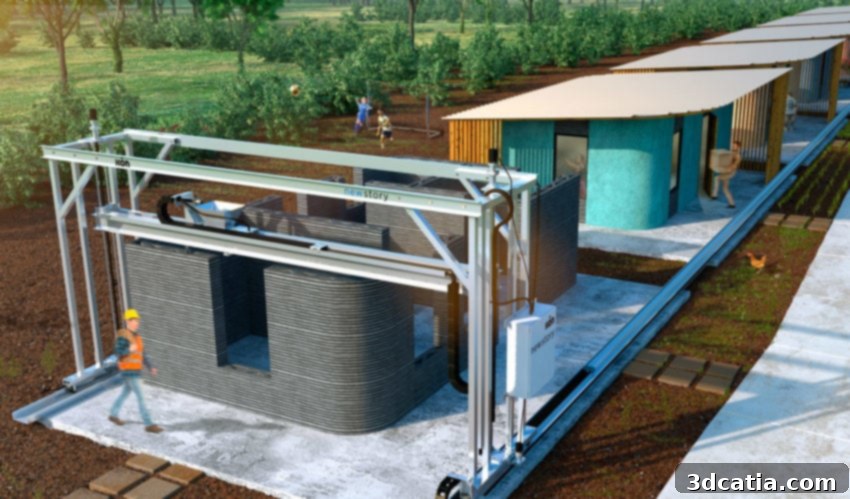
The Future of Construction: Exploring Concrete 3D Printers and Their Impact
In recent years, the landscape of the construction industry has been undergoing a significant transformation, largely propelled by the growing adoption of additive manufacturing technologies. Among these innovations, concrete 3D printers have emerged as particularly influential, rapidly gaining traction among forward-thinking architects, engineering firms, and construction companies worldwide. This advanced technology promises to revolutionize how structures are designed and built, offering unprecedented levels of efficiency, cost-effectiveness, and design freedom.
Concrete, a fundamental composite material composed of water, cementitious compounds, and aggregates like sand, gravel, and crushed stone, is the most consumed substance on Earth after water. Its abundance and affordability have historically made it the material of choice for countless construction projects. However, traditional concrete construction methods can be labor-intensive, time-consuming, and prone to material waste. This is where concrete 3D printing steps in, offering a compelling alternative that addresses many of these challenges. While the initial investment in a construction-grade concrete 3D printer can be substantial, often ranging from approximately $180,000 to well over $1 million, the long-term benefits and return on investment are increasingly making them an attractive proposition.
The advantages of employing concrete 3D printers over conventional construction techniques are manifold and impactful. This cutting-edge approach delivers projects that are demonstrably faster, significantly cheaper, inherently safer, and overall more efficient. By automating the layering process, concrete 3D printing drastically reduces the need for extensive manual labor on site, thereby lowering labor costs and enhancing safety by minimizing human exposure to hazardous conditions. Furthermore, the precision of additive manufacturing leads to minimal material waste, contributing to more sustainable building practices. Supply chains are streamlined and shortened, and projects can achieve a significantly higher degree of structural resilience and geometric complexity, opening up new possibilities for architectural innovation and structural integrity.
The operational principle of a standard concrete 3D printer shares a remarkable resemblance with that of a typical Fused Deposition Modeling (FDM) printer, as both technologies are fundamentally based on material extrusion. This shared foundation results in a largely analogous process flow. It begins with the creation of a detailed digital 3D model using specialized 3D modeling software. This model is then digitally “sliced” into numerous horizontal layers and translated into G-Code, a programming language that dictates the precise movements and actions of the printer. The G-Code then orchestrates the printhead, which systematically deposits layers of specially formulated concrete material, pumped continuously from a connected cement mixer, until the final structure is meticulously built layer by layer. A typical concrete 3D printer designed for additive manufacturing in construction is characterized by a robust robotic arm. One end of this arm is affixed to the printhead, while the other is securely integrated into either a large gantry system or a crane-like robotic arm setup. The specific design, capabilities, and operational nuances of a concrete 3D printer can vary considerably based on its type, the underlying technology, its manufacturer, and its intended applications. Key performance metrics such as build volume, print resolution, practicality, and overall efficiency are all dependent on these factors, allowing for a diverse range of machines tailored to different construction needs.
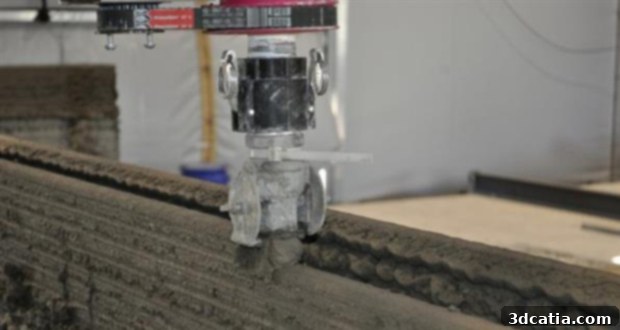
Concrete 3D printing saves cost and time, accelerating modern construction projects (Photo Credit: Mike Jazdyk)
Gantry Concrete 3D Printers
The term gantry in this context refers to the distinctive overhead structural framework that supports and guides the printer’s movement. Gantry-style concrete 3D printers are a popular and powerful choice for large-scale commercial and industrial construction projects due to their expansive build envelopes and inherent stability. However, their sheer size and associated challenges with portability, coupled with the significant technical effort required for their initial setup and subsequent dismantling, generally make them impractical for smaller, more agile projects. These machines typically operate within a Cartesian coordinate system, utilizing precisely defined x, y, and z axes. The x-axis governs the longitudinal movement of the printhead along the length of the supporting rails, enabling forward and backward motion. The y-axis defines the lateral movement, carried by a rail that connects the main structural pillars. These pillars, in turn, embody the z-axis, allowing the printhead to move vertically, layer by layer, to build up the desired structure. This robust, fixed-position system ensures consistent precision and allows for the creation of extensive structures with high accuracy.
A prime example of a gantry concrete 3D printer is ICON’s renowned Vulcan II. This formidable machine operates on the principles of a gantry system, boasting an impressive build volume of 260 x 850 x 260 cm. Weighing approximately 1.7 tonnes and standing roughly 2.5 meters tall and 8.5 meters wide, the Vulcan II is designed for significant construction undertakings. It exclusively utilizes ICON’s proprietary concrete material, *Lavacrete*, which is optimized for additive manufacturing. As with most large-scale concrete 3D printers, the Vulcan II represents a substantial capital expenditure, priced at just under $250,000. Despite this, the economic advantages derived from additive manufacturing often lead construction companies to opt for hiring or leasing the machine, rather than outright purchasing it, to benefit from reduced operational costs. A remarkable achievement demonstrating its capabilities occurred in 2019 when ICON’s printer successfully constructed a complete house for under $4,000, completing the entire process in an astonishing 24 hours. This feat underscored the profound potential of gantry systems to deliver rapid, affordable, and high-quality housing solutions.
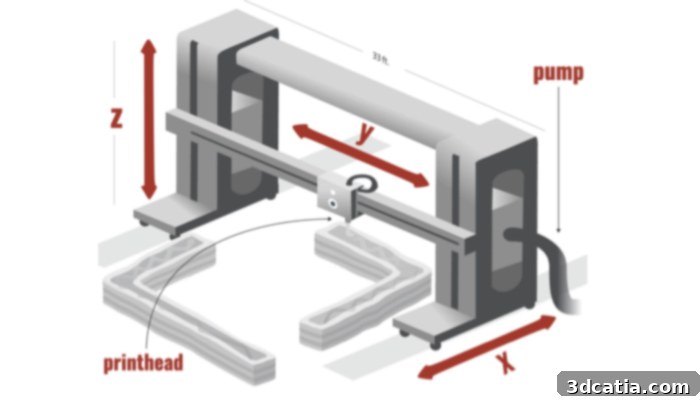
ICON’s Vulcan II incorporates a gantry system with x, y, and z axes for large-scale precision. (Credit: ICON)
Robotic Arm Concrete 3D Printers
In contrast to the fixed gantry systems, a mechanized or robotic arm concrete 3D printer is typically supported by a crane-like structure, offering a dramatically different set of capabilities. These systems usually operate on 6 axes, providing an exceptional degree of freedom of movement. This multi-axis articulation enables the creation of significantly more complex geometries and parts with higher resolution and finer details compared to what is typically achievable with a gantry-based machine. Beyond enhanced geometric versatility, robotic arm printers offer the added benefits of increased portability and a more compact footprint. This makes them considerably easier to transport, set up, and dismantle, allowing for greater flexibility in project location and deployment. Historically, these systems were often constrained by limited build volumes, restricting them to smaller parts or components. However, recent and rapid advancements in robotic arm technology have paved the way for the development of machines with substantially larger build volumes, now rivaling, and in some cases even exceeding, those of traditional gantry printers. While offering superior flexibility and precision, robotic arm printers generally tend to be a more significant investment than their gantry counterparts due to their advanced mechanical sophistication and control systems.
The pioneering work of Russian startup Apis Cor exemplifies the transformative potential of robotic arm concrete 3D printing. In 2018, the company garnered global attention after successfully constructing a 400-square-foot home entirely from scratch using their proprietary robotic arm concrete 3D printer. This groundbreaking project was completed in an astonishing 24 hours in Moscow and came with an incredibly low cost of just $10,000, showcasing the unprecedented speed and affordability possible with this technology. Just two years later, Apis Cor again made headlines by successfully erecting the world’s largest 3D printed building in Dubai, utilizing their advanced additive manufacturing technology. These achievements highlight the immense scalability and versatility of robotic arm systems, proving their capability to handle projects ranging from compact residential units to monumental architectural structures.
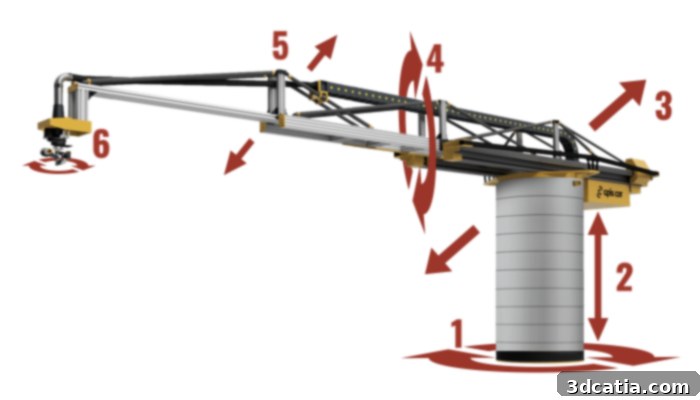
Apis Cor’s robotic arm concrete 3D printer, with its 6 axes, offers unparalleled flexibility and design freedom. (Photo Credit: Apis Cor)
Applications and Future Outlook of Concrete 3D Printing
Despite the common misconception that an entire building can be fully constructed solely by a concrete 3D printer, it’s typically the structural elements, primarily the walls and foundations, that are additively manufactured. Other components like roofs, windows, doors, and internal fittings are still installed using traditional methods, often seamlessly integrated into the 3D printed structure. Nevertheless, concrete 3D printing has already made an enormous and undeniable impact on the construction industry, fundamentally altering workflows and opening new architectural possibilities. Over the last decade in particular, a vibrant ecosystem of specialized construction companies focusing on additive manufacturing with concrete has rapidly emerged.
A notable player in this evolving field is the Danish company COBOD. They made headlines by constructing Germany’s first-ever 3D printed residential building using their advanced BOD2 gantry-style concrete 3D printer. Building on this success, COBOD has since announced a groundbreaking three-story residential building project, which has already commenced construction and is designed to encompass a substantial surface area of 380 square meters. The global reach and versatility of concrete 3D printing are further evidenced by its adoption in various housing projects across numerous countries, including Belgium, Dubai, Morocco, and France, in addition to Germany. Beyond residential applications, the technology has also been successfully employed to construct functional offices, such as one built in Copenhagen, Denmark, demonstrating its broad applicability across different types of structures.
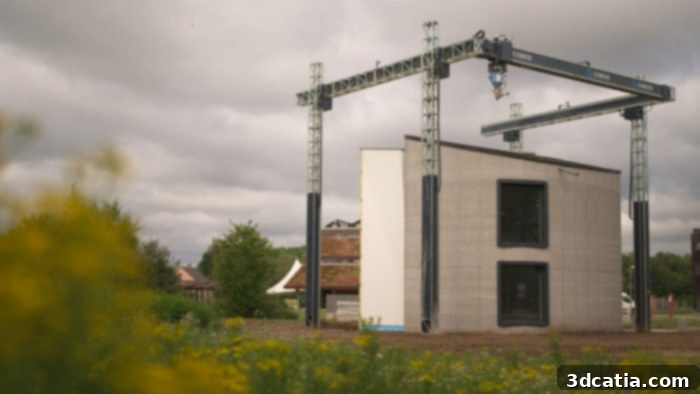
An example of a residential house constructed with COBOD’s innovative concrete 3D printer. (Photo Credit: COBOD)
The rapid and continuous development of concrete 3D printing technology is a testament to its profound potential, leading to several impressive and often ingenious innovations. For instance, Twente Additive Manufacturing (TAM) has pushed the boundaries by combining the strengths of both gantry and robotic arm systems to create a sophisticated 9-axis printer. This hybrid system integrates the standard 6 axes of a robotic arm concrete 3D printer with the additional elevation, translation, and rotational Cartesian axes typically found in gantry systems. Such advanced configurations offer unparalleled flexibility, enabling the creation of even more intricate and robust structures. Many of these ongoing advances hold globally significant applications, addressing critical issues such as accelerating the provision of affordable housing to combat homelessness and contributing to the more efficient use and preservation of natural resources through reduced material waste and optimized designs. Concrete 3D printing is not just changing construction; it’s offering tangible solutions to some of humanity’s most pressing challenges.
What are your thoughts on the revolutionary potential of concrete 3D printers in the evolving construction industry? We invite you to share your perspectives in the comments section below or join the conversation on our Facebook and Twitter pages! For the latest updates and insights directly to your inbox, don’t forget to sign up for our free weekly Newsletter here.