
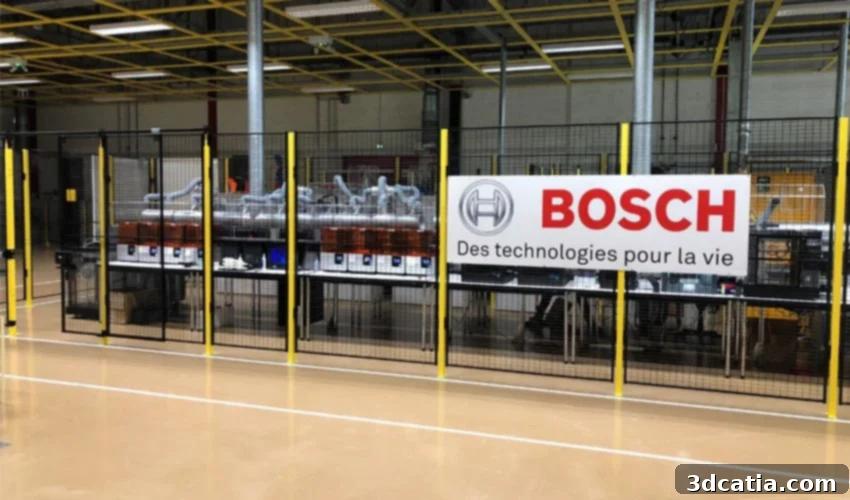
Bosch Mondeville’s 3D Printing Revolution: Driving Industrial Innovation and Efficiency
Across diverse industries, companies are increasingly embracing additive manufacturing technologies to enhance productivity and accelerate innovation. The esteemed German conglomerate, Bosch, stands at the forefront of this trend, pushing boundaries with the establishment of a dedicated 3D printing service. This pivotal service is headquartered at Bosch’s industrial site in Mondeville, Normandy, France. For the past three years, Théophile Guettier, a specialist in industrial equipment manufacturing at Bosch, has been instrumental in creating a wide array of 3D printed parts, ranging from intricate prototypes and essential templates to high-quality finished products. This strategic integration of additive manufacturing underscores Bosch’s commitment to staying ahead in a rapidly evolving technological landscape.
3DN: Could you please introduce yourself and explain your involvement with 3D printing?
“I joined Bosch in 2000, initially working as a buyer and then in supplier/customer quality roles. For the last three years, my focus has shifted entirely to specializing in 3D printing. This exciting new mission was entrusted to me as a crucial part of the ongoing transformation of our Mondeville industrial site, located near Caen in Normandy. Our Mondeville facility represents a unique case within the Bosch group. In addition to our longstanding, ‘historical’ activities as an industrial equipment manufacturer, Bosch Mondeville now offers a comprehensive ‘Electronic Manufacturing Services’ (EMS) division. This service is specifically designed to industrialize electronic products, particularly those related to the Internet of Things (IoT), for external third-party customers. It was within this context, at the beginning of 2015, that I was tasked with exploring the potential of 3D printing technology.”
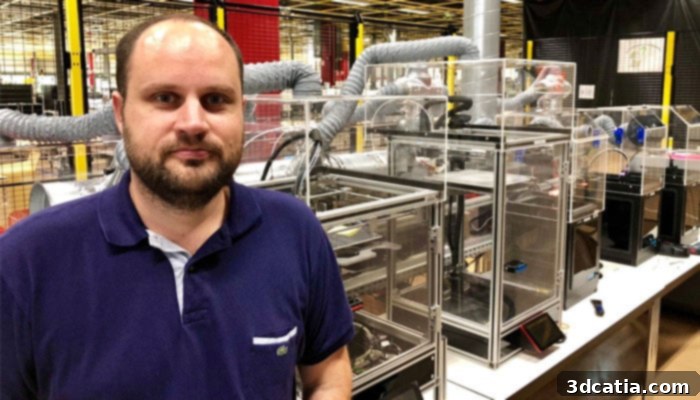
Théophile Guettier at the Mondeville site, pioneering 3D printing applications.
“Following extensive market research, which included in-depth online investigations and a valuable visit from a specialized 3D printing startup, we made our initial investment in a wire deposition machine, commonly known as an FDM printer. The return on investment for this machine was almost immediate and truly remarkable. A prime example of its profitability was the printing of custom robot jaws, which enabled us to reduce costs by a staggering factor of over 100 compared to traditional manufacturing methods. This initial success quickly demonstrated the immense potential of the technology. Subsequently, a deluge of other compelling use cases emerged from various departments, including manufacturing operators, our engineers, and even our external customers. These applications spanned a wide range, from specialized bindings and precision jigs to rapid prototypes, innovative packaging solutions, ergonomic tools, and even directly usable finished products, solidifying 3D printing’s indispensable role in our operations.”
“In parallel with our internal developments, we were fortunate to receive significant funding amounting to €200,000 (approximately $234,833.57) from our division. This substantial financial backing was complemented by invaluable support from the University of California, Berkeley, which played a crucial role in helping us further develop our innovative activities within additive manufacturing. With this support, we were able to assemble a dedicated team of 5 to 7 specialists. This team was tasked with driving forward several key initiatives: developing a sophisticated photogrammetric scanner for accurate 3D data capture, creating advanced automatic data processing software to streamline our workflows, and formulating customized materials tailored to our specific application needs. This holistic approach has allowed us to not only adopt existing 3D printing solutions but also to innovate within the technology itself, enhancing its capabilities and versatility for Bosch and our clients.”
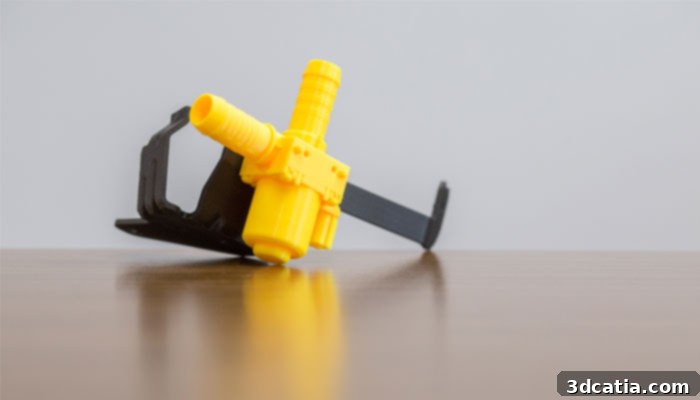
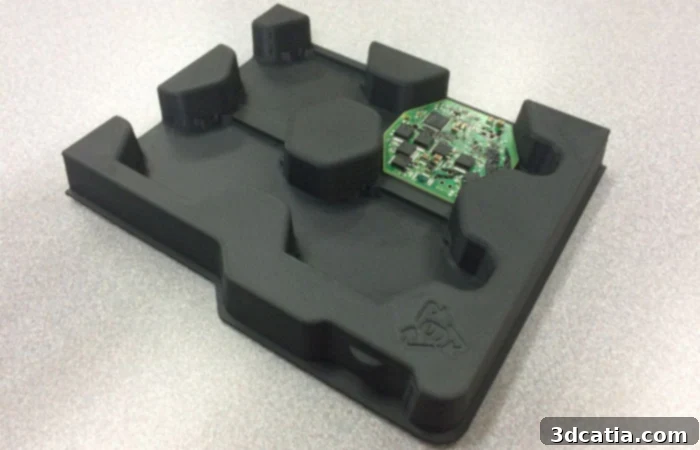
A precisely engineered component produced by Bosch using 3D printing.
3DN: Which additive manufacturing technologies are you currently utilizing, and for what specific applications?
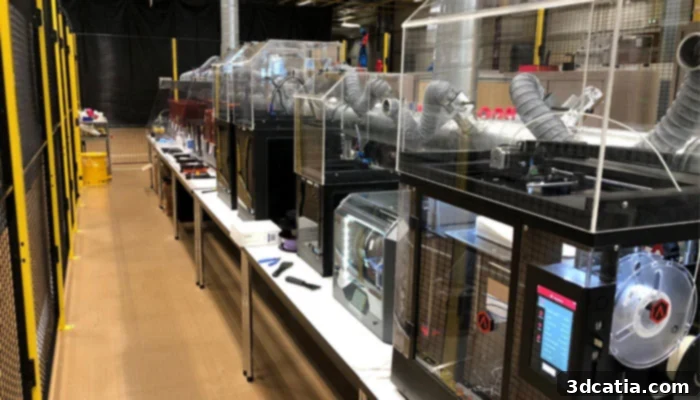
“Due to an exponential surge in demand—not only from our Mondeville site but also from other Bosch factories across France and internationally, as well as an increasing number of external customers—we have made substantial investments in our 3D printing capabilities. Today, our facility houses approximately twenty polymer 3D printers, encompassing a comprehensive range of technologies. We primarily utilize Fused Deposition Modeling (FDM) for cost-effective prototyping, tooling, and fixtures due to its material versatility and robust parts. Stereolithography (SLA) is employed for applications requiring high detail, smooth surface finishes, and aesthetic prototypes, especially for intricate electronic components. Furthermore, Selective Laser Sintering (SLS) is crucial for producing strong, functional parts with complex geometries and excellent mechanical properties, ideal for end-use components and batch production. This diverse technological arsenal allows us to address a vast spectrum of needs, from rapid iteration and custom jigs to functional components and small-batch production, ensuring we can deliver optimal solutions for various industrial challenges.”
3DN: What tangible added value does additive manufacturing bring to your daily operations?
“Additive manufacturing has fundamentally transformed our operational approach, enabling us to test innovations with unprecedented speed and at significantly reduced costs. We have definitively moved away from a rigid ‘Waterfall’ project management methodology, where every detail is meticulously planned upfront, often leading to unforeseen complications that can derail an entire project. Instead, we have embraced a much more agile and iterative development process. This allows us to continuously refine our designs and solutions based on real-time feedback and experimental results.”
“The core principle guiding our new approach is ‘fail early, fail often.’ The remarkably low cost associated with 3D printing has eliminated the traditional apprehension around experimenting with new ideas. This empowers any employee, regardless of their position, to transform their concepts into physical prototypes without significant financial risk. Phrases like ‘I’m not sure if it’s going to work,’ ‘It might cause friction,’ or ‘That’s impossible to manufacture’ have become relics of the past. We are constantly learning and are frequently pleasantly surprised by the outcomes. Concepts that were once considered far-fetched or impractical have, in fact, proven to be immense successes. For instance, the ability to integrate several distinct elements within a single 3D printed product – such as combining protection grids, battery housing, and ventilation fins – has yielded substantial time and cost savings. This ability to consolidate parts and simplify assembly is a game-changer for efficiency and innovation.”
3DN: What do you foresee as the future of additive manufacturing within the automotive sector?
“Indeed, 3D printing is a powerful catalyst that unleashes creativity, fosters greater employee engagement, and delivers substantial economic benefits. At an industry-wide level, this transformative technology is perfectly positioned to meet the escalating customer demand for personalization and customization. We are no longer limited to mass production of identical items; we can now envision the production of unique, tailored models, even within a series – and that is truly no oxymoron! The continuous development of advanced tools will further propel this revolution. Instant 3D scanners will allow for rapid digitization of objects and environments, while sophisticated ‘generative design’ software will autonomously create optimized, lightweight, and complex structures. Furthermore, comprehensive 3D file databases will provide a wealth of design options and historical data. Together, these advancements will enable the production of truly revolutionary products that were previously unimaginable.”
“Imagine multi-material dashboards with organic, ergonomic shapes perfectly tailored to the driver, or personalized supports for your cherished items, whether it’s a surfboard or a bicycle, seamlessly integrated into your vehicle’s interior. Beyond aesthetics and customization, this technology will unlock entirely new avenues for developing products that were once deemed unachievable due to manufacturing constraints. This includes the creation of complex cooling circuits directly within injection molding or foundry tools, leading to more efficient and durable manufacturing processes. Similarly, we can produce topologically optimized parts – designs where material is intelligently placed only where structurally necessary – significantly reducing weight while simultaneously increasing resistance and overall performance. This isn’t a futuristic dream; it’s already a reality in demanding sectors like aeronautics, where lightweight, high-strength components are critical. We confidently predict that this paradigm shift will gradually permeate and revolutionize all sectors of industrial manufacturing, making advanced, customized, and optimized production the new standard.”
3DN: Do you have a final message for our readers?
“If you haven’t already, I strongly encourage all manufacturers to invest in 3D printers and, crucially, to empower their employees with the freedom and resources to test their innovative ideas. The potential for unlocking creativity, fostering agile development, and achieving significant economic gains is immense and truly transformative. For more detailed information about our services and initiatives in electronic manufacturing and 3D printing, please visit our official website.”
What are your thoughts on the innovative additive manufacturing initiatives developed by Bosch Mondeville? We encourage you to share your feedback in a comment below or connect with us on our Facebook and Twitter pages! Don’t forget to sign up for our free weekly Newsletter to receive all the latest news and updates in 3D printing directly in your inbox!