

Unlocking the Future: The Most Innovative Glass 3D Printers and Technologies
Glass, an ancient material with a history spanning over 100,000 years, has been a cornerstone of human innovation. From early tools and weapons to its ubiquitous presence in modern life, glass has constantly evolved, offering diverse forms and properties. Today, it’s found in everything from skyscraper windows and smartphone screens to sophisticated medical instruments and optical lenses. Given its prevalence, a natural question arises in the realm of advanced manufacturing: can glass be 3D printed? The answer is a resounding yes, although it presents unique challenges. Working with glass requires extremely high melting temperatures—often exceeding 1,000°C—and an environment of precise thermal control. Despite these formidable constraints, visionary companies and research institutions are developing groundbreaking glass 3D printers capable of producing an array of intricate parts. While some of these innovative systems are beginning to reach commercial markets, many remain at the forefront of research and development. This article delves into the pioneering efforts and technologies shaping the future of glass additive manufacturing.
Maple Glass Printing: The Accessible Desktop Glass 3D Printer
Maple Glass Printing is revolutionizing access to glass additive manufacturing with its Maple 4 desktop glass 3D printer. This innovative system aims to democratize glass fabrication, traditionally a process demanding extreme heat, specialized industrial equipment, and extensive expertise. The Maple 4 streamlines this complex operation, making it more efficient and accessible for a broader range of users. With compact dimensions of 736 x 600 x 985 mm and a manageable weight of approximately 100 kg, it is designed for integration into various environments, operating conveniently on a standard 220–240V outlet. Despite its desktop footprint, the Maple 4 is engineered for advanced performance, achieving nozzle temperatures of nearly 1000 °C, essential for processing glass. It boasts a generous 200 × 200 × 300 mm build volume, allowing for the creation of substantial glass components, and is capable of managing high flow rate printing for rapid production. Users can produce detailed glass parts, ranging from prototypes to functional elements, in under an hour. Key features such as one-click printing, automatic mesh bed leveling, and a magnetic print bed significantly enhance user experience, simplify operation, and ensure consistent, high-quality results. The Maple 4 represents a significant step towards bringing industrial-grade glass 3D printing capabilities to research labs, design studios, and even small-scale production facilities.
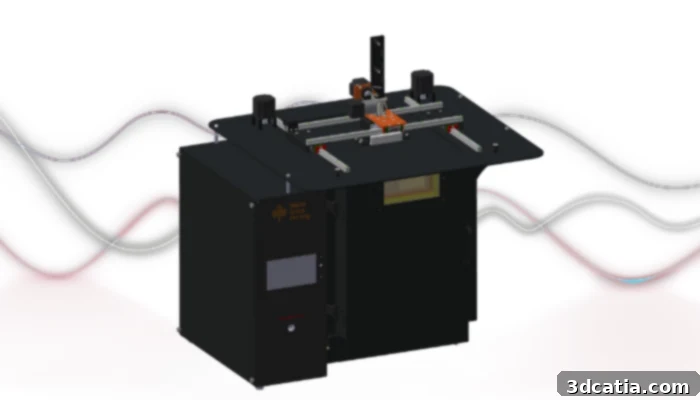
(Photo Credit: Maple Glass Printing)
Nobula’s Direct Glass Laser Deposition (DGLD) Technology
Nobula is pushing the boundaries of glass 3D printing with its innovative Glass 3D Printer, which utilizes a proprietary technology called Direct Glass Laser Deposition (DGLD). This method is touted by the company as making “printing glass as straightforward as printing plastic,” a bold claim given the material’s inherent complexities. DGLD employs non-contact laser heating, enabling the printer to reach exceptionally high temperatures, up to 2200 °C. This extreme heat allows for precise control over the melting and deposition of glass, resulting in highly accurate parts. A significant advantage of Nobula’s technology is its energy efficiency and the elimination of the need for extensive post-processing, which often adds considerable time and cost to traditional glass fabrication. The device itself is compact, measuring approximately 100 × 40 × 60 cm and weighing just over 50 kg, making it relatively manageable for various lab or workshop settings. The Nobula system delivers impressive resolution, ranging from 100–250 μm, and offers flexibility with infill options from 0 to 100 percent, catering to diverse structural requirements. With print speeds varying from 5 to 200 mm per minute, users can efficiently produce complex, free-standing glass structures that boast fine detail and superior performance. Optimized for silica glass, a material known for its high thermal and chemical resistance, the Nobula printer is also compatible with both Nobula’s proprietary and commercial slicing software, ensuring broad usability. This advanced Glass 3D Printer from Nobula is poised to unlock new possibilities for creating complex, high-quality glass components across a wide spectrum of applications, including advanced research, industrial design, and specialized manufacturing.
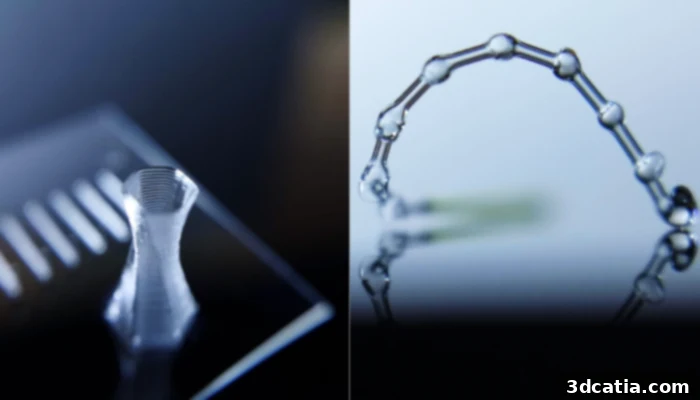
A vase and hollow structure printed using the Nobula Glass 3D Printer with the company’s unique patent-pending glass filament. (Photo Credit: Nobula)
MIT’s Pioneering Glass 3D Printing: The G3DP Series
The Massachusetts Institute of Technology (MIT) has long been a trailblazer in advanced manufacturing research, and its contributions to glass 3D printing are no exception. MIT’s pioneering efforts in this field date back to 2015, when a research team led by Neri Oxman unveiled a revolutionary process capable of extruding molten glass layer by layer. This initial breakthrough, known as G3DP (Glass 3D Printing), laid the groundwork for subsequent developments. A few years later, the G3DP evolved into its second iteration, the G3DP2, a more refined and robust printing solution. The G3DP2 significantly enhanced the capabilities of glass additive manufacturing, offering continuous deposition of up to 30 kilograms of molten glass. A critical component of this system is its integrated thermal control mechanism, which meticulously manages the temperature throughout the printing process. This precise thermal regulation is crucial for ensuring proper glass formation, maintaining structural integrity, and achieving optimal material quality. With these advancements, the G3DP2 can produce transparent glass parts with exceptional clarity and strength, making them suitable for a vast array of applications, from architectural elements to artistic installations and functional components. While the G3DP2 system is not directly available for commercial purchase as a standalone printer, its impact is far-reaching. The technology is actively utilized daily by Evenline, a studio that leverages MIT’s expertise to offer bespoke glass parts directly through their website, effectively bridging the gap between cutting-edge research and practical application for designers, architects, and manufacturers.
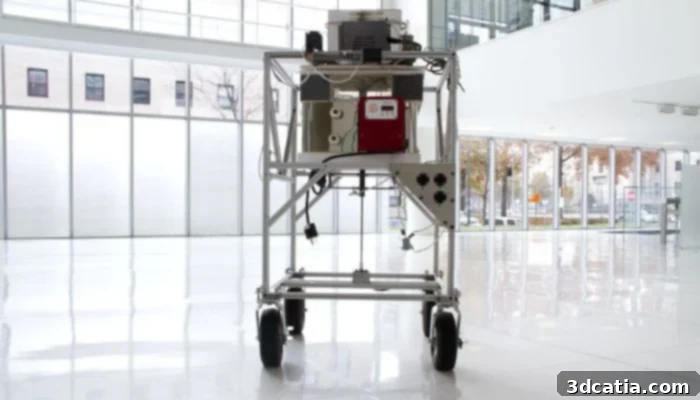
The first iteration of the G3DP (Photo Credit: MIT/Oxman)
Glassomer: Expertise in 3D Printing Glass Prototypes and Components
Glassomer, a German company, has carved out a unique niche in the additive manufacturing of glass, focusing primarily on providing expertise and services rather than marketing standalone machines. Specializing in the 3D printing of glass prototypes and functional components, Glassomer offers unparalleled flexibility in creating intricate shapes and designs. Their service caters to a diverse clientele, from industrial designers seeking to prototype future bottle designs to artisans developing decorative objects and bespoke jewelry. The ability of Glassomer to offer such specialized services stems from its groundbreaking development of a proprietary raw material. This material is a sophisticated composite, featuring a liquid form optimized for 3D printing and a solid form suitable for injection molding. It is primarily composed of high-purity silica glass powder meticulously blended with an organic binder. This unique material formulation is at the heart of their additive manufacturing process, enabling the production of fully transparent glass parts with excellent optical and mechanical properties. By focusing on material innovation and a service-oriented model, Glassomer effectively lowers the barrier to entry for businesses and individuals looking to leverage the benefits of 3D printed glass without the need to invest in complex machinery themselves. Their approach highlights the importance of material science in advancing the capabilities of additive manufacturing, making intricate and high-quality glass components more accessible for various applications.
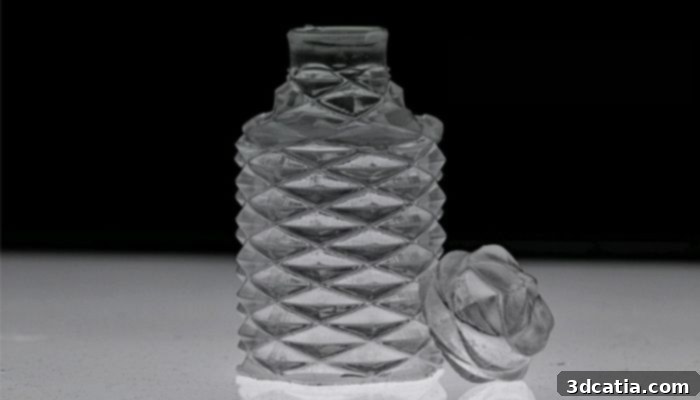
An example of a 3D printed bottle from the printer. (Photo Credit: Glassomer)
Revolutionary Low-Temperature Additive Manufacturing of Glass by MIT Lincoln Laboratory
A particularly groundbreaking line of research in glass additive manufacturing is being pursued by MIT’s Lincoln Laboratory, focusing on low-temperature processing of glass. This approach is profoundly innovative because glass is almost invariably processed at extremely high temperatures, typically exceeding 1000 °C, to achieve melting and shaping. The Lincoln Laboratory team, however, has developed a method that sidesteps these conventional requirements. Their process uniquely begins at room temperature, utilizing a technique known as direct ink writing. In this method, the desired object is meticulously formed layer by layer from a specialized ink. After the initial room-temperature formation, the object undergoes a curing stage in a mineral oil bath heated to a mere 250 °C. This dramatically lower temperature contrasts sharply with the thousands of degrees Celsius traditionally needed for glass sintering or melting. Once the thermal treatment is complete, the printed piece is rinsed with an inorganic solvent to thoroughly remove any residual mineral oil, rendering it ready for use. The material compatible with this revolutionary process is a multimaterial ink, also developed by Lincoln Laboratory, composed of a silicate solution combined with nanoparticles of other inorganic compounds. This unique ink allows for precise deposition and subsequent low-temperature solidification. While still an ongoing study, initial results are highly promising, indicating that this technique could significantly simplify and expand the possibilities for 3D printing complex glass devices. Potential applications include intricate microfluidic systems, high-precision optical lenses for advanced imaging, and robust high-temperature electronic components, opening new avenues for innovation in these critical fields.
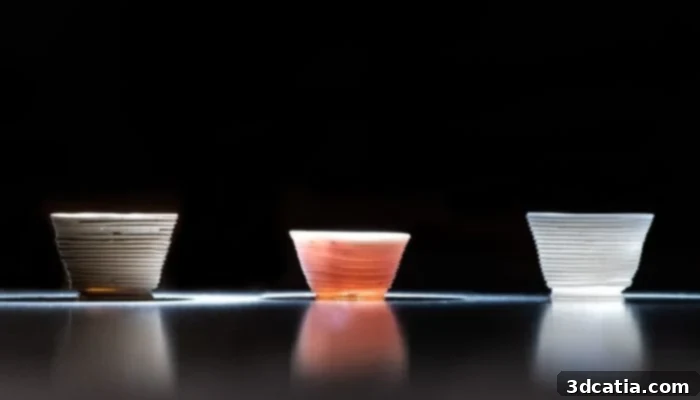
Glass cups printed using the low-temperature process. (Photo Credit: Lincoln Laboratory)
3D Printing Glass Microstructures with University of California, Berkeley & Freiburg
Researchers at the University of California, Berkeley, in a collaborative effort with the University of Freiburg in Germany, have made significant strides in the field of glass additive manufacturing by developing a sophisticated technique to 3D print glass microstructures. This groundbreaking method builds upon a process established years ago known as computed axial lithography (CAL). While CAL allowed for volumetric printing, the new iteration, dubbed micro-CAL, has been refined to achieve an unprecedented level of detail, enabling printing at the microscale and specifically with glass. Unlike conventional 3D printing methods that construct objects layer by layer, micro-CAL distinguishes itself by printing the entire object simultaneously. The process involves using a precisely directed laser to project intricate light patterns into a specialized resin material. This resin is ingeniously formulated, containing glass nanoparticles uniformly dispersed within a light-sensitive binder. When exposed to the laser light, the binder selectively solidifies in the areas defined by the light patterns, forming the desired shape. Following this initial curing, the object undergoes a crucial post-processing step: it is heated to a high temperature. This heat serves two primary functions: first, to burn away the excess organic binder, and second, to fuse the remaining glass nanoparticles together, resulting in a solid, pure glass piece. The ability to print microstructures in glass opens up a wealth of transformative applications. The researchers highlight its potential for creating microscopic optical components with extreme precision, advanced lenses for virtual reality glasses, next-generation microscopes with enhanced capabilities, and various other highly specialized scientific instruments that require the unique properties of glass at a tiny scale.

A 3D-printed trifurcated microtubule model next to a mosquito. (Photo Credit: Adam Lau / Berkeley Engineering)
ETH Zurich’s Stereolithography-Based 3D Printed Glass
In 2019, researchers at ETH Zurich embarked on an ambitious project to demonstrate the feasibility of 3D printing complex glass objects using a method akin to traditional photopolymerization, and they succeeded, later securing a patent for their innovation. Their approach leverages stereolithography (SLA), a process renowned for its ability to produce highly detailed parts. The core of their method lies in a specially formulated resin that combines plastic polymers and organic molecules, which are intricately bonded to glass precursors. This unique resin acts as the building material, allowing the team to create incredibly intricate and highly porous glass structures. Specifically, they employed Digital Light Processing (DLP), a variation of SLA, where an entire layer is cured simultaneously using a digital light projector. A key discovery made during their research was the ability to precisely tune the pore size of the printed object simply by adjusting the intensity of the projected light, offering unprecedented control over the material’s microstructure. Once the resin was cured and the green part formed, the printed pieces underwent a crucial two-stage firing process. The first stage involved heating the objects to 600˚C, a temperature sufficient to burn away the polymer framework, leaving behind a fragile, porous ceramic preform. In the second stage, the temperature was increased to approximately 1000˚C, which densified the ceramic into a solid, transparent glass. While this firing process resulted in considerable shrinkage of the objects, a common characteristic in ceramic and glass processing, the final product exhibited properties similar to high-quality window glass – transparent, hard, and chemically resistant. This research from ETH Zurich highlights the versatility of SLA technologies for processing advanced materials and paves the way for new applications in optics, microfluidics, and architectural design.
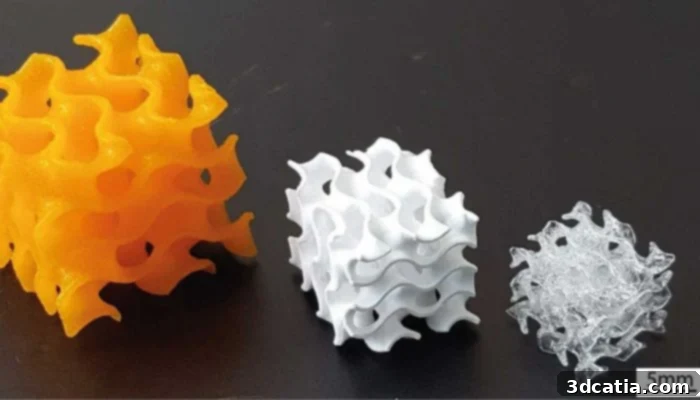
The blank (left) is fired at 600 degrees to remove the plastic framework. The object is fired again and becomes glass (right). (Photo Credit: Group for Complex Materials / ETH Zurich)
University of Notre Dame’s Deposition-Based Glass 3D Printing
The University of Notre Dame has also contributed significantly to the evolving landscape of glass 3D printing with its unique deposition-based method, offering another innovative pathway to fabricating glass components. This technique utilizes a carbon dioxide (CO2) laser, which precisely heats the surface of a glass rod. As the rod’s surface melts, the molten glass is then carefully deposited onto a fused quartz substrate. This substrate is mounted on a highly precise 4-axis CNC platform, allowing for intricate movement and control during the printing process. The formation of the glass is meticulously controlled by a complex interplay of forces: the interaction with the substrate, the applied pressure from the unheated portion of the filament (glass rod), the omnipresent force of gravity, and the surface tension of the molten glass itself. By mastering these variables, the research team initially demonstrated the capability to create both elaborate 2D patterns and self-supporting 3D spiral structures. The research saw further advancement when Ed Kinzel, who spearheaded the Notre Dame study, collaborated with colleagues from the Monterrey Institute of Technology and Higher Education in Mexico. This collaboration marked a crucial turning point, moving beyond the production of hollow shapes to successfully achieving dense, fully transparent 3D solids. This breakthrough indicated a significant step towards manufacturing functional, optically clear glass parts. While achieving ultra-high precision continues to be a challenge, as with many pioneering additive manufacturing technologies, the researchers remain highly optimistic. They believe that with ongoing refinements and further development, even higher levels of performance, accuracy, and complexity can be attained, potentially expanding the range of applications for this deposition-based glass 3D printing method in fields requiring high-quality transparent components.
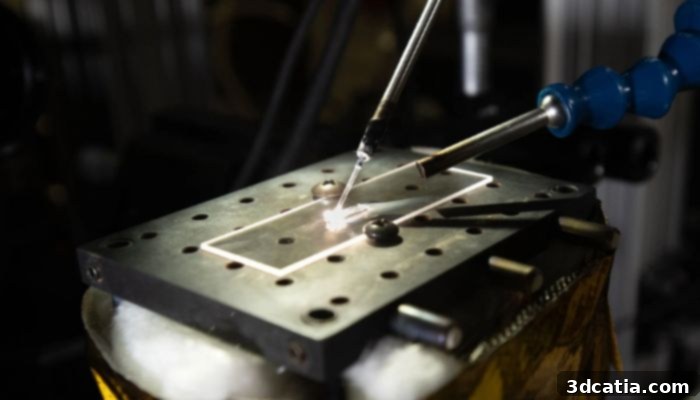
The University of Notre Dame developed the 3D printing method. (Photo Credit: Wes Evard / University of Notre Dame)
The Transformative Potential of Glass 3D Printing
The advancements in glass 3D printing highlighted above represent a pivotal shift in how we approach manufacturing one of humanity’s oldest materials. From desktop solutions making glass accessible to groundbreaking research in low-temperature processes and micro-scale fabrication, the field is rapidly evolving. These innovations are not just technological marvels; they are opening doors to entirely new design possibilities and functional applications across numerous industries. The ability to create complex, bespoke glass components on demand, with intricate internal structures and precise optical properties, holds immense promise for sectors like medical devices, advanced optics, aerospace, and even high-end consumer goods. As researchers continue to refine materials, increase print speeds, and enhance precision, we can expect glass 3D printing to move from specialized labs to more mainstream industrial adoption. The future of glass fabrication is being rewritten, promising greater customization, efficiency, and innovation than ever before. This evolving landscape ensures that glass, a material of enduring utility and beauty, will continue to shape our world in ways we are only just beginning to imagine.
What are your thoughts on these pioneering glass 3D printers and technologies? Have you ever had the opportunity to experiment with 3D printing glass, or do you have insights into its future potential? We invite you to share your experiences and opinions in a comment below or connect with us on our LinkedIn or Facebook pages! For those keen to stay at the forefront of additive manufacturing, don’t forget to sign up for our free weekly Newsletter to receive the latest 3D printing news directly in your inbox. You can also explore our extensive library of videos on our YouTube channel for more in-depth content and demonstrations.