
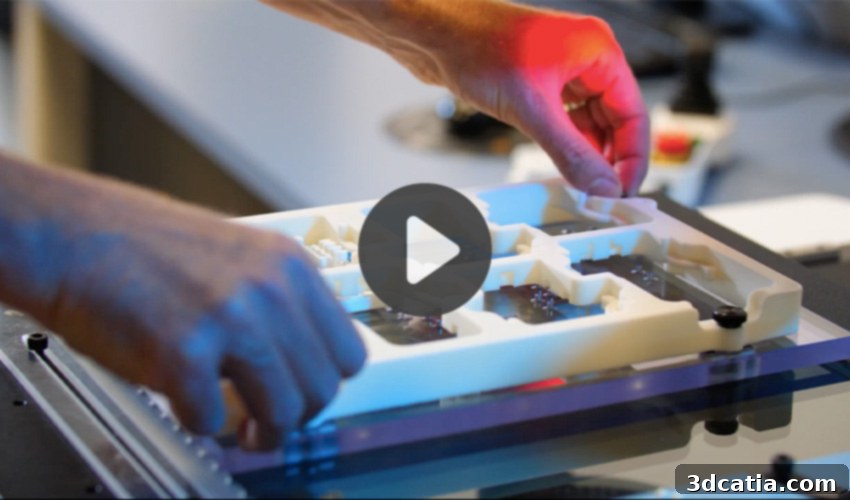
The Latest in 3D Printing: Boosting Production, Building Bridges, and Transforming Industries
The world of additive manufacturing continues to evolve at a breathtaking pace, bringing groundbreaking innovations and practical solutions to a myriad of industries. This week’s highlights perfectly illustrate the transformative power of 3D printing, from significantly increasing production efficiencies for specialized metrology equipment to pioneering new infrastructure and addressing critical challenges in high-stakes sectors like nuclear energy. We’ll explore how companies are leveraging this versatile technology to save time and money, push the boundaries of design, and facilitate wider industrial adoption. Join us as we delve into these fascinating developments, showcasing the diverse applications and profound impact of 3D printing across the globe.
Our journey begins in Europe, where a metrology specialist is revolutionizing its production lines. Then, we venture to China to witness an engineering marvel in the form of the world’s first 3D printed retractable bridge. Next, we examine ExOne’s strategic expansion of its metal 3D printing capabilities in Germany, designed to accelerate technology adoption. We’ll also consider the current state and future challenges of 3D printed homes and conclude with a crucial application in nuclear power plant maintenance. These stories collectively paint a vibrant picture of an industry constantly innovating and pushing the limits of what’s possible.
TOP 1: MCE Metrology Achieves Major Production Boost and Cost Savings with BCN3D 3D Printing
MCE Metrology, a prominent company specializing in high-precision three-dimensional measuring machines, is experiencing a remarkable transformation in its production capabilities thanks to the strategic integration of 3D printing. With established operations in both France and Switzerland, MCE Metrology’s core business revolves around delivering sophisticated solutions for quality control and precision measurement, where accuracy and reliability are paramount. The company has embraced additive manufacturing not just as a supplementary tool, but as a critical component to significantly enhance its production efficiency and reduce time-to-market for its specialized components.
To achieve these ambitious goals, MCE Metrology has invested in advanced 3D printing technology from BCN3D, specifically equipping itself with the BCN3D Epsilon W27 and its accompanying Smart Cabinet. The Epsilon W27, known for its Independent Dual Extrusion System (IDEX) technology, allows for printing with two different materials or colors simultaneously, or for printing identical parts to double production speed. This capability is crucial for MCE Metrology, enabling them to produce complex jigs, fixtures, and specialized parts for their measuring machines in-house. Before adopting 3D printing, the production of certain components through traditional manufacturing methods would typically require a lead time of approximately four weeks. However, with the integration of BCN3D printers, this timeline has been drastically cut to just one week.
This significant reduction in production time translates directly into substantial cost savings and a considerable increase in overall production capacities. MCE Metrology projects savings of more than €10,000, primarily by avoiding outsourcing costs, reducing material waste through optimized design, and minimizing labor hours associated with conventional fabrication. The ability to rapidly iterate on designs and produce custom parts on demand allows MCE Metrology to respond more agilely to market needs and customer requirements, reinforcing its competitive edge in the highly specialized field of metrology. This case serves as a powerful testament to how additive manufacturing can drive efficiency and innovation in high-precision engineering sectors.
TOP 2: China Unveils the World’s First 3D Printed Ret retractable Bridge, a Marvel of Modern Infrastructure
In a monumental stride for urban development and additive manufacturing in construction, the industrial center of the Baoshan district in Shanghai, China, recently became home to an engineering first: the world’s inaugural 3D printed retractable bridge. This groundbreaking project not only showcases the incredible design freedom and speed afforded by 3D printing but also emphasizes a strong commitment to sustainable construction practices. Stretching an impressive 9 meters in length, the bridge is a testament to modular design and innovative material use.
The unique structure of the bridge is comprised of nine distinct segments, ingeniously designed to allow for retraction and extension, a feature that enhances its functionality in an urban industrial environment. Each segment incorporates multiple components, totaling thirty-six individual 3D printed triangular panels. What makes these panels particularly remarkable is that each one boasts its own unique design details, showcasing the ability of additive manufacturing to create highly customized and intricate geometries without incurring additional costs or manufacturing complexities typically associated with traditional methods. This level of customization allows for optimal structural integrity and aesthetic appeal.
Beyond its novel design and functionality, the bridge champions environmental responsibility. Every single panel of the bridge has been 3D printed using a high-performance, recyclable composite material. This choice was made with a clear objective: to significantly minimize the ecological footprint of the project. The use of recyclable materials aligns with global efforts to promote circular economy principles in construction, reducing waste and conserving resources. Furthermore, the efficiency of the 3D printing process itself often leads to less material waste compared to subtractive manufacturing.
Perhaps one of the most astonishing aspects of this project is the speed of its deployment. According to the innovative bridge makers, the entire structure required only three days to erect on-site. While the specific 3D printing technology used for the bridge’s construction was not publicly disclosed, the rapid assembly time underscores the potential for prefabrication and modular construction facilitated by additive manufacturing. This dramatically reduced construction timeline holds immense implications for urban planning, infrastructure development, and emergency response, offering a faster, more efficient, and more sustainable way to build the essential elements of our modern cities.
TOP 3: ExOne’s New German Center Accelerates Metal Binder Jetting Adoption in Europe
ExOne, a global leader in binder jetting 3D printing technology, is making significant strides in accelerating the adoption of metal additive manufacturing with the establishment of its newest technology adoption center in Germany. This strategic expansion is part of ExOne’s broader initiative to create a global network of specialized centers, which already includes facilities in the United States and Japan. The primary objective of these centers is to provide prospective and existing customers with direct, hands-on access to the intricate 3D binder jet printing process, effectively lowering the barriers to entry for companies considering this advanced manufacturing method.
The newly inaugurated center is strategically located in Gersthofen, Germany, a prime location within Europe’s robust manufacturing landscape. This placement is particularly beneficial for European manufacturers, who can now access comprehensive binder jet printing discovery services closer to home. Binder jetting is a powerful additive manufacturing technique that uses a liquid binding agent to selectively join powdered material, layer by layer, to form a solid object. Unlike many other metal 3D printing processes, binder jetting often allows for greater design freedom, faster build speeds, and the use of a wider range of metal alloys, including those that are difficult to process with laser-based systems. It’s particularly well-suited for producing complex, high-volume parts without the need for intricate support structures, which can be a significant advantage in post-processing.
These technology adoption centers are designed to be more than just showrooms; they are interactive hubs where manufacturers can thoroughly evaluate the binder jetting process for their specific applications. The “discovery services” offered typically include feasibility studies, material testing, design for additive manufacturing (DfAM) consultations, and benchmarking of parts against traditionally manufactured components. This allows companies to gain a deep understanding of the technology’s capabilities, its potential return on investment (ROI), and how it can be seamlessly integrated into their existing production workflows. By providing a low-risk environment for experimentation and learning, ExOne aims to demystify metal 3D printing and facilitate its widespread industrial application.
The expansion into Germany underscores Europe’s importance as a manufacturing powerhouse, particularly in sectors like automotive, aerospace, and industrial machinery, all of which stand to gain immensely from advanced metal additive manufacturing. ExOne’s commitment to fostering technological understanding and providing direct support through these centers is crucial for driving the next wave of industrial digital transformation. It empowers manufacturers to explore, test, and ultimately adopt binder jetting, unlocking new possibilities for part consolidation, lightweighting, and on-demand production.
TOP 4: Tomorrow’s Build Explores Key Challenges Facing 3D Printed Homes
The construction industry stands on the precipice of a revolution, with additive manufacturing emerging as a truly disruptive force. The promise of 3D printed homes and structures is immense, offering tantalizing opportunities for companies to address critical issues such as housing shortages, labor scarcity, and the need for more sustainable building practices. The benefits are clear: rapid construction timelines, significant reductions in material waste, unparalleled design freedom for architects, and the potential for lower construction costs, especially for customized or complex geometries. From affordable housing projects to disaster relief shelters and even lunar habitats, the applications seem boundless.
However, as with any nascent technology aiming for widespread adoption in a traditional sector, 3D printing in construction faces a unique set of formidable challenges. A recent video from “Tomorrow’s Build,” a respected voice in construction technology, incisively highlights some of these critical hurdles. One major challenge lies in material development and standardization. While concrete and geopolymers are commonly used, the range of suitable materials still needs to expand to meet diverse structural and aesthetic requirements, often at a competitive cost. Ensuring the long-term durability, weather resistance, and insulation properties of 3D printed structures is also paramount, requiring rigorous testing and validation.
Regulatory hurdles and building codes present another significant obstacle. Existing building codes were developed around traditional construction methods, and incorporating novel 3D printed structures requires extensive lobbying, research, and adaptation of these regulations. This process can be slow and costly, creating uncertainty for developers and contractors. Furthermore, the initial capital investment in large-scale construction 3D printers can be substantial, making it a difficult proposition for smaller firms. There’s also a need for a skilled workforce capable of operating and maintaining these advanced machines, as well as integrating 3D printing into existing construction workflows, which often involves a steep learning curve and a cultural shift.
Beyond the technical and regulatory aspects, public perception and acceptance also play a role. While innovative, some may view 3D printed homes with skepticism regarding their quality, safety, or aesthetic appeal compared to conventionally built houses. Overcoming these challenges will require collaborative efforts across industry, academia, and government, fostering innovation in materials, streamlining regulatory processes, investing in workforce development, and educating the public. Despite the hurdles, the momentum behind 3D printed construction is undeniable, and addressing these issues will pave the way for a truly transformative impact on how we build our future.
TOP 5: ENGIE Laborelec Harnesses 3D Printing to Combat Nuclear Obsolescence
The nuclear power industry, a critical component of global energy supply, faces a unique and persistent challenge: obsolescence. Given the incredibly long operational lifespans of nuclear power plants, often extending for decades, components and parts that were readily available during their initial construction can become exceedingly difficult or impossible to source. This obsolescence can arise for several reasons: original part manufacturers may go out of business, cease production of specific legacy components, or introduce new replacement parts that require a complex and costly re-certification process under stringent nuclear safety regulations. The consequences of such obsolescence can be severe, leading to extended plant downtime, enormous financial losses, and in the worst cases, potential safety risks if critical parts cannot be replaced or maintained.
Recognizing the gravity of this issue, ENGIE Laborelec, a leading research and expertise center in electrical power technology for the ENGIE group, is pioneering a groundbreaking solution: applying industrial 3D printing to manage and mitigate nuclear obsolescence. The core idea is to leverage additive manufacturing to supply critical nuclear parts on-demand, ensuring consistency, quality, and rapid availability when traditional supply chains fail. By digitally storing designs and producing parts only when needed, ENGIE Laborelec can overcome the challenges posed by discontinued manufacturing lines and lengthy procurement processes.
The application of 3D printing in the nuclear sector is particularly complex due to the industry’s unparalleled safety standards and rigorous certification requirements. Every component used in a nuclear power plant must meet extremely precise specifications and undergo extensive qualification processes to ensure its performance and integrity under demanding operational conditions. ENGIE Laborelec’s initiative involves developing and validating robust 3D printing processes and materials that can meet these exacting standards. This includes meticulous material characterization, process control, and non-destructive testing to ensure that 3D printed parts are identical to or even superior in performance to their conventionally manufactured predecessors.
The benefits of this approach are multi-faceted. Firstly, it significantly enhances the operational reliability and safety of nuclear power plants by ensuring a consistent and timely supply of critical replacement parts. Secondly, it drastically reduces the costs associated with obsolescence, such as emergency procurement, reverse engineering of parts, or extensive re-certification procedures. Thirdly, 3D printing offers the potential for design optimization, allowing for parts to be improved or consolidated, leading to enhanced functionality or reduced weight. ENGIE Laborelec’s work is a powerful demonstration of how cutting-edge additive manufacturing technology can provide essential solutions for managing the complex and critical infrastructure of the energy sector, ensuring a safer and more efficient future for nuclear power.
This week’s roundup clearly underscores the incredible versatility and transformative potential of 3D printing across a diverse range of industries. From optimizing manufacturing processes for precision metrology and pioneering sustainable infrastructure with retractable bridges, to democratizing access to advanced metal additive manufacturing and tackling critical obsolescence issues in nuclear power, the advancements are truly inspiring. While challenges remain, particularly in areas like regulatory integration for 3D printed homes, the continuous innovation and strategic adoption of additive manufacturing are paving the way for more efficient, sustainable, and flexible solutions in the global economy.
We hope you found this deep dive into the latest 3D printing news both informative and engaging. What are your thoughts on these groundbreaking applications? Do you see other areas where additive manufacturing could make an even bigger impact? Share your insights and comments below, or connect with us on our Facebook and Twitter pages. And don’t miss out on any future developments—sign up for our free weekly newsletter to receive all the latest news in 3D printing delivered directly to your inbox!