
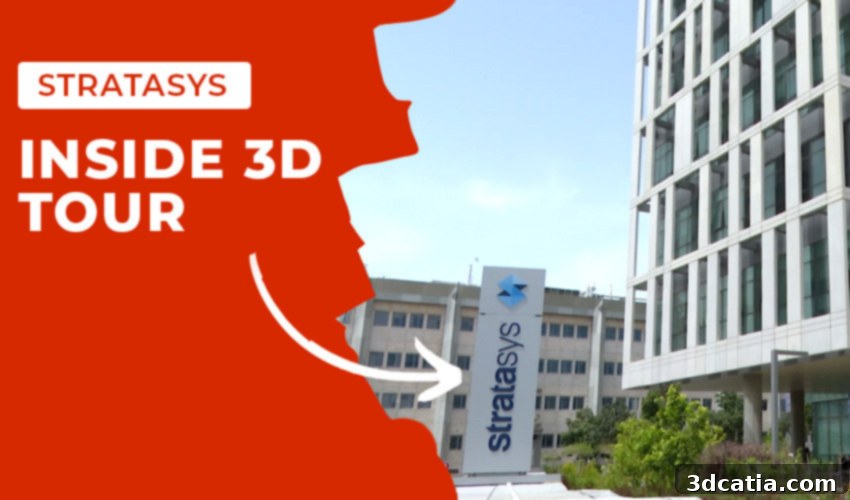
Stratasys Unveiled: An Inside Look at Additive Manufacturing Innovation in Israel
Welcome to another captivating episode of our “Inside 3D Tour,” a unique video series dedicated to exploring the forefront of additive manufacturing. In this series, we embark on exclusive journeys to the facilities of leading manufacturers and distributors across the 3D industry. Our mission is to provide an unparalleled, firsthand perspective on how various additive manufacturing methods are developed, and to demystify the intricate processes that the industry’s most advanced technologies undergo before they even begin production. We’ve previously taken you behind the scenes at innovative companies like BCN3D in Barcelona, Spain, and Velo3D in Augsburg, Germany, offering deep dives into their groundbreaking operations. This time, our exploration takes us to the vibrant technological hub of Israel, where we had the privilege of visiting the multinational giant, Stratasys – not only touring their corporate headquarters but also their critical machine production site. Prepare to immerse yourself in the world of one of additive manufacturing’s true pioneers in this brand new episode of the Inside 3D Tour!
A Warm Welcome from the Heart of Stratasys Innovation
Our journey began with a warm reception by Yoav Zeif, the esteemed CEO of Stratasys, a company that stands as a foundational pillar and a formidable force in the realm of additive manufacturing. Stratasys is not just a participant; it’s a definer of the industry, boasting an impressive and diverse portfolio that spans more than five distinct manufacturing technologies. This technological breadth allows them to cater to an incredibly wide range of industrial applications, from rapid prototyping to final part production across numerous sectors. Our team was granted an extensive tour through the bustling corridors of their headquarters, nestled in Rehovot, Israel. This location serves not only as their administrative hub but also as a vibrant epicenter of research and development, where future innovations are conceptualized and brought to life. During our visit, we also had the invaluable opportunity to explore their cutting-edge 3D printing labs, which are the very engines of their technological advancements.
Diving Deep into PolyJet Technology and Material Innovation
One of the highlights of our tour at the Rehovot headquarters was the detailed exploration of their PolyJet technology labs. We were guided by Ron Scherf, the VP of Healthcare and Consumer R&D, whose expertise illuminated the sophisticated nuances of this powerful additive manufacturing method. PolyJet technology is celebrated for its ability to produce smooth, detailed, and multi-material, multi-color prototypes and parts with exceptional precision. It works by jetting minute droplets of liquid photopolymer onto a build tray, which are then immediately cured by UV light, layer by layer, until the part is complete. This process allows for the creation of intricate geometries and complex designs that would be impossible with traditional manufacturing methods.
Beyond the mechanics, our discussions with Ron Scherf delved into Stratasys’s relentless pursuit of innovation in materials science. PolyJet’s strength lies not just in its precision but in its versatility, offering a wide array of materials that can simulate various properties, from rigid plastics to flexible elastomers, and even transparent or bio-compatible options. We learned about their latest breakthroughs in terms of material development, which are critical for expanding the applications of 3D printing across diverse industries. These innovations include materials designed for increased durability, enhanced aesthetic qualities, specific mechanical properties, and compliance with stringent industry standards, such as those in healthcare. The continuous advancement in material science ensures that Stratasys users can create more functional, realistic, and application-specific prototypes and end-use parts, pushing the boundaries of what’s possible with additive manufacturing.
From Concept to Reality: The Kiryat Gat Production Powerhouse
After experiencing the innovation and R&D prowess at the Rehovot headquarters, our “Inside 3D Tour” culminated with an equally insightful visit to Stratasys’s main production site, strategically located in Kiryat Gat, Israel. This facility is where the vision and engineering from the R&D labs transform into tangible, market-ready 3D printing solutions. Accompanied by Koren Matalon, the VP of Global Operations, we were afforded an unprecedented look into the manufacturing heart of Stratasys. It was here that we witnessed firsthand the meticulous processes involved in bringing their advanced 3D printers to life.
The Kiryat Gat plant is a testament to precision engineering and efficient global logistics. We observed the assembly lines where various components come together to form complex industrial 3D printing systems. This involves rigorous quality control at every stage, from the initial sourcing of materials to the final assembly of the intricate mechanical, electrical, and optical systems that define a Stratasys machine. Each printer undergoes extensive calibration and testing protocols to ensure it meets Stratasys’s exacting standards for performance, reliability, and accuracy. This comprehensive preparation includes functional testing of all moving parts, verification of printing accuracy, and validation of material compatibility. Understanding these deep-seated processes provided crucial insight into the exceptional quality and robust engineering that characterizes Stratasys products.
The final phase before shipment is equally critical, involving careful packaging designed to protect these sophisticated machines during transit to customers worldwide. Koren Matalon elaborated on the logistical intricacies of managing a global supply chain, ensuring that machines reach their destinations efficiently and in perfect condition, ready for immediate integration into diverse industrial environments. This dedication to operational excellence at Kiryat Gat underscores Stratasys’s commitment to delivering not just machines, but complete, reliable, and high-performance additive manufacturing solutions to its global clientele.
Stratasys: A Legacy of Innovation and Future Ambition
Stratasys’s journey began over three decades ago, pioneering Fused Deposition Modeling (FDM) technology, and since then, it has consistently remained at the vanguard of additive manufacturing. Their strategic acquisitions, notably the merger with Objet in 2012, broadened their technological footprint significantly, incorporating PolyJet technology and solidifying their position as a dual-technology leader. This dual expertise in FDM, known for its robust and functional parts, and PolyJet, celebrated for its high-detail, multi-material capabilities, allows Stratasys to serve a vast spectrum of applications, from rapid prototyping in automotive and aerospace to creating detailed medical models and consumer product designs. Their portfolio has further expanded to include advanced technologies like Stereolithography (SLA), P3™ (Programmable PhotoPolymerization), and SAF™ (Selective Absorption Fusion) technology, catering to ever-evolving industrial demands for higher throughput, broader material choices, and greater precision.
The impact of Stratasys’s innovations extends across numerous industries. In healthcare, their 3D printers enable surgeons to create patient-specific anatomical models for surgical planning, significantly improving outcomes and reducing risks. Aerospace companies utilize their technology for lightweight, complex parts that enhance fuel efficiency and performance. In the automotive sector, rapid prototyping accelerates design cycles, bringing new vehicle concepts to market faster. Furthermore, their commitment to education helps foster the next generation of engineers and designers, integrating additive manufacturing into academic curricula worldwide. Stratasys isn’t just selling machines; it’s providing solutions that drive industrial transformation, enabling companies to innovate faster, optimize supply chains, and manufacture more sustainably.
The Future of Additive Manufacturing with Stratasys
Looking ahead, Stratasys continues to invest heavily in research and development, constantly pushing the boundaries of what additive manufacturing can achieve. Their focus remains on developing more versatile materials, enhancing machine reliability, increasing print speeds, and making 3D printing more accessible for large-scale production. The visit to both their R&D labs and their production facility underscored a holistic approach: an unwavering commitment to pioneering new technologies paired with an equally robust dedication to producing reliable, industrial-grade systems that can withstand the rigors of modern manufacturing. As industries worldwide continue to embrace the agility and capabilities of 3D printing, Stratasys is poised to lead the charge, offering solutions that empower businesses to create, innovate, and thrive in an increasingly complex and demanding global market.
What are your thoughts on this exclusive “Inside 3D Tour” of Stratasys and its impressive facilities? Which leading additive manufacturing company would you like us to visit next for our upcoming episodes? Let us know your ideas and feedback in a comment below or connect with us on our officialLinkedIn,Facebook, andTwitter pages! Don’t forget to sign up for our free weeklyNewsletter here, to get the latest 3D printing news, insights, and market trends delivered straight to your inbox every week! You can also find all our compelling videos and more industry coverage on our dedicatedYouTube channel.