

Layer One Atom 3: Redefining Desktop 3D Printing with Hybrid FDM and SLA Technology
Our startup of the month for December, Layer One, is revolutionizing the desktop additive manufacturing landscape. Layer One has engineered the groundbreaking Atom 3, a truly hybrid 3D printer that seamlessly integrates both Fused Deposition Modeling (FDM) and Stereolithography (SLA) technologies into a single, modular system. We’ve extensively covered the various types of FDM 3D printers on our site, but the Atom 3 takes versatility to an unprecedented level. This unique combination allows users to 3D print with an expansive array of materials, from robust engineering plastics to high-resolution photopolymer resins, all from one desktop unit. We were so profoundly impressed by the Atom 3’s capabilities and its innovative approach to hybrid 3D printing that we immediately sought a deeper understanding. To gain comprehensive insights into this pioneering device, we recently sat down with the team at Layer One for an exclusive interview.
3DN: Could you please introduce yourself and Layer One? What was the driving force behind developing a hybrid FDM/SLA 3D printer?
I’m Mike Galvez, and I lead Global Marketing at Layer One. Our fundamental goal has always been to transform the Atom into the ultimate, complete desktop digital fabrication system, and we recognized early on that FDM alone wouldn’t allow us to achieve that vision entirely. While FDM excels in many areas, particularly with its cost-effectiveness and broad material compatibility for larger, functional parts, it inherently faces limitations when it comes to achieving ultra-fine details and exceptionally smooth surface finishes. This is precisely where SLA technology shines, offering unparalleled precision, intricate geometries, and an isotropic finish crucial for many applications, from intricate prototypes to highly detailed models.
The idea of integrating SLA into our Atom platform has been a long-standing aspiration for us. However, the physical constraints and operational complexities of traditional SLA units historically prevented us from implementing this vision sooner. For years, SLA systems, especially those offering significant build volumes and reliability, were typically bulky and not conducive to a compact, modular desktop design. Fortunately, recent and rapid advancements in LCD technology have been a game-changer. These innovations have enabled us to develop a powerful, high-resolution SLA apparatus that is compact enough to integrate seamlessly into the Atom’s existing modular framework. This technological leap has allowed us to overcome previous barriers, making it finally possible to deliver a truly versatile hybrid desktop 3D printer that provides the best of both worlds to our users. The goal was always clear; the technology has only just caught up to make it a reality.
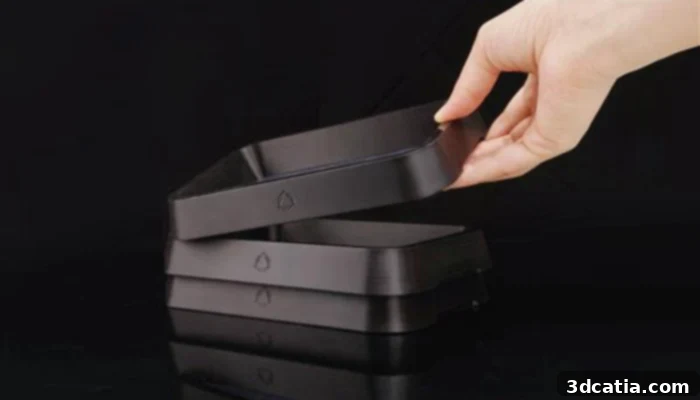
Interchangeable parts in Layer One’s Atom 2.5 printer.
3DN: How does the Atom 3 facilitate the transition between FDM and SLA printing technologies?
The ease of switching between FDM and SLA modes is one of the Atom 3’s standout features, designed for maximum user convenience and workflow efficiency. This seamless transition is made possible by our proprietary MagSwap system, which has received significant upgrades in holding power and precision specifically for the Atom 3. The MagSwap system allows users to quickly and effortlessly swap out the printer’s end effector – the tool head responsible for the printing process.
When you want to switch from FDM to SLA, you simply detach the FDM Print Module and magnetically affix the SLA Build Module in its place. Concurrently, a resin tank is easily secured to the base of the machine to hold the liquid photopolymer resin. The beauty of this system is its inherent intelligence: the printer’s firmware automatically detects which module is installed. It then adjusts all necessary parameters, including temperature settings, print profiles, and calibration routines, to correspond with the selected technology. This means the user doesn’t have to fiddle with complex settings; the printer’s advanced software takes care of virtually all the operational adjustments, ensuring a smooth and precise printing experience regardless of the chosen method. This modular approach significantly enhances the printer’s utility, eliminating the need for separate machines and streamlining the entire additive manufacturing workflow for diverse projects.
3DN: What range of materials can users expect to utilize with the Atom 3, and what is its expected price point?
When the Atom was first conceived, we took immense pride in our ability to enable easy and reliable PLA printing. While this might seem commonplace today, it was a significant technical achievement at the time. Historically, ABS was the dominant material in FDM because other plastics, like PLA, were notoriously difficult to print without constant clogging. We invested considerable engineering effort into designing a nozzle with a meticulously small melt zone and a super-sharp heat break to prevent PLA from jamming. We prioritized this development because, frankly, we were tired of ABS—it emits unpleasant fumes, often suffers from poor layer adhesion and warping, and is far from an environmentally friendly or sustainable choice.
Today, the demands of the 3D printing community have evolved significantly. Users desire a much broader spectrum of options, even for desktop applications where PLA remains a popular and safe choice. Our new engineering challenge with the Atom 3 is to provide an accessible and reliable way to print with as many materials as possible, encompassing both FDM filaments and SLA resins. This becomes even more complex and exciting when considering the possibility of combining multiple materials within a single print, opening up unprecedented design and functional possibilities. The Atom 3 is engineered to be compatible with virtually every major material currently available for desktop 3D printing, from standard PLA, PETG, and Nylons to advanced engineering filaments like carbon fiber composites, and a wide variety of photopolymer resins—including tough, flexible, castable, and even biocompatible formulations. Furthermore, it will facilitate the integration of multiple materials into one cohesive object, all while operating at significantly increased speeds without compromising print quality.
Regarding the price, while the official figures will be unveiled at its launch, I can confidently state that the Atom 3 is designed to offer exceptional value. Given its unparalleled functionality, which includes the seamless integration of FDM and SLA technologies, advanced material compatibility, and superior print speed, we believe even casual hobbyists will find it to be an incredibly worthwhile investment. For professionals and advanced users, the Atom 3 represents a cost-effective solution that consolidates the capabilities of multiple machines into one sophisticated and efficient package.
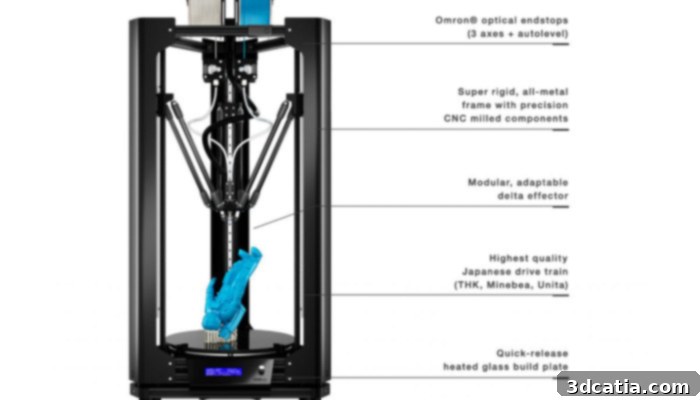
Specifications and parts of the printer.
3DN: Who is the primary target audience for the Atom 3, and what applications do you envision for it?
The Atom 3 is unequivocally designed for individuals and organizations that are constantly translating digital designs into physical objects. To be more precise, the Atom series represents sophisticated machines crafted for sophisticated users. Our core mission is to empower advanced users—including engineers, product designers, architects, and researchers—with an unparalleled level of power, versatility, and functionality, all encapsulated within the most elegant and user-friendly package possible. If your daily workflow involves rapid prototyping, creating functional components, or producing high-fidelity models, then the Atom 3 is meticulously engineered to meet your demanding needs.
We aim to deliver a machine that a seasoned professional can fully leverage for intricate and demanding tasks, such as creating complex jigs and fixtures, producing detailed architectural models, or developing proof-of-concept prototypes that require both robust FDM capabilities and fine SLA precision. Simultaneously, we’ve ensured it’s a platform that students and emerging designers can confidently learn and innovate with, providing an accessible gateway to understanding the full spectrum of additive manufacturing. Its hybrid nature makes it an ideal educational tool, allowing users to experiment with different material properties and structural requirements without needing multiple, specialized devices. Whether for advanced engineering, artistic creation, or academic exploration, the Atom 3 serves as a singular, powerful hub for digital fabrication.
3DN: What are Layer One’s future development plans for the Atom platform?
Our vision for the Atom platform extends far beyond simply combining FDM and SLA; we aspire for it to become the ultimate, all-encompassing desktop digital fabrication hub. Essentially, whatever tool or capability within the realm of digital fabrication that our users can imagine, we are actively working towards integrating it into the Atom ecosystem. The Atom 3 marks a significant leap forward, launching with its powerful hybrid FDM and SLA functionalities as a robust starting point. However, this is just the beginning.
We have an ambitious roadmap for developing a diverse array of additional modules and tools. Imagine modules for laser engraving and cutting, precise CNC milling, paste extrusion for ceramics or composites, or even integrated automated post-processing solutions. Our goal is to create a truly modular and expandable system where users can customize their Atom printer with various interchangeable heads and accessories to suit their specific creative or industrial needs. We are constantly listening to our community and exploring emerging technologies to expand the Atom’s capabilities, solidifying its role as a versatile powerhouse for personalized manufacturing and innovation. The Atom is designed to evolve, ensuring that it remains at the forefront of desktop digital fabrication for years to come.
The Atom 2.5 3D printer.
3DN: Do you have any final thoughts or messages for our readers?
Looking ahead, we firmly believe that twenty years from now, the term “3D printer” will have largely faded from common usage. Just as we no longer refer to cars as “horseless carriages,” the descriptive but somewhat clunky phrase “3D printer” will likely be superseded by something far more succinct, intuitive, and reflective of its integrated role in daily life. We envision a future where the act of creating physical objects from digital designs is so ubiquitous and effortless that the tool itself becomes a seamless extension of our creativity, much like a pen or a keyboard today.
It will probably be replaced by something shorter and easier to say, a word that encapsulates the broader concept of personalized digital fabrication and instant creation. Perhaps a four-letter word, possibly even starting with “A.” At Layer One, we are striving to be at the forefront of this evolution, making sophisticated manufacturing technology accessible, intuitive, and indispensable. Our aim is to demystify the creation process, empowering everyone to bring their ideas to life with unprecedented ease. We invite your readers to join us on this exciting journey as we redefine the future of creation.
Did you find this in-depth interview with Layer One insightful? We’d love to hear your thoughts and comments below! You can also connect with us on our Facebook and Twitter pages. Don’t miss out on the latest advancements in additive manufacturing—sign up for our free weekly Newsletter to get all the cutting-edge news in 3D printing delivered directly to your inbox!