
AREVO: Revolutionizing Manufacturing with 6-Axis Carbon Fiber 3D Printing Technology
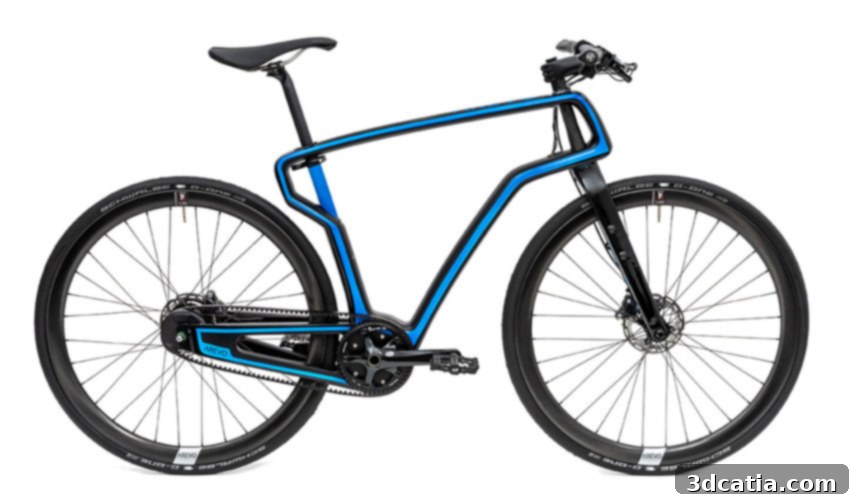
AREVO, a pioneering Californian startup, is at the forefront of a manufacturing revolution. They have developed an advanced additive manufacturing platform featuring a sophisticated 6-axis robotic arm, uniquely capable of extruding various plastics and polymers, most notably carbon fiber composites. This innovative approach to 3D printing aims to fundamentally transform traditional manufacturing processes by enabling the creation of intricate, complex geometric shapes and drastically reducing production timelines. While their inaugural and highly publicized application showcases a groundbreaking 3D printed bike frame, co-founder and president, Hemant Bheda, emphasizes that their technology extends far beyond this initial demonstration, poised to disrupt numerous industrial sectors. We had the exclusive opportunity to sit down with Mr. Bheda to delve deeper into AREVO’s proprietary technology, its profound implications, and the exciting projects on their horizon.
3DN: Can you introduce yourself and tell us more about AREVO and its genesis?

Hemant Bheda
My career began as a design engineer, working at esteemed institutions like Intel and AT&T Bell Labs. These early experiences provided an invaluable foundation, allowing me to hone my skills in combining cutting-edge innovation with rigorous engineering expertise. This period was instrumental in shaping my problem-solving approach. Following this, I relocated to Silicon Valley in California, a vibrant hub of technological advancement, where I embarked on an entrepreneurial journey. Over the years, I founded several startups across diverse technological domains, including Mediametics, Parama, and Metta. A unifying thread through all these ventures was a commitment to tackling what, at the time, was often deemed impossible. We thrived on pushing boundaries and challenging conventional wisdom.
In my previous companies, our focus primarily revolved around software solutions, and we consistently sought out the very best manufacturing partners to bring our innovations to life. After my time at Metta, I found myself immersed in the world of polymer manufacturing. This was a pivotal experience that provided me with a deep, hands-on understanding of the intricacies of the manufacturing business – a realm quite distinct from the often-abstract bubble of Silicon Valley. It was during this period that a compelling idea began to crystallize: to develop a revolutionary technology capable of creating lightweight yet incredibly strong structures for a wide array of production applications. Furthermore, the prospect of inventing a technology that could play a significant role in revitalizing and bringing manufacturing capabilities back to the United States resonated deeply with me. This powerful combination of vision and practical experience ultimately led to the creation of AREVO, a company founded on the principle of transforming manufacturing through advanced additive composites.
3DN: Can you elaborate on the unique capabilities of AREVO’s 6-axis 3D printing platform? What distinguishes it from conventional systems?
Certainly. To understand our innovation, it’s crucial to first look at the limitations of traditional 3D printers. Most conventional systems utilize a 3-axis Cartesian or delta gantry. These machines deposit material layer by layer on a two-dimensional, horizontal XY plane, much like a standard paper printer. We often refer to this as “2.5D printing” rather than true 3D printing, because the material’s structural integrity and fiber orientation are predominantly confined to two dimensions, often leading to anisotropic properties and weaker parts in the Z-axis direction.
At AREVO’s inception, we posed a fundamental question: Why continue printing on a flat plane when we could leverage the full potential of three-dimensional space by printing directly onto a 3D surface? The primary advantage we immediately recognized was the ability to dramatically enhance the strength and performance of parts, particularly in the critical Z-axis direction, by precisely aligning continuous fibers. This was a significant challenge, as it necessitated a complete reinvention of the underlying software algorithms and the development of specialized multi-axis machines capable of genuine 3D surface printing, rather than just layering. We turned to sophisticated, off-the-shelf robotic, multi-axis arms, integrating them with our proprietary software. This fusion allowed us to achieve what we now proudly call “free-motion deposition” or “True 3D printing.” Our 6-axis robot provides unparalleled dexterity and control, allowing us to extrude material along complex, non-planar paths, optimizing fiber orientation for maximum strength and minimal weight. This capability unlocks design freedom previously unimaginable in additive manufacturing, leading to parts that are not only lighter and stronger but also inherently more structurally efficient.
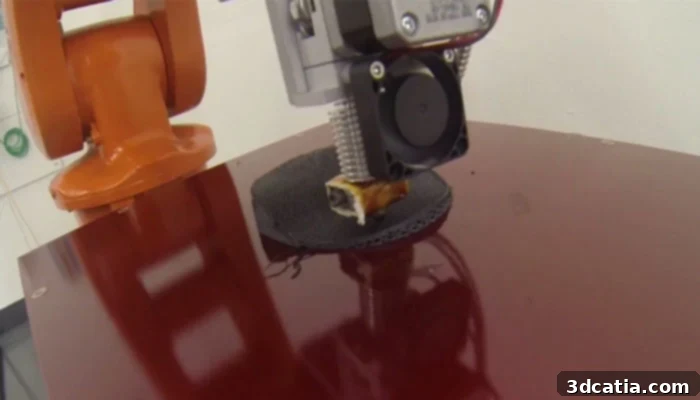
The 3D printing platform developed by AREVO
3DN: What significant advantages does AREVO’s additive manufacturing technology offer compared to traditional manufacturing methods, especially concerning composite materials?
For us, the marriage of additive manufacturing of composite materials with our advanced software yields transformative results that are simply unattainable through conventional production techniques. Our process consistently produces parts that are both significantly lighter and substantially stronger. This is due to the precise control we have over fiber placement and orientation, allowing us to engineer material properties exactly where they are needed, reducing unnecessary mass while enhancing structural integrity.
Furthermore, our technology excels at creating incredibly complex geometries. Traditional manufacturing, particularly with composites, often relies on molds, tooling, and intricate multi-step processes that severely limit design freedom. With AREVO’s platform, these geometric constraints are largely removed. We can design and produce highly optimized structures with organic shapes, internal lattices, and integrated functionalities that improve performance and reduce part count, leading to more efficient designs. This capability opens doors to innovative product designs and engineering solutions that were previously impossible or prohibitively expensive to manufacture.
Beyond design and performance, the economic benefits are profound. By integrating advanced robotics and sophisticated software, we achieve a high degree of automation that dramatically streamlines the production workflow. A critical aspect of this is the elimination of expensive and time-consuming tooling. Traditional composite manufacturing, in particular, incurs substantial costs and lead times for molds and jigs. Our tool-less process bypasses these bottlenecks entirely, allowing for rapid iteration and significant cost reductions. In fact, through automation and the removal of tooling, we have been able to reduce overall production costs by a factor of four, making advanced composite parts accessible for a much broader range of applications and industries.
3DN: You recently unveiled a remarkable 3D printed bike frame. Why choose 3D printed carbon fiber for this application, and what does it demonstrate about AREVO’s capabilities?
The 3D printed carbon fiber bike frame is more than just a product; it’s a powerful demonstration of what AREVO’s Additive Composite technology can achieve. We chose this application specifically because it perfectly showcases the technology’s ability to create ultralight and exceptionally rugged structures with geometries that were previously considered impossible to manufacture. Traditional carbon fiber bike frames are typically made by meticulously laying up sheets of carbon fiber composite by hand into molds, a process that is labor-intensive, time-consuming, and often results in design compromises due to manufacturing limitations.
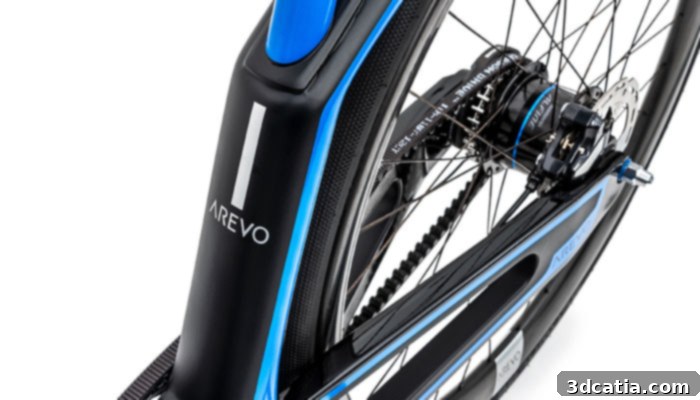
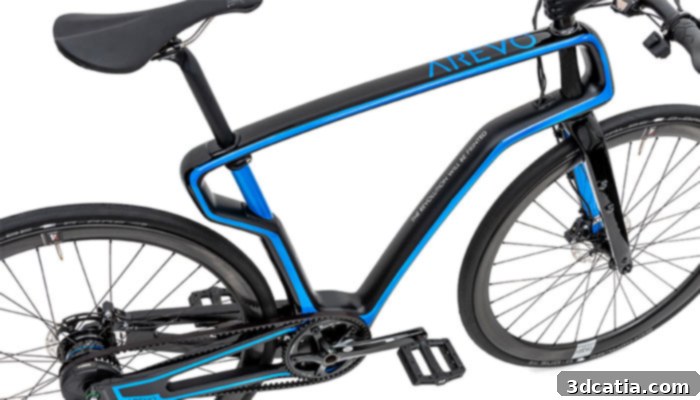
With our continuous carbon fiber 3D printing process, we can precisely orient individual carbon fibers along the load paths of the frame, optimizing stiffness and strength exactly where it’s needed while minimizing material usage elsewhere. This results in an incredibly strong, durable, and lightweight structure. The frame of the bicycle is an outstanding example of this principle in action. It’s a holistic integration of design and manufacturing that redefines what’s possible in high-performance bicycle construction.
Perhaps one of the most compelling aspects of this project is the speed of development. The entire bike, from the initial design concept to the final, rideable production, was realized in an astonishing 18 days. This contrasts starkly with the 18 months typically required for traditional manufacturing methods for a new bicycle frame. This dramatic reduction in lead time highlights our ability to rapidly innovate, prototype, and produce, significantly accelerating time-to-market for complex products.
Furthermore, our technology fundamentally enables mass customization. We are now able to offer a fully customizable bike in terms of its size, geometry, and even aesthetic style, tailored precisely to the individual rider’s physique and preferences. This level of personalization is impractical with traditional manufacturing, which thrives on economies of scale through mass production of identical items. AREVO’s approach makes high-performance, custom-fit products economically viable, ushering in a new era for consumer goods.
3DN: What exciting future projects are AREVO currently pursuing or planning?
Our vision for AREVO extends far beyond the bike frame. We are actively developing and preparing various transformative applications across a multitude of high-stakes industrial sectors. These include significant projects in construction, where lightweight yet strong composite structures can revolutionize building methods and material efficiency; in transportation, offering solutions for lighter, more fuel-efficient vehicles, from automotive to rail; and critically, in the demanding aerospace and defense sectors, where the benefits of custom, high-strength, lightweight components are paramount for performance and safety. While we cannot disclose specific details about these projects at this moment due to their proprietary nature, we can assure you that the innovation pipeline is robust and filled with solutions poised to address critical challenges in these industries. We encourage everyone to stay tuned to our news channels for upcoming announcements, as we are eager to share more as these projects mature and come to fruition.
3DN: How do you envision the future of additive manufacturing within the broader industrial landscape, particularly with advancements like AREVO’s?
We firmly believe that additive manufacturing is no longer just a prototyping tool; it is rapidly evolving into one of the most viable and indispensable options for full-scale production in the industrial sector. This is especially true for demanding applications that have traditionally struggled with the limitations of conventional manufacturing. We see immense potential in areas requiring high energy efficiency, where lightweight components directly translate to reduced operational costs and environmental impact. Our technology excels in producing parts with complex geometries, opening up new design possibilities for optimization and integration that simply weren’t feasible before. This capability is crucial for advanced engineering applications where every gram and every structural detail matters.
Furthermore, the future of manufacturing is increasingly leaning towards mass customization. Consumers and industries alike are demanding products tailored precisely to their needs, rather than generic, mass-produced items. Additive manufacturing, particularly AREVO’s platform, is perfectly positioned to deliver this, enabling bespoke production at an industrial scale without the prohibitive costs associated with traditional custom manufacturing. Finally, for applications requiring exceptionally high strength-to-weight ratios and overall resistance, such as those found in aerospace, high-performance automotive, and critical infrastructure, additive manufacturing of advanced composites provides unparalleled solutions. We anticipate a significant expansion of additive manufacturing in critical sectors such as aerospace for structural components, transportation for lighter vehicle frames and parts, and construction for innovative building materials and architectural elements, ultimately driving a more efficient, flexible, and sustainable manufacturing ecosystem worldwide.
3DN: Do you have a final message or insight you’d like to share with our readers?
What is truly most exciting and revolutionary about this technology is its inherent ability to enable the production of parts exactly when they are needed and virtually anywhere in the world. This decentralized manufacturing capability has the profound potential to rebalance global manufacturing, fostering local production, reducing supply chain vulnerabilities, and diminishing reliance on distant factories. It’s about creating a more resilient, agile, and environmentally conscious manufacturing landscape. We encourage everyone interested in the future of advanced manufacturing to explore more details about our innovations and groundbreaking projects on our official website! The journey towards a more intelligent and sustainable production future is just beginning, and AREVO is proud to be leading the way.
What are your thoughts on AREVO, their cutting-edge platform, and the remarkable 3D printed bike? We invite you to share your insights in the comments section below or join the conversation on our Facebook and Twitter pages! And for those eager to stay abreast of the latest developments in 3D printing and advanced manufacturing, remember to sign up for our free weekly Newsletter, delivering all the essential news straight to your inbox!