
Top 5 Revolutionary 3D Printing Videos: Military Innovation, Sustainable Futures, and DIY Creativity
Welcome to our weekly compilation of the most captivating and impactful developments in the world of 3D printing. This week’s Top 5 videos offer a diverse look into how additive manufacturing continues to push boundaries across various sectors, from defense and industrial production to environmental responsibility and personal projects. We’ll delve into the innovative spirit of the Australian Army as they integrate advanced metal 3D printing into their field operations, exploring how this technology enhances military logistics and readiness. We’ll also examine the crucial role of sustainability within the 3D printing industry, highlighting efforts by major players like HP to foster a circular economy through digital manufacturing. For those who enjoy hands-on projects, we feature an ingenious DIY solution for an IKEA desk, showcasing the versatility of consumer-grade 3D printing. Furthermore, we’ll explore industrial-scale solutions with Xerox’s ElemX, a printer designed to revolutionize supply chain resilience, and finally, uncover how rapid prototyping is being optimized to significantly reduce development costs and accelerate innovation. Prepare to be inspired by the transformative power of additive manufacturing as we explore these cutting-edge applications.
Top 1 – Australian Army Forges Ahead with Additive Manufacturing
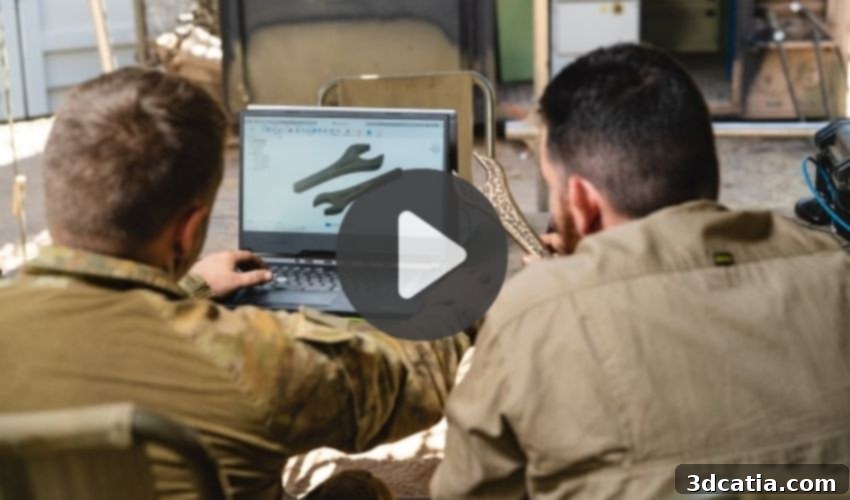
The Australian Army is at the forefront of integrating cutting-edge additive manufacturing capabilities into its operational framework, marking a significant leap forward in military logistics and field readiness. This segment highlights their pioneering efforts, showcasing the successful completion of rigorous field trials using the WarpSPEE3D metal 3D printer. This advanced cold spray technology allows for the rapid production of high-quality metal parts, crucial for maintaining equipment and reducing reliance on traditional, often vulnerable, supply chains in remote or hostile environments.
Following these successful trials, the Australian Army has established and is now actively training its first-ever additive manufacturing cell team. This specialized unit is equipped with a comprehensive skill set encompassing design, printing, machining, and certification of 3D-printed components. Their expertise is vital for ensuring that parts produced in the field meet stringent military specifications and can withstand demanding conditions. The video provides an exclusive look into the extensive testing and validation processes carried out by this dedicated cell team in Australia’s Northern Territory, underscoring the strategic importance of localized, on-demand manufacturing for defense applications. This initiative not only enhances operational self-sufficiency but also significantly reduces downtime for critical equipment, ultimately bolstering the army’s overall effectiveness. The ability to produce spare parts on demand directly at the point of need represents a paradigm shift in military supply logistics, offering unprecedented agility and responsiveness. Discover more about this groundbreaking military application of 3D printing below:
Top 2 – HP’s Commitment to Sustainable 3D Technology
In an era where environmental consciousness is paramount, companies across all manufacturing industries are increasingly recognizing their responsibility to adopt sustainable practices. The multinational technology giant HP stands out as a leader in this regard, actively pursuing initiatives with a strong focus on ecological responsibility and the promotion of a circular economy. HP is strategically leveraging its extensive additive manufacturing capabilities to significantly reduce the environmental footprint associated with production processes.
This segment delves into HP’s innovative approach to sustainability within the 3D printing landscape. The video, presented by Fast Company, offers an exclusive glimpse behind the scenes of the HP Innovation Laboratory in Palo Alto. Here, researchers and engineers are not just developing new technologies but are meticulously focusing on the future of digital manufacturing with a clear objective: to empower and promote a truly circular economy. This involves designing products for longevity, recyclability, and resource efficiency, minimizing waste at every stage of the product lifecycle. From exploring new eco-friendly materials to optimizing energy consumption in their printers and developing closed-loop recycling programs for printed parts and powders, HP is demonstrating a holistic commitment to reducing its environmental impact. Their efforts show how 3D printing, with its inherent ability to create complex geometries with minimal material waste and facilitate on-demand localized production, can be a powerful tool for sustainable manufacturing. By focusing on these principles, HP aims to set a new standard for environmentally responsible production within the additive manufacturing sector. Learn more about their vision for a greener future in manufacturing:
Top 3 – Creative D.I.Y. Solutions with 3D Printing: The Router Table Adjustment
While industrial applications of 3D printing often capture headlines, the technology’s democratizing power for everyday problem-solving and creative DIY projects should not be overlooked. This week, we showcase an ingenious D.I.Y. solution that highlights the accessibility and practical utility of personal 3D printers. The project involves 3D printing and assembling a custom component designed to adjust the height and angle of an IKEA desk, offering a personalized and ergonomic solution for students or home office users.
This particular DIY router table component utilizes parts made with common desktop 3D printing filaments: PLA (Polylactic Acid) for rigid structures and TPU (Thermoplastic Polyurethane) for parts requiring flexibility and grip. The design process itself leveraged sophisticated parametric modeling tools, having been crafted in Rhino 3D in conjunction with Grasshopper. This combination allowed the maker to create a precisely fitting and functionally optimized component. While this makeshift router table attachment may not be a permanent industrial-grade replacement, the maker certainly crafted a well-made temporary substitute perfectly suitable for basic woodworking tasks requiring minimal support and offering impressive versatility. It exemplifies how 3D printing empowers individuals to design and produce custom tools or modifications that perfectly fit their unique needs, often at a fraction of the cost and time of traditional manufacturing methods. Such projects inspire innovation and demonstrate the diverse applications of additive manufacturing beyond high-tech industries, bringing custom fabrication directly into homes and workshops. Witness the creative potential of desktop 3D printing in action:
Top 4 – Additive Manufacturing: A Game Changer for Supply Chain Resilience
The recent global health crisis vividly exposed the inherent vulnerabilities and fragilities of traditional supply chains, causing widespread disruptions that severely impacted manufacturing companies worldwide. Long lead times, geographical dependencies, and unexpected stoppages brought many industries to a grinding halt, underscoring the urgent need for more robust and flexible production solutions. Additive manufacturing emerges as a powerful antidote to these challenges, offering a pathway to unprecedented supply chain resilience and flexibility.
This segment introduces a significant industrial solution poised to revolutionize how companies approach manufacturing and logistics: the Xerox® ElemX ™ 3D printer. Developed by Xerox, a company renowned for its innovation, the ElemX is engineered to tackle supply chain disruptions head-on. How does it achieve this? By enabling manufacturers to produce robust, production-grade metal parts directly on-site and on-demand, often in a matter of hours rather than weeks or months. This capability drastically reduces reliance on distant suppliers and minimizes the need for extensive physical inventory, thereby lowering warehousing costs and mitigating risks associated with global shipping and political instability.
The Xerox ElemX printer utilizes a liquid metal additive manufacturing process, allowing for the creation of functional parts that are suitable for demanding industrial applications. This technology empowers companies to take control of their production, fostering a more agile and responsive manufacturing ecosystem. By creating a decentralized manufacturing network, businesses can adapt more quickly to market demands, unforeseen events, and changing customer needs. The benefits extend beyond crisis management, offering strategic advantages such as accelerated product development, cost reduction through optimized inventory, and enhanced customization options. This innovative solution provides significant benefits to companies seeking to strengthen their operational continuity and strategic independence in the additive manufacturing sector. We encourage you to discover for yourself how this technology is disrupting and fortifying global supply chains:
Top 5 – Revolutionizing Rapid Prototyping with Additive Manufacturing
Prototyping is an absolutely critical, yet often bottlenecked, phase in any product development cycle and additive manufacturing project. Traditionally, this stage can be plagued by significant challenges, including long lead times for bespoke parts, exorbitant costs associated with tooling and multiple iterations, and a complex logistical process. Producing a prototype with the same functionality and material properties as the final product typically requires employing the same manufacturing processes, which can be time-consuming and expensive, thus slowing down innovation and increasing overall project costs.
However, this video offers a compelling look into how these conventional barriers are being systematically dismantled by advancements in rapid prototyping through 3D printing. Formlabs, a leader in desktop and benchtop stereolithography (SLA) and selective laser sintering (SLS) 3D printers, brilliantly demonstrates how companies can dramatically reduce both the costs and time associated with producing high-fidelity prototypes. Their integrated ecosystem of rapid prototyping printers and intuitive software solutions is designed to streamline the entire prototyping workflow.
The key advantage of Formlabs’ approach lies in its ability to quickly translate digital designs into physical objects with exceptional detail and accuracy. This allows engineers and designers to conduct multiple design iterations in a fraction of the time, test concepts rigorously, and validate functionalities much earlier in the development process. By providing access to professional-grade prototyping capabilities at an accessible price point, Formlabs empowers businesses, from startups to large enterprises, to accelerate their innovation cycles. This not only speeds up time-to-market for new products but also facilitates a more iterative and experimental design process, ultimately leading to superior final products. The video illustrates how their technology can create functional prototypes that closely mimic the final product’s performance, thereby ensuring a smoother transition from prototype to full-scale production. See how Formlabs is setting new standards for efficiency in rapid prototyping:
What do you think of this week’s compelling compilation of 3D printing videos? From the cutting-edge applications in military logistics and the vital push for sustainability in manufacturing, to clever DIY solutions and industrial breakthroughs in supply chain resilience and rapid prototyping, these stories underscore the incredible versatility and transformative power of additive manufacturing. We’d love to hear your thoughts and insights! Share your comments below or engage with us on our Facebook and Twitter pages. Don’t miss out on the latest advancements and news in the dynamic world of 3D printing; make sure to sign up for our free weekly newsletter, delivered straight to your inbox!