
Revolutionizing Additive Manufacturing: Addiguru’s Real-Time Monitoring for Enhanced Quality and Productivity
In the dynamic and rapidly evolving landscape of additive manufacturing, users frequently encounter the challenge of potential manufacturing defects. These imperfections are more than just a minor inconvenience; they represent significant losses in time and financial investment, while critically compromising the quality and integrity of the final product. Addressing these pervasive issues, the innovative startup Addiguru has emerged with a sophisticated software solution designed to mitigate defects and streamline the production workflow. By providing real-time monitoring capabilities, Addiguru aims to automate crucial aspects of the additive manufacturing process. Initially, this groundbreaking solution is tailored for Laser Powder Bed Fusion (LPBF) technology, a high-precision method often used for metal parts. However, the vision extends far beyond this, with plans to expand its applicability to other prominent 3D printing methods, including Fused Deposition Modeling (FDM) and Directed Energy Deposition (DED). To gain a deeper understanding of this transformative software, its diverse functionalities, and Addiguru’s ambitious future endeavors, we had the privilege of interviewing Shuchi Khurana, the pioneering CEO of Addiguru.
3DN: Can you introduce yourself and tell us about your relationship to 3D printing?

Shuchi Khurana
Certainly. I hold a Master’s degree in Materials Engineering, and my professional background is deeply rooted in the predictive analysis of welding and joining processes. These processes are fundamentally related to the underlying principles of various 3D printing technologies, especially those involving material fusion. In my previous startup venture, I leveraged 3D printing extensively for rapidly prototyping medical devices. This experience was incredibly valuable, allowing us to quickly iterate and refine designs, significantly accelerating our development cycles. For over a decade, I have dedicated my career to developing and successfully launching numerous products, including a predictive maintenance software solution for a prominent global manufacturing company. This extensive experience in predictive analytics and product development laid a crucial foundation for the vision behind Addiguru.
3DN: How did the idea to create ADDIGURU come up? Can you tell us how your monitoring technology works?
The concept for Addiguru originated from a deep understanding of additive manufacturing processes. As a layer-by-layer fabrication method, each successive layer presents a unique opportunity to observe and assess the quality of the build. My extensive experience with predictive analysis in manufacturing led me to realize that while many existing monitoring solutions focused on continuous observation of the melt pool – an incredibly challenging task due to the laser’s rapid movement and the immense volume of data generated – a more practical and industrially scalable approach was needed. Monitoring the process layer by layer, I concluded, offers a far more manageable and affordable solution for the industry. I recognized a significant opportunity to apply my past experience in predictive analysis and product launches to address this critical gap. This conviction led me to establish Addiguru in September 2019. The name itself reflects our mission: ‘Addi’ is derived from Additive Manufacturing, and ‘guru’ signifies our aim to create an intelligent software that provides expert guidance and insights for 3D printing processes, much like a seasoned guru guides their disciples. Our technology works by capturing data at each completed layer, analyzing it for anomalies, and applying sophisticated predictive algorithms to identify potential defects before they escalate. This proactive approach significantly reduces waste and improves overall part quality.
3DN: Which brands and AM technologies can implement ADDIGURU’s monitoring system?
Addiguru’s overarching vision is to establish a universal platform capable of monitoring all additive manufacturing technologies. We initiated our journey by focusing on the Laser Powder Bed Fusion (LPBF) process, and our software architecture has been meticulously designed to facilitate the seamless integration of additional processes. Currently, we are actively developing the capabilities to incorporate FDM (Fused Deposition Modeling) processes, with a beta launch anticipated soon. Furthermore, support for DED (Directed Energy Deposition) processes is slated for inclusion in the coming months, underscoring our commitment to a comprehensive solution. A cornerstone of Addiguru’s philosophy is its brand-agnostic nature. Our software is compatible with a wide array of machine brands and is also sensor-agnostic, meaning it can integrate with various types of sensors already present on machines or easily retrofitted. This flexibility ensures that manufacturers are not locked into specific hardware ecosystems and can leverage their existing investments while upgrading their monitoring capabilities.
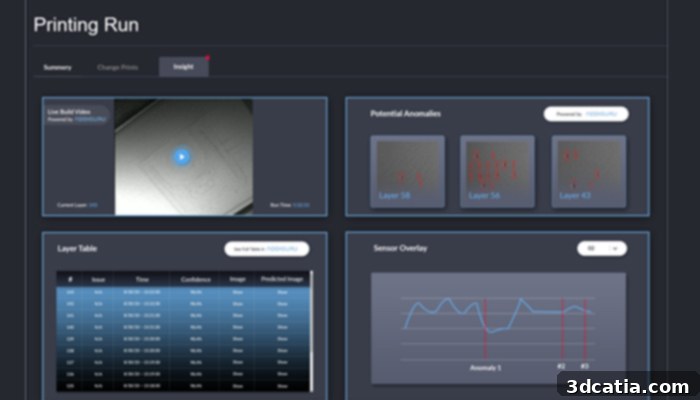
Addiguru’s platform interface showing real-time data
3DN: In your opinion, why is it important nowadays to implement an AM monitoring system? How can it help to improve productivity?
Implementing an advanced AM monitoring system has become not just beneficial but absolutely critical in today’s manufacturing environment. The additive manufacturing process is inherently complex, influenced by a multitude of factors, from material properties to environmental conditions and machine parameters. Even minor variations in any of these process parameters can result in a defective part, often with internal flaws that are invisible to the naked eye. An operator, no matter how experienced, can easily miss these subtle variations that could ultimately compromise the part’s structural integrity or performance. A robust, real-time monitoring system like Addiguru’s provides an unprecedented level of confidence in the quality of produced parts. This assurance is vital for accelerating the adoption of AM, especially in highly regulated industries such as aerospace and medical where part reliability is paramount. By enabling immediate detection of anomalies, it significantly reduces the reliance on costly and time-consuming Non-Destructive Testing (NDT) at the end of the build process. This shift from reactive inspection to proactive quality control is a game-changer. In metal AM processes, particularly Direct Metal Laser Sintering (DMLS), the defect rate can be notably high, and each part can represent a substantial investment in materials, machine time, and labor. Our meticulous calculations indicate that for a DMLS process, a real-time monitoring solution that alerts operators to anomalies can generate average annual savings of approximately $160,000 per machine. Many industry professionals even contend that this figure is conservative and that the actual value derived can be even higher when considering expedited delivery times and enhanced customer satisfaction. While the savings for polymer part production may be slightly lower due to less expensive materials, the gains in productivity, reduced waste, and improved part reliability remain highly significant with a real-time monitoring system.
3DN: Can you tell us what sectors you’re targeting? Can you share some of your current clients with us?
Our initial focus has been on proving the efficacy of our software in critical applications. We currently have a beta version of our software specifically for the LPBF process, which is deployed across four diverse locations. These include reputable service bureaus that cater to various industries, as well as a leading research institution dedicated to advancing additive manufacturing technologies. The part manufacturers utilizing our system are primarily concentrated in the highly demanding Aerospace industry, where precision and reliability are non-negotiable, and the tool-making industry, which benefits immensely from rapid prototyping and high-quality production. We are also actively engaged in discussions to expand our installations, notably with a company specializing in the production of medical implants – another sector where stringent quality control is paramount. Looking ahead, we are making significant progress in integrating FDM process monitoring into our software, with its beta launch anticipated by the end of 2020. This will open doors to a broader range of applications and industries. Following this, DED process monitoring is scheduled for integration in Q1 2021, further solidifying our platform’s versatility and reach across different additive manufacturing technologies and the diverse sectors that employ them.
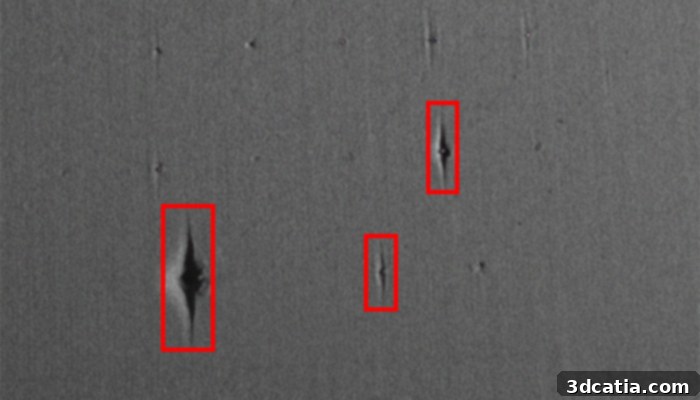
Anomalies detected in the laser fusion process by Addiguru’s artificial intelligence algorithms are indicated by red boxes, providing critical insights for quality control.
3DN: Where do you see ADDIGURU in 5 years?
In five years, we envision Addiguru as an indispensable and foundational technology within the additive manufacturing ecosystem. As I mentioned earlier, our core vision is to build a truly platform-agnostic technology – independent of specific machine brands, sensor types, and even specific processes. We anticipate that within this timeframe, Addiguru will have developed into a robust, widely adopted, and immensely beneficial software solution across the global AM industry. A key aspect of our future is the concept of the “digital twin.” We foresee a future where the data meticulously collected and analyzed by Addiguru’s software will enable the creation of a comprehensive digital twin for every manufactured part. This digital twin will encapsulate the entire build history, offering unprecedented traceability and quality assurance, from the initial powder to the final component. Furthermore, we expect our software to be deeply embedded within AM machines, sold as a seamless add-on solution directly by Original Equipment Manufacturers (OEMs). This integration will ensure that quality monitoring is an inherent part of the machine’s functionality. Alongside OEM partnerships, Addiguru’s data and intuitive user interface will remain accessible directly from our platform, and crucially, will be fully integrated with various Manufacturing Execution System (MES) software solutions available in the market. This multi-faceted approach will cement Addiguru’s position as a central hub for quality control and process optimization in additive manufacturing.
3DN: Do you have any last words for our readers?
Additive manufacturing is truly an exciting and transformative technology that is experiencing explosive growth. However, to unlock its full potential and achieve widespread industrial adoption, addressing quality and reliability challenges is paramount. This is precisely where real-time monitoring systems come into play. Such systems can drastically reduce wasted time, minimize financial losses, and eliminate many of the operational headaches that part manufacturers currently face. I strongly encourage all professionals within the industry to thoroughly evaluate the profound benefits that real-time monitoring can offer and to actively seek out appropriate tools to implement these capabilities. Moreover, it is crucial for researchers and engineers who are dedicated to developing real-time monitoring technologies to actively engage with end-users. Hearing directly from users about their specific needs, challenges, and pain points is essential for developing solutions that are truly helpful, practical, and impactful. So, please, be vocal about your operational challenges and what you need from these technologies.
Another critical observation is that virtually all experts in the AM industry concur that a sophisticated monitoring system would provide immense benefits to users and the industry at large. Despite this consensus, there is a noticeable dearth of comprehensive quantitative studies that rigorously assess the advantages and return on investment of real-time monitoring systems for additive manufacturing processes. I earnestly encourage the engineering and business school communities to collaborate on such vital research. These studies are essential to provide empirical evidence and validate the economic and operational benefits, thereby fostering greater investment and adoption. If you wish to learn more about Addiguru and our innovative solutions, please visit our website HERE.
What are your thoughts on Addiguru’s groundbreaking solution for additive manufacturing? We invite you to share your insights in a comment below or join the conversation on our Linkedin, Facebook, and Twitter pages! Don’t miss out on the latest advancements in 3D printing; sign up for our free weekly Newsletter here and get the freshest news delivered straight to your inbox!