
Top 5 Innovations in Additive Manufacturing: Revolutionizing Industries with 3D Printing
Additive manufacturing, commonly known as 3D printing, continues to redefine what’s possible across a multitude of sectors, from healthcare to construction and sustainable engineering. This dynamic technology is rapidly evolving, pushing the boundaries of material science, design complexity, and production efficiency. For this week’s essential insights, we’ve curated five groundbreaking videos that showcase the forefront of additive manufacturing innovation. These highlights delve into fascinating applications, including the creation of eco-friendly biocomposites, the development of life-saving bioresorbable heart valves, advanced techniques for mass production, sustainable housing solutions, and specialized components for filtration and flow control systems. Join us as we explore these transformative advancements that are shaping the future of manufacturing. Happy watching!
1. Sustainable Futures: Exploring 3D Printed Recycled Biocomposites
In an era where sustainability is paramount, the convergence of additive manufacturing and eco-friendly materials offers a powerful solution. Breton, a renowned Italian multi-sector industrial group, stands at the forefront of this movement. Known for designing and building sophisticated machinery across diverse technologies, Breton is now making significant strides in large-scale additive manufacturing using recycled biocomposites. This innovative approach allows companies to drastically reduce waste and production costs without compromising on performance or structural integrity.
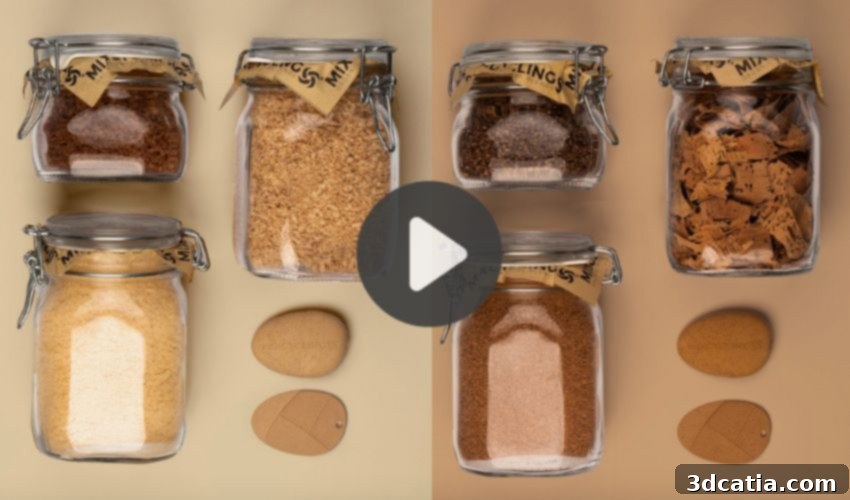
This fascinating video explores how Breton collaborates with Mixcycling, a pioneer in eco-friendly material development, and leverages the specialized expertise of Stylplex. By combining these forces, Breton is propelling sustainable additive manufacturing to unprecedented levels. Mixcycling excels in transforming various recycled materials—such as cork, wood, bamboo, coconut, and even discarded denim—into high-performance, sustainable composites. These materials are not only environmentally responsible but also offer unique properties suitable for a wide range of applications, from consumer goods to industrial components. The ability to integrate such diverse organic and recycled matter into 3D printable filaments or pastes opens up a world of design possibilities, fostering a circular economy model within manufacturing. Discover the impact these materials are making and the innovative processes behind them in the video below:
2. Advancing Cardiovascular Health: 3D Printed Bioresorbable Heart Valves
Heart valve disease affects over five million Americans annually, often necessitating complex surgeries, which can lead to further interventions, especially in pediatric patients. The prospect of an implant that could naturally integrate and regenerate tissue, eliminating the need for repeated operations, is a medical marvel. Researchers at Georgia Tech are turning this vision into a reality with their groundbreaking work on 3D printed bioresorbable heart valves.
This remarkable innovation utilizes advanced 3D printing techniques to create heart valves from biocompatible materials that are designed to gradually dissolve within the body over time. Crucially, as these printed structures resorb, they actively promote the body’s natural tissue regeneration processes, allowing the patient’s own cells to rebuild and take over the function of the valve. This transformative solution promises a new paradigm in cardiac care, offering immense benefits for both adult and pediatric heart patients. For children, it means avoiding multiple surgeries as they grow, and for adults, it reduces the long-term risks associated with permanent artificial implants. The precision and customization offered by 3D printing are essential here, allowing valves to be tailored to individual patient anatomy, ensuring optimal fit and function. This research represents a significant leap forward in tissue engineering and offers hope for millions worldwide. Learn more about this incredible research and its potential impact on millions of lives:
3. Revolutionizing Production Speed: Visitech’s Multihead Scrolling Technology for Mass Production
For additive manufacturing to truly compete with traditional mass production methods, scalability and speed are critical. Visitech, a leading DLP (Digital Light Processing) systems company, is tackling this challenge head-on with its innovative multihead scrolling technology. Specializing in high-performance solutions for direct imaging lithography and additive manufacturing subsystems, Visitech is redefining what’s possible for industrial-scale 3D printing.
Their groundbreaking solution employs scrolling light engines, which dramatically multiply the effective build area per photo head. Unlike static DLP systems with fixed build platforms, this scrolling mechanism allows the photoheads to traverse a much larger printing bed. This means manufacturers are no longer limited by the physical size of a single projector’s field of view; they can theoretically utilize a print bed of almost any size that the photoheads can cover. The key benefit of this approach is the ability to achieve a vast build space while maintaining micrometer-level accuracy—a crucial factor for precision engineering—without compromising on cost-efficiency or throughput. This technology promises to unlock true mass production capabilities for additive manufacturing, enabling the rapid and accurate creation of large batches of components or even very large single parts. Industries requiring high precision and significant volume, such as automotive, aerospace, and consumer electronics, stand to benefit immensely from Visitech’s advancements. Discover how this technology is setting new benchmarks for speed and precision in 3D printing:
4. Building the Future: Emergent 3D Plans for 3D Printed Homes in Los Angeles
In regions susceptible to natural disasters like wildfires, and amidst a pressing housing crisis, the advent of 3D printed homes offers a beacon of hope. These innovative structures promise not only accelerated construction times but also enhanced resilience and safety. Emergent 3D, a visionary company based in Northern California, has already demonstrated the life-saving potential of this technology by successfully 3D printing several fire-resistant homes made from concrete in Redding, California. These homes provide durable and secure shelter, offering a robust alternative to conventional building methods.
Building on their proven success, Emergent 3D is now expanding its transformative efforts into Los Angeles. The company has already secured its first contract with a family in the bustling city and has ambitious plans for further construction projects throughout the area. Their approach involves using large-scale concrete 3D printers that can rapidly construct the walls and foundational elements of a home, significantly reducing both labor costs and construction timelines. Beyond mere efficiency, 3D printing offers design flexibility and the ability to build homes that are more resistant to environmental threats, including fires and seismic activity, which are particularly relevant in California. This technology not only addresses housing shortages but also contributes to building safer, more sustainable communities. Learn more about their innovative 3D printing process and its profound promise to help those affected by housing challenges and natural disasters:
5. Enhancing Industrial Performance: Additive Manufacturing for Filtration and Flow Control
In many industrial applications, filtration and flow control systems are critical for efficiency, purity, and operational integrity. These systems frequently rely on intricate, specially designed components that are engineered to minimize pressure drop and optimize energy consumption. However, creating these highly complex geometries—featuring internal channels, porous structures, and precise pathways—often proves challenging, or even impossible, using traditional manufacturing methods like casting, machining, or welding. These conventional techniques are limited by tool access and material removal capabilities, making intricate internal designs particularly difficult to achieve.
Additive manufacturing, with its layer-by-layer fabrication process, offers a revolutionary solution to these design constraints. Global engineering technology company Renishaw, a leader in metal 3D printing, has partnered with Mott Corporation, a renowned manufacturer of filtration and flow control components, to unlock new possibilities. Renishaw provided Mott Corporation with its cutting-edge RenAM 500S Flex machine, specifically designed for robust and flexible metal additive manufacturing. This partnership enables Mott Corporation to produce previously unattainable component designs, offering superior performance characteristics such as enhanced fluid dynamics, greater surface area for filtration, and reduced weight. The ability to create parts with optimized internal structures directly translates to improved system efficiency, lower energy consumption, and increased product lifespan for their clients. Discover the immense benefits of this strategic collaboration and how additive manufacturing is bringing unparalleled flexibility and performance to the demanding fields of filtration and flow control in the video here:
The innovations highlighted this week underscore the incredible versatility and transformative power of additive manufacturing. From creating sustainable biocomposites that reduce environmental impact to developing life-saving medical devices and advancing mass production capabilities, 3D printing is truly at the forefront of industrial and technological progress. What are your thoughts on the potential of 3D printed biocomposites and other groundbreaking applications? Let us know in a comment below, or engage with us on our LinkedIn, Facebook, and Twitter pages! Don’t forget to sign up for our free weekly Newsletter here to get the latest 3D printing news delivered straight to your inbox! You can also find all our compelling videos and more insights on our YouTube channel.
*Cover Photo Credit: Organic materials that form biocomposites. Credit: Mixcycling