
Unlocking Innovation: Top 5 Transformative Applications of 3D Printing and Additive Manufacturing
In an era defined by rapid technological advancement, 3D printing, also known as additive manufacturing, stands out as a true game-changer. This revolutionary technology is not just an industrial trend; it’s fundamentally reshaping how products are designed, produced, and deployed across virtually every industry. From enhancing critical healthcare responses to revolutionizing traditional manufacturing processes and preserving our invaluable cultural heritage, the reach of 3D printing is expanding at an unprecedented pace. This week, we’ve curated a compelling selection of the top 5 videos that vividly illustrate how additive manufacturing is driving innovation and transforming various sectors. We’ll explore groundbreaking applications ranging from medical breakthroughs and automotive advancements to intricate cultural preservation projects and efficient toolmaking. Join us as we dive into these inspiring examples and discover the immense potential of 3D printing. For those eager to delve deeper, our dedicated Youtube channel offers an extensive library of 3D printing videos to explore even further. We hope you enjoy this insightful journey into the future of manufacturing!
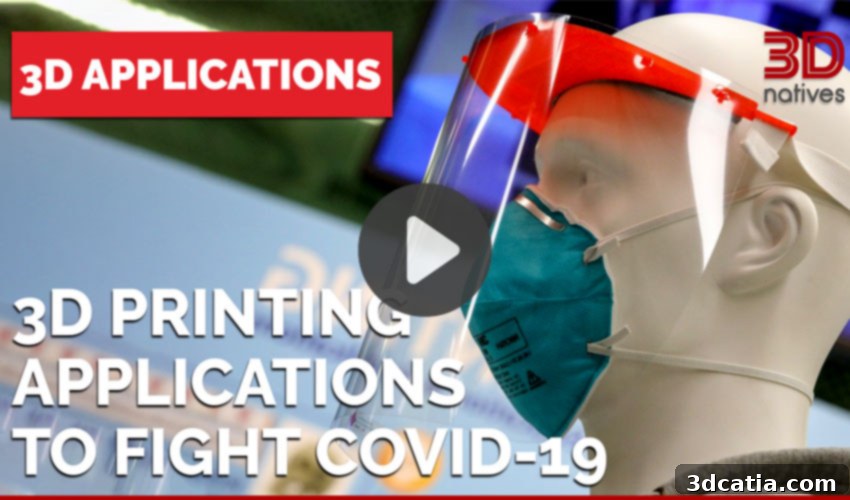
Top 1: How 3D Printing Mobilized to Combat the COVID-19 Pandemic
The global health crisis presented by COVID-19 brought unprecedented challenges, exposing critical vulnerabilities in traditional supply chains, especially concerning medical equipment. In this moment of acute need, the worldwide 3D printing community rose to the occasion, demonstrating an extraordinary capacity for rapid innovation and decentralized production. As hospitals faced severe shortages of personal protective equipment (PPE) and essential medical devices, countless initiatives sprung up, leveraging additive manufacturing to bridge the gap.
From individual hobbyists with desktop printers to large industrial enterprises, the collective effort was immense. Volunteers and companies alike began producing vital supplies such as customized face shields, protective goggles, and even redesigned respirator components. The agility of 3D printing allowed for rapid prototyping and iteration, enabling designs to be quickly tested, improved, and disseminated globally. This rapid response capability meant that critical protective gear for frontline medical staff – items like hands-free door openers, mask adjusters, and medical swabs – could be manufactured on-demand, often locally, bypassing the delays inherent in traditional manufacturing and shipping. This video showcases the remarkable dedication and innovative spirit of the 3D printing sector in confronting one of the greatest public health challenges of our time, highlighting its potential as a crucial resource in future crises.
Top 2: Automotive Giant Ford Harnesses 3D Printing for Essential Face Shields
The rapid adoption of additive manufacturing during the COVID-19 pandemic extended far beyond specialist 3D printing companies, drawing in major industrial players from diverse sectors. Automotive giant Ford Motor Company exemplifies this shift, repurposing its advanced manufacturing capabilities to address critical public health needs. Operating from its state-of-the-art manufacturing center, Ford swiftly pivoted its operations, running its industrial 3D printers at peak capacity to produce thousands of much-needed face shields for medical professionals.
Leveraging validated designs, including models similar to those popularized by Prusa, Ford demonstrated the incredible adaptability of its production facilities. The company utilized its robust industrial-grade machines, specifically employing Stratasys FDM (Fused Deposition Modeling) solutions for their reliability and ease of use, alongside high-performance SLS (Selective Laser Sintering) printers from industry leader EOS for greater volume and material versatility. While exact daily production figures remain undisclosed, the sheer scale of their available equipment suggests a massive output, significantly contributing to the supply of essential PPE. This initiative not only showcased the immense power of additive manufacturing in the automotive sector but also highlighted the critical role that large corporations can play in times of crisis, underscoring the versatility and societal impact of modern manufacturing technologies.
Top 3: Preserving and Rebuilding Cultural Heritage with 3D Printing
The world’s rich cultural heritage, embodied in ancient artifacts, historical structures, and intricate artworks, faces constant threats. Whether from the ravages of time, the destruction caused by wars, the unpredictable forces of natural disasters, or the slow degradation from environmental factors, preserving these invaluable relics for future generations is a monumental challenge. Fortunately, 3D printing technologies offer a powerful and innovative solution to this ongoing dilemma, providing new avenues for both conservation and reconstruction.
The process typically begins with advanced 3D scanning, which meticulously captures every detail of an object or site, creating a precise digital model. This digital twin serves as an invaluable archive, safeguarding the form and structure of the artifact even if the original is lost or further damaged. Once digitized, these models can be brought back to life through additive manufacturing. Using 3D printers, perfect physical reproductions can be created, ranging from small, intricate pieces to large-scale architectural elements. These replicas can be used for museum exhibitions, educational purposes, or even to replace damaged sections of historical monuments, ensuring their longevity and accessibility.
The results of this technological marriage between preservation and reproduction are often breathtakingly impressive, allowing us to interact with history in unprecedented ways. The accompanying video features Acciona, a company at the forefront of this application, demonstrating its sophisticated workflow. They explain not only the intricate process of scanning and digital reconstruction but also showcase the impressive capabilities of their large-format 3D printing machines, which can replicate significant cultural artifacts with remarkable accuracy and scale. This innovative approach ensures that our collective past remains tangible and accessible, bridging the gap between historical fragility and future understanding.
Top 4: Revolutionizing Toolmaking with Additive Manufacturing
Tooling, encompassing jigs, fixtures, molds, and patterns, is a critical component of virtually every manufacturing process. Traditionally, toolmaking has been a time-consuming and expensive endeavor, often involving complex machining or casting processes. However, additive manufacturing has emerged as a disruptive force, offering unprecedented advantages in terms of speed, cost-efficiency, design flexibility, and performance enhancements for various tooling applications. The video below provides an insightful look into how modern industries are leveraging 3D printing technologies to create superior tools.
One of the primary benefits of using 3D printing for toolmaking is the ability to produce highly customized and geometrically complex designs that would be impossible or prohibitively expensive to create with conventional methods. This enables engineers to optimize tools for specific functions, often leading to lighter, more ergonomic designs that improve worker efficiency and reduce fatigue. Furthermore, additive manufacturing drastically cuts down lead times for tool production, allowing for faster iterations and quicker adaptation to design changes on the production line.
The process involves several crucial steps, starting with “Design for Additive Manufacturing” (DfAM). This specialized design approach considers the unique capabilities and limitations of 3D printing processes, such as minimizing material usage, integrating multiple parts into a single print, and optimizing internal structures for strength and weight. The video delves into these considerations, emphasizing the importance of intelligently incorporating and then minimizing support structures – temporary geometries necessary to ensure the structural integrity of complex overhangs during the printing process. By understanding these principles, manufacturers can create highly efficient, durable, and cost-effective tools, transforming their production workflows and unlocking new levels of operational excellence. Dive into the video to explore the intricate world of additive toolmaking!
Top 5: Accelerating Innovation in the Transportation Sector with 3D Printing
The transportation industry, encompassing everything from automotive and aerospace to rail and marine, is constantly striving for innovation, efficiency, and safety. 3D printing, or additive manufacturing, has emerged as a pivotal technology, significantly accelerating development cycles and enabling groundbreaking advancements across the sector. This final video in our series highlights the profound impact of additive manufacturing on the transportation landscape, specifically showcasing its application within rail.
One prime example is the collaboration between Stratasys, a leading provider of 3D printing solutions, and Bombardier Transportation. In German-speaking countries, Bombardier has successfully integrated Stratasys’ additive manufacturing technology into its operations to dramatically speed up the development process for new train designs and components. The ability to rapidly prototype complex parts, test various iterations, and even produce end-use components on-demand offers immense benefits.
For transportation, these benefits are multi-faceted: it allows for the creation of lighter parts, which translates to improved fuel efficiency and reduced operational costs. Engineers can design components with optimized geometries, leading to enhanced performance and passenger comfort. Furthermore, 3D printing facilitates the customization of interior elements and the production of spare parts for older models, alleviating supply chain issues and extending the lifespan of vehicles. The speed with which new designs can move from concept to physical prototype, and even to final production, is truly transformative. This video offers a compelling glimpse into how companies like Bombardier are embracing additive manufacturing to drive innovation, improve sustainability, and set new standards in the design and production of future transportation systems. Don’t miss this insightful demonstration of 3D printing in the transportation sector.
The videos showcased today offer just a glimpse into the vast and continually expanding universe of 3D printing and additive manufacturing. From rapidly responding to global health crises and revolutionizing industrial production lines to meticulously preserving invaluable cultural artifacts and accelerating innovation in critical sectors like transportation, the applications are as diverse as they are impactful. These examples underscore the technology’s inherent versatility, its capacity for rapid iteration, and its potential to democratize manufacturing and problem-solving on a global scale.
We’ve seen how 3D printing is not just a niche technology but a foundational pillar of future manufacturing, empowering industries to be more agile, sustainable, and responsive to evolving demands. As materials science advances and printer capabilities expand, we can only expect to see even more astonishing applications emerge, further blurring the lines between digital design and physical reality.
What are your thoughts on these incredible 3D printing applications? Which innovation do you find most compelling, and what future possibilities do you envision? We invite you to share your insights and engage with our community by dropping a comment below or by connecting with us on our vibrant social media platforms, including Facebook and Twitter. To stay at the forefront of the latest advancements, trends, and news from the dynamic world of the 3D industry, don’t forget to sign up for our free weekly Newsletter, delivered straight to your inbox. Keep exploring, keep learning, and keep building the future with additive manufacturing!