
Unveiling the Future: Revolutionary 3D Printing Applications at RAPID + TCT 2024
As the curtains close on RAPID + TCT 2024, North America’s premier additive manufacturing event, the overwhelming takeaway is the boundless potential of 3D printing across an astonishing array of industries. From groundbreaking innovations in medical and aerospace sectors to creative breakthroughs in entertainment and sustainable manufacturing, the event served as a powerful testament to how additive manufacturing is reshaping our world. Attendees witnessed firsthand how this transformative technology is being leveraged to create intricate, functional, and often awe-inspiring parts. We embarked on a journey through the exhibition halls, meticulously examining some of the most captivating 3D printed applications showcased by leading exhibitors, highlighting their ingenuity and the tangible impact of advanced manufacturing. Join us as we delve into these remarkable examples that underscore the versatility and innovative spirit driving the 3D printing revolution.
Stratasys’ Electrifying 3D Printed Drum Set: A Harmony of Tech and Artistry
Prepare for a crescendo of innovation! For anyone who has followed popular music since the mid-2000s, Panic! At the Disco is a name synonymous with catchy anthems. What might come as a surprise, however, is the band’s drummer, Dan Pawlovich, is not only a talented musician but also an avid advocate for 3D printing technology. This passion culminated in a truly unique commission: a full 3D printed drum set crafted by Stratasys Direct Manufacturing, a testament to the technology’s readiness for demanding, real-world applications. This isn’t just a prototype; these drums have actually hit the road, gracing stages during the band’s tours. At Stratasys’ booth at RAPID + TCT 2024, two distinct versions of Pawlovich’s custom drum kits were proudly displayed, each demonstrating different facets of Stratasys’ capabilities. One set utilized advanced polymer powder bed fusion, a technique celebrated for its ability to produce complex geometries with excellent surface finish and material properties. The other showcased the robust FDM (Fused Deposition Modeling) process. Most remarkably, the FDM-printed snare drum was played by Pawlovich directly off the printer, without any post-processing, highlighting the remarkable functional quality and immediate usability of parts produced by this method. This extraordinary application vividly illustrates the profound impact additive manufacturing can have on the music industry, offering unprecedented opportunities for customization, acoustic experimentation, and rapid prototyping of instruments.
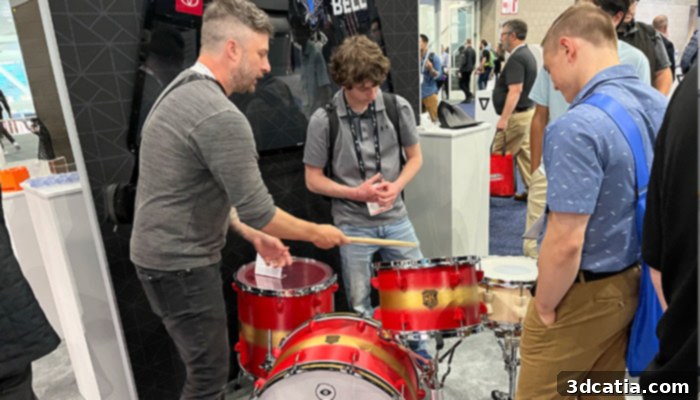
Dan Pawlovich playing the drums made using FDM 3D printing
The creation of a 3D printed drum set for a touring professional musician is a groundbreaking achievement, showcasing not only the aesthetic possibilities but also the structural integrity and acoustic performance achievable with additive manufacturing. Traditional drum manufacturing involves intricate processes and specific material choices to achieve desired sound qualities. By leveraging 3D printing, Pawlovich and Stratasys were able to experiment with geometries and internal structures impossible with conventional methods, potentially leading to unique tonal characteristics and lighter instruments. This project transcends novelty, demonstrating that 3D printing is mature enough to meet the rigorous demands of professional performance, opening new avenues for instrument design and personalization across the entire music industry. Imagine custom-designed guitars, wind instruments, or even entire stage props, all optimized through the precision and freedom offered by additive manufacturing. This application underscores the increasing adoption of additive manufacturing in creative fields, allowing for unprecedented artistic expression and functional performance enhancements.
Willo’s Sustainable 3D Printed Trees: Blending Eco-Consciousness with Aesthetic Design
In an era where the clamor for sustainability has grown into a powerful global chorus, 3D printing is emerging as a pivotal technology for eco-conscious innovation. At RAPID + TCT 2024, Bambu Lab’s booth hosted a truly inspiring display: the magnificent 3D printed trees by Willo. This visionary project has garnered significant accolades for its exceptional combination of environmental responsibility and captivating design. What makes Willo’s trees particularly noteworthy is their origin – they are meticulously crafted from recycled plastic bottles, transforming waste into beautiful, functional art. Produced entirely in the US, these pieces exemplify a commitment to circular economy principles and local manufacturing. Designed to be more than just decorative elements, Willo’s trees are perfect for enhancing home decor, adding a touch of nature and modern design to any interior space. They are available in a versatile range of sizes, including impressive 7.5 ft, 12 ft, and 14 ft options, alongside three distinct and artistic designs, allowing for varied aesthetic expressions. Beyond their visual appeal, these innovative structures are engineered with an additional purpose: to dampen sound. The company envisions these trees creating more serene and pleasant environments, particularly in bustling public spaces, offices, or commercial settings where noise reduction is a critical factor. Willo’s commitment to transforming recycled materials into aesthetically pleasing and acoustically functional products demonstrates the powerful synergy between advanced manufacturing and environmental stewardship, setting a new standard for sustainable design in the modern world.
The innovative approach taken by Willo highlights the potential of additive manufacturing to address pressing environmental concerns. By utilizing recycled bottles as feedstock, they contribute significantly to reducing plastic waste, turning a problematic material into a valuable resource. This not only minimizes landfill burden but also reduces the carbon footprint associated with producing new materials. The ability to 3D print intricate, large-scale structures like these trees with precision allows for optimized designs that are both visually appealing and acoustically effective. This dual functionality is a key differentiator, demonstrating how design freedom afforded by 3D printing can lead to multi-purpose products that add value in multiple ways. Furthermore, the commitment to US-based production supports local economies and reduces supply chain complexities, aligning with broader goals of resilient and sustainable manufacturing. Willo’s trees are a vibrant example of how 3D printing can drive meaningful change towards a more sustainable future, offering solutions that are both beautiful and beneficial for the planet. This blend of artistry, environmental responsibility, and functional innovation truly distinguishes Willo’s contribution to the sustainable design movement.
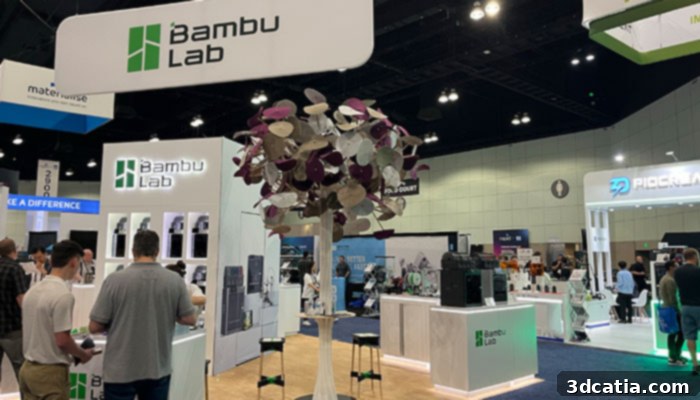
The Willo 3D printed tree at Bambu Lab’s booth at RAPID + TCT
Bell Flight’s Gigantic Helicopter Blade Mold: Soaring to New Heights with Aerospace AM
The aerospace sector remains a frontier of unparalleled excitement and critical application for additive manufacturing, constantly pushing the boundaries of what’s possible. This sentiment was unequivocally echoed at RAPID + TCT 2024, particularly at the Thermwood booth. Thermwood, renowned globally for its prowess in large-scale additive manufacturing (LSAM) systems, presented a compelling case for the technology’s impact on this demanding industry. Among their impressive exhibits was a colossal 18-foot helicopter blade mold, a prime example of their groundbreaking capabilities. What made this display truly astounding was the speed of its production: this massive mold was printed on a Thermwood LSAM system in an astonishingly short period of just three hours and eight minutes. Such rapid fabrication times represent a seismic shift in manufacturing lead times for large, complex aerospace tooling. The blade mold itself was fabricated using TechnerPM 25% Carbon Fiber reinforced PESU, a high-performance polymer composite celebrated for its exceptional strength-to-weight ratio, thermal stability, and mechanical properties – qualities paramount in aerospace applications. This exhibit profoundly demonstrated the immense potential of 3D printing, especially large-scale additive manufacturing, in revolutionizing the design, prototyping, and production of critical components for helicopters and other advanced aircraft. It signifies a future where tooling for aerospace can be produced faster, more cost-effectively, and with greater design flexibility than ever before, accelerating innovation cycles significantly.
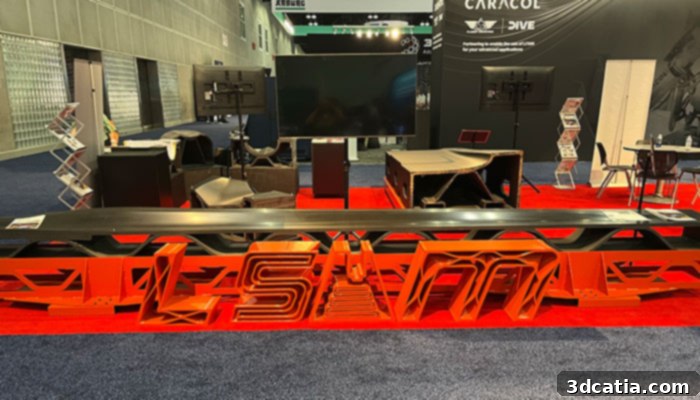
The 3D printed blade at Thermwood’s booth
The demonstration of Bell Flight’s helicopter blade mold by Thermwood highlights several key advantages of large-scale additive manufacturing in aerospace. Firstly, the drastic reduction in production time for such a substantial tool directly translates into significant cost savings and faster product development cycles. In an industry where speed to market and iterative design are crucial, this capability is invaluable. Secondly, the use of advanced materials like TechnerPM 25% Carbon Fiber reinforced PESU underscores the material science advancements enabling AM to meet rigorous aerospace standards. These materials offer not only high performance but also the ability to be processed efficiently by LSAM systems, producing tools that can withstand the stresses of composite layup and curing. This application is not just about producing a mold; it’s about validating a paradigm shift in how aerospace companies can approach large-part manufacturing, from rapid prototyping of new designs to creating custom tooling on demand. This greatly enhances agility in manufacturing complex components and accelerates the journey from concept to flight, solidifying additive manufacturing’s critical role in the future of aerospace innovation and potentially leading to more efficient, lighter aircraft.
Hollywood Showcase: Bringing Movie Magic to Life with 3D Printing at RAPID + TCT
One of the undisputed highlights of RAPID + TCT 2024 was the captivating Hollywood Showcase, an immersive experience that allowed attendees to peer behind the scenes and discover how cutting-edge 3D technologies are seamlessly integrated into the enchanting world of movie magic. The exhibit was a treasure trove of fascinating creations, but among the endless wonders, our personal favorites were the instantly recognizable figures of Mike and Sulley from Disney Pixar’s “Monsters University.” These beloved characters stood proudly at the entrance of the showcase, serving as vibrant ambassadors for the transformative power of additive manufacturing in entertainment. Created by Disney for a sophisticated marketing display, these life-size figures were brought to fruition using Large Format SLA (Stereolithography), a highly precise 3D printing technology. The process leveraged Accura Extreme, a durable resin known for its excellent mechanical properties, combined with synthetic fur to achieve their iconic texture and appearance. The digital sculpting prowess of Maxon Zbrush and the advanced print preparation capabilities of Materialise Magics were instrumental in translating these animated characters from screen to tangible reality. Beyond Mike and Sulley, the showcase featured an impressive roster of iconic figures, including a meticulous reconstruction of the DeLorean time machine from “Back to the Future,” the menacing presence of Darth Vader, and the graceful figures of Anna and Elsa from “Frozen,” among many other unforgettable cinematic artifacts. This collection not only celebrated pop culture but also vividly demonstrated how 3D printing empowers artists and prop makers to achieve unprecedented levels of detail, accuracy, and speed in creating movie props, costumes, and promotional displays, truly blurring the lines between digital imagination and physical reality.
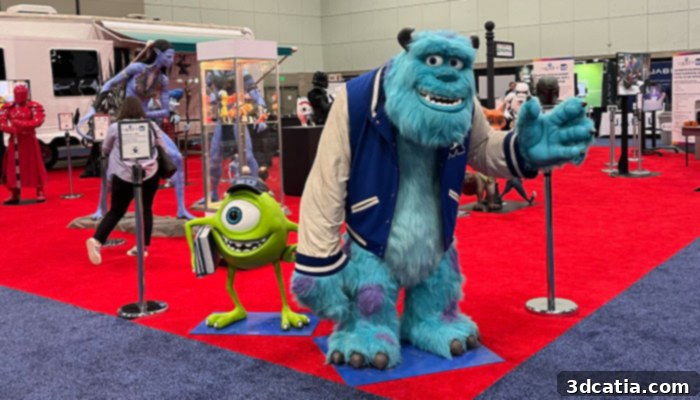
Mike and Sulley greet attendees at the Hollywood Showcase at RAPID + TCT, with other incredible applications in the background
The Hollywood Showcase at RAPID + TCT underscored the burgeoning role of 3D printing in the entertainment industry, a field that constantly demands innovation and visual fidelity. For characters like Mike and Sulley, the ability of Large Format SLA to produce large, high-resolution parts with smooth surfaces is critical for achieving photorealistic results that resonate with audiences. The integration of digital sculpting tools like Zbrush allows for organic, complex forms to be perfectly translated into printable models, while software like Materialise Magics ensures printability and optimizes the build process. This synergy between digital artistry and physical fabrication empowers studios to create props, models, and marketing displays that are not only accurate to their digital counterparts but also robust enough for exhibition and even on-set use. The display of beloved characters and iconic props served as a powerful reminder that 3D printing isn’t just for industrial parts; it’s a creative tool that fuels imagination, enabling the detailed realization of fictional worlds and characters, making the impossible tangible and enhancing the magic of storytelling for millions. This seamless integration of technology and artistry is revolutionizing how cinematic experiences are brought to life, offering unparalleled freedom and precision.
3D Systems’ Life-Size 3D Printed Skeleton: Advancing Medical Training and Diagnostics
Finally, and of paramount importance, the medical applications of 3D printing commanded significant attention across the show floor at RAPID + TCT 2024. Among these, a truly remarkable exhibit from 3D Systems stood out. In a powerful demonstration of the company’s leading capabilities in producing FDA-cleared, diagnostic-quality anatomical models, 3D Systems showcased a fully 3D printed, life-sized human skeleton at its booth. Affectionately nicknamed “Manny,” this intricate model was a masterclass in multi-technology additive manufacturing, effectively illustrating 3D Systems’ comprehensive range of solutions. The creation of Manny involved several different 3D printing technologies, each carefully chosen for specific parts of the skeleton to achieve optimal anatomical accuracy, material properties, and visual fidelity. These technologies included Multijet Printing (MJP) for fine details and smooth surfaces, Colorjet Printing (CJP) for realistic anatomical coloration, FDM for robust structural components, SLA (Stereolithography) for high-resolution anatomical structures, and SLS (Selective Laser Sintering) for strong, functional parts. This multi-faceted approach, combined with the company’s VSP Orthopedics complete surgical planning workflow, highlighted how 3D Systems can deliver highly accurate and patient-specific medical models that are invaluable for surgical preparation, medical education, and diagnostic purposes. Manny wasn’t just a display piece; it represented a tangible step forward in personalized healthcare and the training of future medical professionals, showcasing the precision and versatility that only advanced additive manufacturing can provide in the critical medical sector.
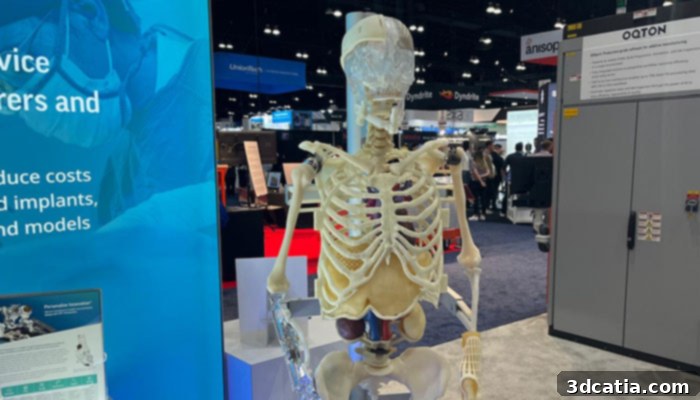
Manny welcomes attendees to 3D Systems’ booth surrounded by other medical applications
The exhibit of Manny, the life-size 3D printed skeleton, by 3D Systems, powerfully illustrates the transformative impact of additive manufacturing on the medical field. The necessity for FDA-cleared, diagnostic-quality models underscores the rigorous standards that 3D printed medical devices and anatomical models must meet. By demonstrating the use of multiple printing technologies—MJP for fine bone structures, CJP for realistic cartilage representation, FDM for support and robustness, SLA for high-fidelity replication, and SLS for durable, functional joints—3D Systems showcased an integrated approach that can cater to the complex and varied requirements of anatomical replication. Such models are indispensable for pre-surgical planning, allowing surgeons to visualize complex cases, practice procedures, and anticipate challenges before entering the operating room, thereby improving patient outcomes and reducing surgical risks. Furthermore, these highly accurate, patient-specific models are revolutionizing medical education, providing students with unparalleled hands-on learning experiences. Manny represents the pinnacle of current capabilities in medical 3D printing, promising a future where personalized medicine, advanced surgical training, and innovative device development are further propelled by the precision and customization inherent in additive manufacturing, ultimately enhancing patient care globally.
As RAPID + TCT 2024 concludes, the myriad applications showcased firmly cement 3D printing’s role as a driving force across virtually every industry. From the rhythmic innovation of custom musical instruments to the sustainable elegance of recycled art installations, the monumental tooling for aerospace, the enchanting props of Hollywood, and the life-saving advancements in medical modeling, additive manufacturing continues to prove its unparalleled versatility and transformative power. Each exhibit not only demonstrated current capabilities but also offered a glimpse into a future where design limitations are continuously eroded, and innovation flourishes at an unprecedented pace. We invite you, our readers, to share your own reflections! Which applications from RAPID + TCT 2024 captivated you the most, and what future innovations do you envision for 3D printing? Let us know your thoughts in a comment below or join the conversation on our LinkedIn, Facebook, and Twitter pages! For those eager to stay abreast of the latest developments, don’t forget to sign up for our free weekly newsletter here, delivering the freshest 3D printing news straight to your inbox! Additionally, immerse yourself in our video content by exploring all our compelling features on our dedicated YouTube channel.