

NTU Singapore Pioneers Sustainable 3D Bioprinting with Revolutionary Sunflower Pollen Bio-Ink
In a significant leap forward for sustainable advanced manufacturing and biomedical engineering, a dedicated team of researchers at Singapore’s Nanyang Technological University (NTU Singapore) has achieved a groundbreaking innovation: the development of a novel 3D-printable ink derived entirely from sunflower pollen. This pioneering bio-ink stands out for its exceptional environmental friendliness, enhanced durability, and remarkable affordability, positioning it as a transformative material for a myriad of applications in the critical fields of tissue engineering and drug delivery systems. One of the most compelling advantages of this innovative pollen-based bio-ink is its inherent ability to maintain its structural integrity and retain its complex geometries with impressive fidelity immediately after being deposited by a bioprinter. This characteristic is crucial for precision manufacturing, as it significantly streamlines the design and fabrication process of intricate biological products, minimizing waste and improving efficiency in the laboratory setting. The implications of this development are vast, pointing towards a future where medical implants and delivery systems are not only more sustainable but also more effective and accessible.
Bioprinting represents a cutting-edge confluence of advanced manufacturing and biological sciences, encompassing an array of sophisticated techniques designed to fabricate cellular structures that intricately mimic the native properties of natural tissues. Among these diverse methodologies, extrusion-based bioprinting is arguably the most prevalent and widely adopted process. Much like a conventional FDM 3D printer, a bioprinter employing extrusion technology precisely deposits the bio-ink – typically a hydrogel laden with living cells – layer by meticulous layer. However, this widely used technique is not without its inherent challenges. A primary hurdle lies in ensuring the structural stability and precise shape retention of the hydrogel, which is often inherently soft and prone to deformation or collapse during the printing process. To counteract this, traditional bioprinting often necessitates the use of auxiliary printing media: the bio-ink is commonly deposited within a supportive matrix or sacrificial scaffold. While effective in providing temporary structural support, this matrix becomes redundant once the cellular structure has solidified, leading to considerable material waste and adding complexity to the post-processing stages. Recognizing these significant limitations, the visionary researchers at NTU Singapore embarked on a mission to discover an ingenious alternative. Their goal was clear: to engineer a bio-ink that could inherently maintain its shape without the need for an external matrix, thereby dramatically reducing waste and advancing the sustainability of bioprinting technology. This quest led them to explore the surprising potential of natural pollen, a material previously underexplored in this context, ultimately paving the way for a more efficient and environmentally conscious approach to bioprinting complex biological structures.
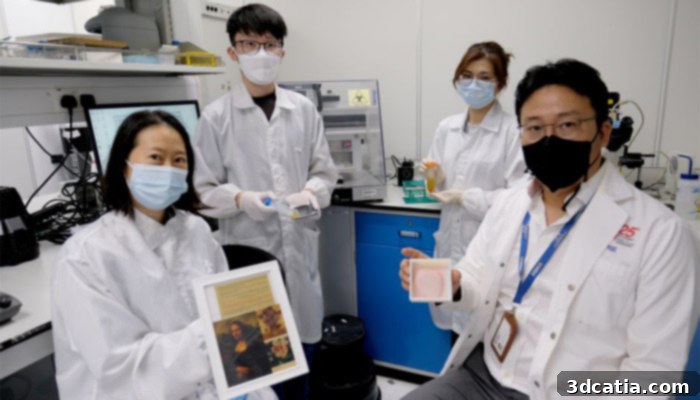
The dedicated team behind this innovative sunflower pollen bio-ink study at NTU Singapore. (Photo Credit: NTU Singapore)
Professor Cho Nam-Joon, a distinguished co-lead author of this seminal study and a leading figure in biomaterials research, eloquently articulates the core challenges and revolutionary potential of their discovery. He explains, “Bioprinting can be a challenge because the material that the inks are made of is usually too soft, which means the structure can collapse during the print. By adjusting the mechanical properties of sunflower pollen, we have developed a pollen-based hybrid ink that can be used to print structures with good structural integrity. This is a significant achievement because the process of making pollen ink is sustainable and affordable. Since there are many types of pollen species with distinct sizes, shapes, and surface properties, pollen microgel suspensions could potentially be used to create a new class of environmentally friendly 3D printing materials.” Professor Cho’s insights underscore the critical hurdle of material fragility in traditional bioprinting, where the delicate balance between printability and structural integrity is often difficult to achieve. The NTU team’s success lies in their innovative approach to manipulating the natural properties of sunflower pollen, transforming it into a robust yet biocompatible hybrid ink. This not only solves the issue of structural collapse but also introduces a material derived from a renewable, abundant, and cost-effective natural resource. Furthermore, Professor Cho highlights the vast, untapped potential within the botanical world; the sheer diversity of pollen species suggests that this breakthrough could be the harbinger of an entirely new category of eco-conscious and versatile 3D printing materials, opening doors to custom-tailored solutions far beyond just sunflower pollen. The sustainability aspect, from sourcing to production, truly sets this innovation apart as a game-changer in the bioprinting landscape.
The Innovative Development of Sunflower Pollen Bio-Ink: A Step-by-Step Breakthrough
The creation of this revolutionary sunflower pollen ink involved a meticulously developed multi-step process, leveraging the unique biological characteristics of pollen grains. The journey begins with the incubation of sunflower pollen in a carefully prepared alkaline solution, a critical step that extends over a precise duration of six hours. During this incubation period, the intricate outer layer of the pollen grains undergoes a controlled transformation, leading to the formation of discrete pollen microgel particles. These microgels are essentially tiny, hydrogel-like spheres derived directly from the pollen, forming the foundational component of the novel bio-ink. Once these essential pollen microgel particles are successfully created, they are then expertly mixed with a selection of well-known and biocompatible hydrogels, including alginate and hyaluronic acid, among others. This careful blending process is vital, as it imparts the desired rheological properties and biological functionalities to the final material. The result of this sophisticated synthesis is the ultimate bio-ink: a highly advanced composite material that combines the inherent strength and structural integrity of the pollen microgels with the flexibility and biocompatibility of the hydrogel components. To rigorously assess the efficacy and performance of their newly developed material, the NTU team put the pollen bio-ink to a practical test. They successfully 3D printed a complex tissue engineering scaffold, a critical structure designed to support cell growth and tissue regeneration. This scaffold, composed of five intricate layers, was fabricated in an impressive twelve minutes, showcasing the material’s excellent printability and the efficiency of the process. Following the successful printing, the researchers meticulously deposited collagen onto the scaffold. Collagen, a vital protein in biological tissues, served to create specific anchor points, facilitating the attachment and proliferation of living cells. The subsequent evaluation of cellular activity yielded remarkable results: the efficiency of seeding cells onto the pollen-based scaffold was measured at an outstanding 96% to 97%. This exceptional rate unequivocally demonstrates that this pollen-based ink possesses a powerful capability to promote robust cell growth, an absolutely indispensable prerequisite for effective tissue regeneration and the future development of functional biological constructs. This profound ability to support cellular viability and proliferation highlights the immense potential of sunflower pollen in the realm of advanced biomedical applications.
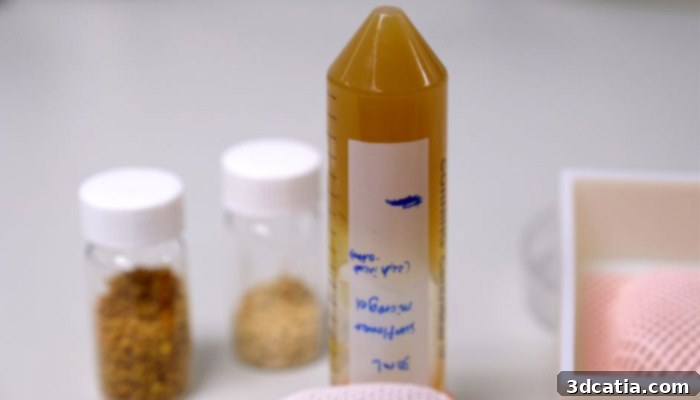
A structure 3D printed with the novel bio-ink made from sunflower pollen, demonstrating its structural integrity. (Photo Credit: NTU Singapore)
Song Juha, another invaluable co-author of this pioneering study, elaborates further on the expansive potential and diverse applications of this innovative pollen-based bio-ink, particularly in the realm of personalized medical devices. She adds, “Our findings may open new doors to custom flexible membranes that conform exactly to the contours of human skin, such as patches or face masks. These soft and flexible membranes are generally made on the basis of a flat geometry, resulting in problems such as fractures or poor fit when applied to large areas of skin, such as the face, or areas that experience frequent movements such as the joints. Using our pollen-based 3D printing ink, which is biocompatible, flexible, and inexpensive, we can make membranes that are adapted to the contours of human skin and capable of bending without breaking.” This insight from Song Juha highlights a critical unmet need in current medical patch and mask technology. Traditional manufacturing methods often produce flat, two-dimensional membranes that struggle to maintain intimate contact and structural integrity when applied to the complex, dynamic surfaces of the human body. This can lead to issues like discomfort, reduced efficacy, and even breakage, particularly in areas subject to movement or requiring a precise fit. The sunflower pollen bio-ink, with its unique combination of biocompatibility, inherent flexibility, and cost-effectiveness, presents a revolutionary solution. It allows for the 3D printing of truly customized, anatomically congruent membranes that can perfectly mimic the contours of individual skin surfaces. Imagine wound dressings that precisely adhere to irregularly shaped injuries, or facial masks designed to fit every unique facial structure without gapping or creasing. Crucially, these pollen-derived membranes demonstrate an exceptional ability to bend and flex without fracturing, ensuring continuous performance and patient comfort even in highly mobile areas like joints. This opens up exciting avenues for more effective drug delivery patches, diagnostic sensors, and therapeutic wearables, promising enhanced patient outcomes and a new era of personalized healthcare solutions that are both gentle on the body and the planet.
The NTU Singapore team is currently immersed in a rigorous exploration of the extensive applications made possible by this remarkable pollen-based bio-ink and the broader advancements in bioprinting technology. They are profoundly convinced of the transformative possibilities that natural pollen, specifically engineered for additive manufacturing, presents across various industries. This research undeniably represents an affordable, highly sustainable, and exceptionally impactful method that is poised to make a significant and lasting mark within the rapidly evolving field of bioprinting. The potential for this bio-ink to reduce production costs, minimize environmental footprint, and enhance the efficacy of medical devices is immense, making it a pivotal innovation in the quest for more sustainable and accessible healthcare solutions. This breakthrough reinforces NTU Singapore’s reputation as a hub for cutting-edge research and development, continuously pushing the boundaries of what is possible with biomaterials. For those interested in delving deeper into the scientific intricacies and comprehensive findings of this groundbreaking research, the full study is readily available and accessible HERE, offering a detailed account of the methodologies, results, and broader implications.
What are your thoughts on this groundbreaking sunflower pollen bio-ink and its potential to revolutionize 3D bioprinting and medical applications? We invite you to share your insights and perspectives in a comment below. You can also join the conversation and connect with us on our official Facebook and Twitter pages, where we regularly discuss the latest innovations in additive manufacturing. Don’t miss out on essential industry updates – remember to sign up for our free weekly newsletter, ensuring all the most recent news and developments in 3D printing are delivered directly to your inbox!
Cover Photo Credit: Frenta/Adobe Stock