
The Global 3D Printing Community’s Unified Response to the Ukraine Crisis: Support, Sanctions, and Humanitarian Aid
In a shocking turn of events last week, the fears of many became a grim reality as Russia launched a full-scale invasion of its sovereign neighbor, Ukraine. This aggressive military action has plunged the region into relentless conflict, triggering an unprecedented humanitarian crisis. Millions of Ukrainians have been forced to flee their homes, seeking safety in neighboring countries and beyond, creating a vast diaspora of displaced persons. The international community, led by nations including the United States and the European Union, has responded with a unified and exceptionally harsh stance. While direct military intervention against Russia has been avoided by most global powers, save for Ukraine’s valiant defense, severe financial sanctions have been swiftly imposed. These measures include cutting key Russian banks off from the SWIFT international payment system, leading to a dramatic plummet in the value of the Ruble, Russia’s national currency, and significantly impacting its economy.
The escalating crisis officially commenced on February 21st, when Russia formally recognized two self-proclaimed separatist states in eastern Ukraine, a move widely condemned as a pretext for invasion. The full-scale military offensive followed just three days later, on February 24th. The conflict had been brewing for weeks, with satellite imagery and intelligence reports confirming a massive buildup of Russian military forces, estimated at over 100,000 soldiers, near the Ukrainian border. Despite urgent warnings and diplomatic efforts from numerous world leaders, Russia proceeded with its invasion. The tragic human cost of this war continues to mount, with casualties reported on both sides, though accurate figures remain elusive given the inherent fog of war. Despite ongoing peace talks, the future of Ukraine remains precariously uncertain, hanging in the balance as the conflict unfolds. In response to this grave geopolitical development, people across the globe, including various sectors of industry and technology, have mobilized. Notably, the additive manufacturing (AM) sector has demonstrated a remarkable commitment to addressing the crisis through a variety of initiatives and condemnations.
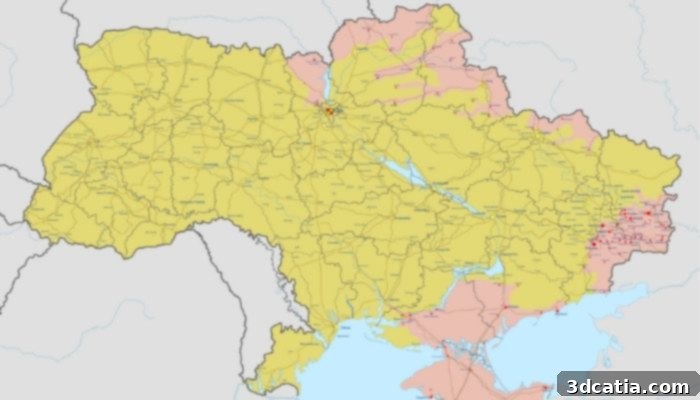
A map of Ukraine showing the extent of the crisis with the red indicating Russian invasion, including Crimea at the bottom (photo credits: Rr016, CC BY-SA 4.0, via Wikimedia Commons)
The Additive Manufacturing Community’s Immediate Response to the Ukraine Crisis
The additive manufacturing (AM) community, often recognized for its innovative problem-solving, has demonstrated a significant and varied response to the unfolding crisis in Ukraine. Unlike the COVID-19 pandemic, where 3D printing companies could directly contribute by producing vital PPE and medical components, the nature of a military conflict necessitates a different approach. Nevertheless, numerous 3D printing companies and influential figures within the industry have stepped forward to address the war in multifaceted ways, primarily focusing on humanitarian aid, solidarity, and economic measures. The initial wave of response prominently featured heartfelt messages of support and solidarity for the Ukrainian people, originating from some of the most recognized names and brands in the sector. Avi Reichental, co-founder and CEO of Nexa3D, was among the first to publicly express his unwavering support for Ukrainians, conveying his thoughts and prayers and issuing a powerful call to global leaders to take decisive action to mitigate the crisis and protect innocent lives.
This sentiment of unity and condemnation of aggression resonated deeply across the entire additive manufacturing community. Prominent voices such as Ilya Mirman, the Head of Marketing at Desktop Metal, and Nora Toure, the esteemed Chairwoman at Women in 3D Printing, echoed similar messages of support and concern. Many industry leaders and professionals not only shared their solidarity but also actively provided links to reputable charitable organizations and resources for those able to contribute financially or through other means. This collective response underscored the strong sense of community and shared values within the 3D printing world, uniting against adversity and demonstrating a collective commitment to peace and humanitarian principles. Beyond mere statements, tangible actions followed swiftly. Nicola Leibinger-Kammüller, CEO of TRUMPF, a global leader in industrial manufacturing and laser technology, sent a poignant letter to all employees. In it, she not only unequivocally condemned Russia’s actions but also announced a concrete initiative: “The TRUMPF Managing Board decided over the weekend to organize an immediate donation for the people from Ukraine in need of help.” This demonstrated a rapid pivot from words to impactful humanitarian aid, characteristic of the industry’s agility.
The conflict also placed companies with ties to both Russia and Ukraine in particularly challenging positions, prompting them to take definitive stances. Anisoprint, a composite 3D printing company with foundational roots in Russia but currently headquartered in Luxembourg, issued a powerful statement advocating for peace and condemning the military aggression. Fedor Antonov, the Russian CEO of Anisoprint, further amplified this message through a personal post, expressing his profound support for Ukraine and emphasizing a crucial point: that a significant portion of the Russian populace does not endorse the actions of the Russian government. This sentiment aligns with numerous anti-war protests that have bravely taken place in Russian cities like Moscow, often at great personal risk of arrest for the participants, showcasing a deep internal division regarding the conflict.
Concurrently, companies with a significant presence or employee base in Ukraine faced immediate and direct challenges. Organizations such as Hearables 3D and 3Dees Industries rapidly implemented measures to support their Ukrainian employees, particularly those still striving to leave the capital, Kyiv, or other heavily affected regions. These efforts highlight the profound personal impact of the war on individuals within the global AM workforce. Similarly, Ukrainian company Jazzros released a strong statement against Russia’s invasion, appealing to the broader international community to act decisively and provide urgent assistance as Ukraine heroically defends its sovereignty against an unprovoked aggressor. These instances underscore the dual impact of the crisis: affecting both the global business landscape and the personal lives of those directly caught in the conflict zone.
Beyond expressions of solidarity and humanitarian donations, some additive manufacturing firms have adopted even stricter operational measures, aligning with broader international sanctions. EOS, a world leader in industrial 3D printing technology, followed Germany’s lead in taking a decisive stance against the conflict. This move mirrors actions taken by other major global corporations, including BP, Volvo, and Daimler Truck, which have ceased or significantly scaled back their business operations in Russia. Marie Langer, CEO of EOS, publicly announced on LinkedIn the company’s significant decision to halt all business dealings with Russian customers. This comprehensive cessation of trade includes all sales, service, and support, with a critical exception for strictly humanitarian or medical applications. This nuanced approach ensures that essential aid can still reach those in need while upholding the spirit of sanctions. EOS’s decision reflects Germany’s broader policy turnaround regarding the conflict. Initially, Germany was perceived as slower than some other EU nations to fully commit to measures like cutting Russia off from SWIFT, partly due to its historical energy dependence on Russia. However, the country has since made a remarkable pivot, steadily providing substantial arms and unwavering support to Ukraine, marking a significant shift in its geopolitical posture and economic strategy.
The response has not been limited to companies; the academic community within additive manufacturing has also heeded the call for aid and solidarity. Yiannis Pontikes, an Associate Professor at KU Leuven, demonstrated a remarkable act of academic generosity. He made a public post on LinkedIn extending an open invitation to any researcher currently affiliated with a Ukrainian university and working on metallurgy or building materials. His offer included a fully paid research visit to Belgium, providing a crucial lifeline for scholars whose work and lives have been disrupted by the war. Professor Pontikes also urged others in the academic and professional spheres to contribute in any capacity they could. This initiative resonated widely within the AM community, receiving extensive shares and likes, underscoring the collaborative and supportive spirit that often defines scientific and technological fields even amidst global turmoil.
What More Can Be Done: The Evolving Role of 3D Printing in Crisis Response
As the situation in Ukraine continues to evolve, much remains uncertain, yet the potential for the additive manufacturing community to provide even greater support in the coming weeks and months is evident. Beyond the immediate humanitarian aid and expressions of solidarity, there are several avenues where 3D printing technology could play a pivotal role. Already, there has been speculation that additive manufacturing might be leveraged by both Russia and the United States for critical logistical support, particularly in the rapid repair and maintenance of aging military aircraft or other equipment in preparation for sustained conflict. However, the applications extend far beyond military logistics. 3D printing offers unique capabilities that can address numerous challenges presented by the war, from humanitarian needs to long-term reconstruction.
The continued outpouring of donations and fervent calls for assistance from the AM community will undoubtedly remain crucial, providing essential resources and comfort to those affected. Furthermore, potential future economic measures from large additive manufacturing companies, similar to the decisive actions taken by EOS, will continue to exert pressure and demonstrate principled stands against aggression. Critically, given that war inevitably leads to severe disruptions in global supply chains, 3D printing technology offers a localized and agile solution. It can be utilized to rapidly create much-needed parts for repairs, fabricate essential medical devices, or even produce temporary shelter components. This capability becomes invaluable in bringing critical supplies to areas that may have become isolated or lost contact with broader international supply networks due to damaged infrastructure or ongoing hostilities. Moreover, as the conflict unfortunately persists, the demand for medical prosthetics for those injured, or specialized tools for emergency responders, could be met through on-demand 3D printing, enabling rapid customization and deployment. The technology also holds promise in future reconstruction efforts, allowing for efficient production of construction components or custom parts needed to rebuild damaged infrastructure. In any scenario, the call for action remains clear: we urge all individuals and organizations within the additive manufacturing sector to continue exploring and implementing ways they can contribute, harnessing the power of innovation for humanitarian good and peace.
What other responses have you observed from the additive manufacturing community concerning the ongoing war in Ukraine? We invite you to share your insights and observations in a comment below or engage with us on our LinkedIn, Facebook, and Twitter pages! Don’t forget to subscribe to our free weekly Newsletter here to receive the very latest 3D printing news directly in your inbox. You can also discover all our informative videos and engaging content on our YouTube channel.