
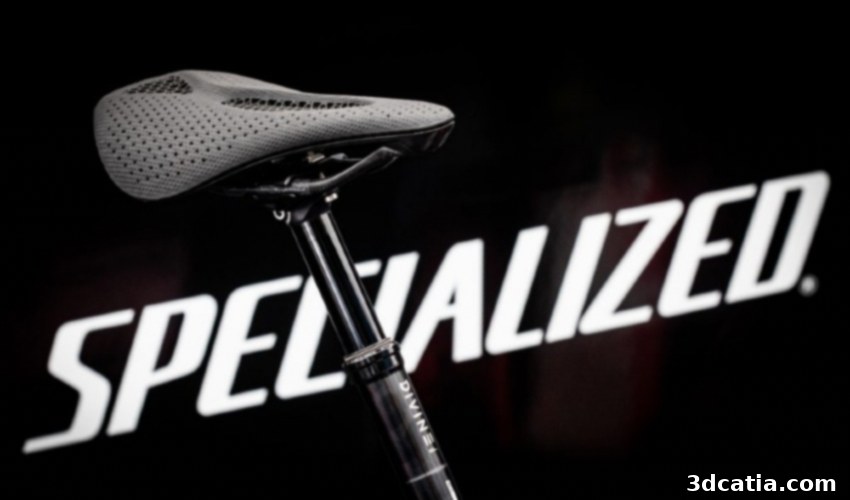
Revolutionizing Cycling Comfort: The Specialized S-Works Power Saddle with 3D Printed Mirror Technology
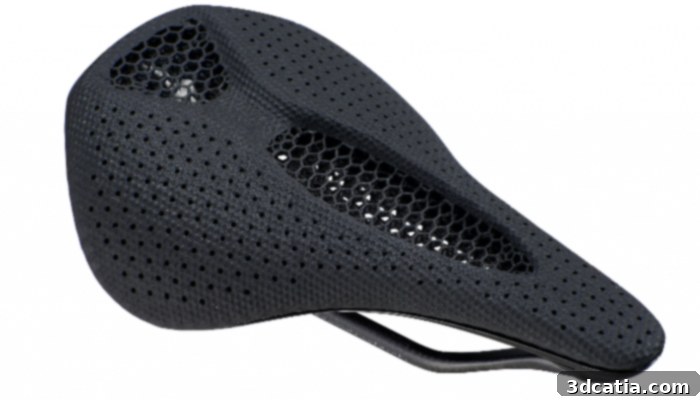
The bicycle saddle, often underestimated, is undeniably one of the most critical components of any bike. Its design profoundly influences not only rider comfort but also overall performance and endurance during a ride. For leading manufacturers of bicycle components, the constant pursuit is to engineer a saddle that optimizes rider performance while simultaneously delivering unparalleled comfort and stability. Recognizing this intricate challenge and the limitations of traditional manufacturing methods, Specialized Bicycle Components Inc., widely known as Specialized, embarked on a groundbreaking collaboration. They partnered with Carbon, a pioneer in digital manufacturing, to develop the industry’s first commercially available 3D printed bike saddle. This innovative product, the S-Works Power Saddle with Mirror Technology, was officially announced for commercial availability earlier this summer by the California-based manufacturer. What sets this saddle apart is its sophisticated elastomeric lattice structure, precisely engineered to overcome the inherent limitations of conventional foam. This revolutionary design significantly enhances performance, provides superior protection, and offers unprecedented comfort for cyclists of all levels. To delve deeper into this exciting integration of 3D printing technologies into their production processes, we had the opportunity to speak with Specialized Product Manager, Garrett Getter, and Associate Product Manager, Emma Boutcher.
3DN: Could you please introduce yourselves and elaborate on your involvement with 3D printing technology?

Garrett: Hello! I’m Garrett Getter, and I serve as the Product Manager for saddles at Specialized Bicycle Components. My journey with 3D printing truly began with the inception and development of the S-Works Power Saddle featuring Mirror Technology. I was intimately involved as the product manager for this groundbreaking saddle right from its earliest stages, starting just a month or two after I joined Specialized. It’s been an incredible experience to witness this project evolve from concept to a commercially available product that is genuinely changing the cycling experience for our riders.

Emma: Hi, I’m Emma Boutcher, an Associate Product Manager here at Specialized. My academic background is in engineering, which provided me with diverse experiences in 3D printing even before I joined Specialized. When I came on board, I was initially brought in for a technical role, which allowed me to engage in some of the very first 3D printing of saddle prototypes. This hands-on experience was invaluable, and after building that foundational knowledge, I was able to transition into leading the preliminary printing efforts for what has now become our acclaimed Mirror Saddle. It’s truly exciting to see how my engineering skills and passion for additive manufacturing have contributed to such an innovative product.
3DN: What drove Specialized to specifically choose 3D printing technology for the development of these advanced saddles?
Emma: By the time Garrett joined our team, Specialized had already initiated preliminary testing into the theoretical application of elastomeric compounds, particularly from Carbon, with the goal of creating a truly rideable saddle. Traditionally, the core padding of a saddle has been constructed from various types of foam. While significant incremental advancements have been made in foam technology over the years, utilizing different materials and constructions, we eventually hit a design plateau. The limitations of foam became apparent in terms of how specific, how targeted, and how intricate the shapes and varying densities could be achieved. As 3D printing technology matured and evolved beyond mere prototyping into a viable tool for mass production, we recognized its immense potential. We saw it as an outstanding opportunity, first to rigorously prototype and validate whether 3D printing could serve as a viable, superior replacement for traditional foam. Once we successfully proved this initial concept and received overwhelmingly positive feedback from our test riders, we knew we had discovered something truly transformative. This validation phase was followed by an extensive period of rigorous ride-testing, meticulous fine-tuning, and countless iterations of designs, all made possible and significantly accelerated by the capabilities of additive manufacturing.
3DN: Can you detail the primary advantages that additive manufacturing offers for your specific applications in saddle design and production?
Garrett: The real and profound advantages of 3D printing technology for our applications in bicycle saddle development begin with two critical factors: unparalleled freedom of design and an incredibly accelerated speed of iteration. To manufacture truly great bike saddles that meet the exacting demands of our riders, it is absolutely essential for us to have the capability to iterate quickly and efficiently. Between these two transformative opportunities that additive manufacturing (AM) grants us, it was quite literally a dream come true for me, especially given my heavy involvement in extensive ride-testing. One of the biggest and most persistent challenges we face with traditional foam-based saddles is the protracted timeline required for iteration. In a conventional process, you would have a sample product, you’d ask a rider to test-ride it, collect their valuable feedback, and then submit a request to the factory to implement a change, whether it’s adjusting the foam density or altering the shape. These two distinct steps in the traditional production process – testing and then manufacturing changes – can consume a significant amount of time, often weeks or even months. With 3D printing, this entire cycle is dramatically compressed. You can design, print, test, and refine almost instantaneously. AM enables us to be incredibly “in the moment” with our product development, fostering a level of responsiveness and agility that we had simply never experienced before. That speed and flexibility are incredibly powerful and fundamentally redefine how we innovate.
All image credits: Specialized
Another significant advantage of using 3D printing is that even during the crucial product-testing stage, we are able to work with a saddle that is remarkably close to its final, perfect version, long before the actual product launch. Traditionally, our prototyping processes were often less accurate, relying on approximations or costly molds that might not fully represent the end-product’s performance. Now, thanks to the precision and flexibility of 3D printing, even when we are still in the prototyping phase, we already possess a highly accurate portrayal of the final product. This essentially means we have a product that is nearly ready for mass production, allowing for more realistic testing and much faster transitions from development to market.
Emma: With the development of the Mirror Saddle, we were able to fundamentally rethink the saddle’s construction by conceptualizing it in distinct “zones.” This approach is a radical departure from traditional saddle design, where such clear-cut differentiation wasn’t practically achievable. The ability to design and meticulously manipulate a complex lattice structure at such an incredibly minute level of detail is paramount. This precision allows us to achieve far greater accuracy in creating specific zones with varying densities and compliance characteristics. In a saddle, we are not looking for a uniform, “dead-state” pressure distribution across its entire length, which is often an unavoidable outcome with traditional foam saddles. Instead, with 3D printing, we can fabricate a single part that incorporates multiple distinct zones, each engineered with different densities and levels of flexibility. This targeted approach allows us to provide support precisely where the rider needs it most, significantly enhancing comfort and performance by dynamically adapting to their unique anatomy and pressure points. This level of customization within a single component is truly revolutionary for saddle ergonomics.
3DN: What significant challenges did your team encounter during the intricate design and development process of this product?
Garrett: For us, 3D printing presents something of a double-edged sword when it comes to product development. On one hand, this technology offers an almost unlimited realm of opportunity and potential – the sheer scope of what you can achieve with it is astounding. However, with that boundless potential comes a unique challenge: it’s incredibly easy to go down various “rabbit holes” pursuing innovative, yet sometimes overly complex or impractical, ideas. Therefore, one of our significant challenges was effectively funneling a multitude of wildly different concepts into a coherent, high-performance product. This required immense discipline and a clear vision. We executed quite a few iterations in a remarkably short period, which, while beneficial for speed, brought its own set of complexities. The main challenge then became meticulously tracking every single change we made, understanding its impact, and constantly ensuring that we were maintaining progress in the right direction towards our ultimate design goals, rather than getting sidetracked by interesting but ultimately unfeasible options.
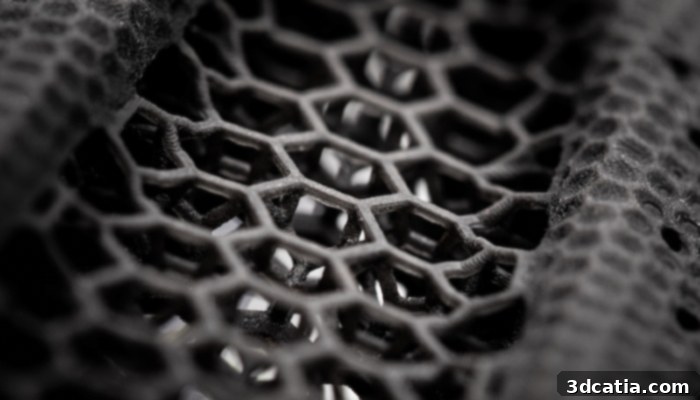
The intricate lattice structure of the Specialized Mirror Saddle.
3DN: Could you share more details about your collaborative partnership with Carbon, and how it contributed to the success of this project?
Emma: Our decision to partner with Carbon was a strategic one, driven by several key factors. First and foremost, working with Carbon provided us with essential access to their high-tech materials and advanced 3D printing processes, which were crucial for achieving the specific performance characteristics we envisioned for the Mirror Saddle. Beyond just the technology, Carbon already possessed a robust production network, which was instrumental in helping us scale out from initial prototypes to full commercial production. This network ensured that we could meet demand efficiently. Furthermore, Carbon’s impressive in-house design capabilities were a huge asset. They weren’t just a technology provider; they were a true collaborative partner deeply invested in the product’s success. I particularly admire their commitment and passion for designing exceptional products specifically utilizing their cutting-edge 3D printers and proprietary materials. This shared vision and collaborative spirit were absolutely vital in bringing the S-Works Power Saddle with Mirror Technology to fruition.
3DN: What is your broader vision for the role of additive manufacturing in the future of the saddle production business?
Garrett: At Specialized, we are relentlessly exploring new and innovative ways to personalize the cycling product experience. In the past, we were pioneers in correlating a rider’s unique seat bone width to the appropriate saddle width, which was a significant first step in customizing this particular product to an individual’s physique. We firmly believe that an even more progressive and granular level of personalization will define the future of saddle ergonomics. In this future, 3D printing will undoubtedly play an absolutely pivotal role. Imagine a world where a saddle isn’t just chosen from a few sizes, but is custom-tailored to a rider’s precise biomechanics, pressure points, and riding style, perhaps even based on individual scans. Additive manufacturing offers the flexibility and precision to create truly bespoke saddles, optimizing comfort, reducing pressure points, and maximizing power transfer for every single rider. This level of individualization, which goes far beyond current mass-production capabilities, is where we see the saddle industry heading, and 3D printing is the key enabler.
3DN: Do you have any final thoughts or words you’d like to share with our readers?
Garrett: Our commitment at Specialized is always to enhance the rider’s experience. If we didn’t firmly believe that 3D printing technology was going to offer significant, tangible benefits to our riders, we simply wouldn’t invest in it. However, the feedback we’ve received on our 3D printed bike saddle has been overwhelmingly positive, consistently indicating that this technology genuinely makes the riding experience better, more comfortable, and crucially, safer. This unwavering belief in the technology is precisely why we continue to champion it. We developed this product with a very specific and critical purpose: to significantly alleviate seat bone pressure, a common source of discomfort for cyclists. This led us to design saddles with intricately variable densities and anatomically optimized sections. The ultimate result is that people are happier and more comfortable riding their bikes, enjoying longer, more pleasant journeys, and that, ultimately, is the greatest measure of our success and all we can truly ask for.
What are your thoughts on the innovative 3D printed bike saddle developed by Specialized and Carbon? Have you had the chance to experience the S-Works Power Saddle with Mirror Technology for yourself? We encourage you to share your experiences and opinions in the comments section below, or engage with us on our Facebook and Twitter pages! Don’t forget to sign up for our free weekly Newsletter to receive all the latest news and advancements in 3D printing directly to your inbox!