

Backflip AI: Revolutionizing 3D Design for Additive Manufacturing with Generative AI
Artificial intelligence (AI) has rapidly transitioned from a futuristic concept to an indispensable component of our daily lives, fundamentally reshaping industries worldwide. Its profound capabilities in optimizing workflows, accurately predicting outcomes, and adapting in real-time are potent forces driving unprecedented innovation. The manufacturing sector, particularly additive manufacturing (AM), stands at the cusp of a revolutionary transformation powered by AI. Among the most thrilling developments in this evolving landscape is the emergence of advanced AI 3D model generators, which are increasingly seen as the next frontier for innovation in design and production.
A significant indicator of this momentum arrived recently with the announcement that Backflip, an innovative AI 3D model generator, secured a substantial $30 million in Series A investment. This funding round, spearheaded by industry veterans Greg Mark (CEO) and David Benhaim (CTO) – founders of the renowned 3D printing company Markforged – signals strong market confidence and significant acceleration in this rapidly evolving field. Backflip is poised to redefine how physical products are conceptualized, designed, and manufactured, bridging the gap between imagination and tangible reality.
The Evolution of 3D Model Generation: From Digital Assets to Physical Products
While 3D model generators have been an integral part of digital content creation for years, their primary applications have historically been confined to digital formats such as animation, video games, and visual effects. These conventional tools, while powerful for their intended purposes, were rarely optimized for the unique demands and stringent requirements of 3D printing and physical manufacturing. This gap presented a considerable challenge for engineers and designers aiming to rapidly iterate and produce physical prototypes or end-use parts.
However, the immense potential of AI-powered technology to bridge this gap in additive manufacturing has captivated the attention of enthusiasts, developers, and investors alike. The market has witnessed a recent surge, with dozens of new and significantly improved AI 3D model generators making their debut. Earlier this year, for instance, Bambu Lab introduced a generator through its MakerWorld platform, empowering users to craft 3D-printable fantasy creatures from simple picture or text prompts. Other platforms, such as Deemos Technologies’ Rodin Gen One, have already demonstrated impressive capabilities in generating high-quality 3D models specifically tailored for direct 3D printing, showcasing the rapidly advancing state of this technology.

Examples of 3D models generated by Backflip, showcasing its capability in generative design.
Backflip’s Distinctive Approach: Designing for the Physical World
In a market that is rapidly becoming saturated with generative AI tools, the critical question arises: how will Backflip carve out its niche and differentiate itself? The answer lies in its foundational philosophy and design ethos. Backflip’s AI 3D design tools were conceived and developed with the explicit intention of interacting with the physical world. This core focus fundamentally distinguishes it from many existing generators geared towards digital assets. The company was born from an ambitious and forward-thinking premise:
“What if designers and engineers could go from ideas to reality at the speed of their imagination? What if one designer could move at the speed of 100?”
This vision directly addresses a major bottleneck in traditional product development cycles, where the iterative process of design, prototyping, and testing can be painstakingly slow and resource-intensive. Backflip aims to compress this timeline, enabling unprecedented agility and efficiency in bringing physical products to market.
On December 19th, 2024, Backflip unveiled its inaugural product, streamlining the design-to-production pipeline into an intuitive three-step process. First, users articulate their design intent, whether through descriptive text, a rough sketch, or an image. This natural language or visual input serves as the creative spark. Second, Backflip’s advanced AI immediately converts this prompt into a fully functional 3D model, often with just a single click, dramatically reducing the time and technical expertise traditionally required for complex modeling. Finally, the designer can take this AI-generated model and print it in a variety of materials, including robust metals, lightweight carbon fiber, or versatile plastics, directly integrating with modern additive manufacturing workflows.
David Benhaim elaborated on the underlying technological breakthrough that powers Backflip’s capabilities:
“AI language models capture how we think, vision models capture how we see, and Backflip is creating foundation models that capture how we build. We’ve invented a novel neural representation that teaches AI to think in 3D, unlocking a new category of models. That development yields 60x more efficient training, 10x faster inference and 100x the spatial resolution of existing state-of-the-art methods.”
This technical innovation is crucial. By teaching AI to “think in 3D,” Backflip moves beyond simple geometric manipulation, enabling the generation of truly optimized and structurally sound designs inherently suitable for fabrication. The dramatic improvements in training efficiency, inference speed, and spatial resolution mean that designers can rapidly iterate on complex concepts with unparalleled detail and precision, transforming theoretical ideas into high-fidelity, printable models faster than ever before. This “foundation model” approach promises to democratize advanced design, making sophisticated engineering accessible to a broader range of creators.
Strategic Funding for a Transformative Future
Investment in Innovation and Industrial Revolution
The substantial $30 million in Series A funding for Backflip was co-led by two of the most prominent venture capital firms in technology: NEA (New Enterprise Associates) and Andreessen Horowitz (a16z). This dual leadership signals not just financial backing, but a strategic endorsement from key players who are shaping the future of tech. The investor syndicate also includes an impressive roster of angel investors, highlighting the widespread recognition of Backflip’s potential. These include Kevin Scott, CTO of Microsoft and co-founder of LinkedIn; Rich Miner, the visionary founder of Android and a leading AI futurist; and Ashish Vaswani, a co-author of the seminal “Attention Is All You Need” research paper, which laid much of the groundwork for modern transformer models in AI. Such high-caliber backing underscores the belief that Backflip is not merely creating a new tool, but pioneering a new paradigm in design and manufacturing.
Lila Tretikov, a Partner at NEA and Head of AI Strategy, articulated the profound implications of this investment:
“The promise of AI extends far beyond transforming knowledge—it is the catalyst for building a world once only imagined. I seek out extraordinary founders capable of driving this transformative vision across massive industries, from manufacturing and construction to transportation and robotics. The Backflip team stands at the forefront of this new industrial age at a pivotal time revitalizing American manufacturing, strengthening national security, and accelerating economic prosperity.”
Her statement highlights the broader societal and economic impact envisioned by Backflip’s investors. This isn’t just about designing gadgets; it’s about fundamentally altering industrial processes, fostering a resurgence in domestic manufacturing, and reinforcing national capabilities in critical sectors. The investment is seen as a strategic move to empower an industrial renaissance, utilizing AI to enhance efficiency, innovation, and resilience in supply chains and product development.
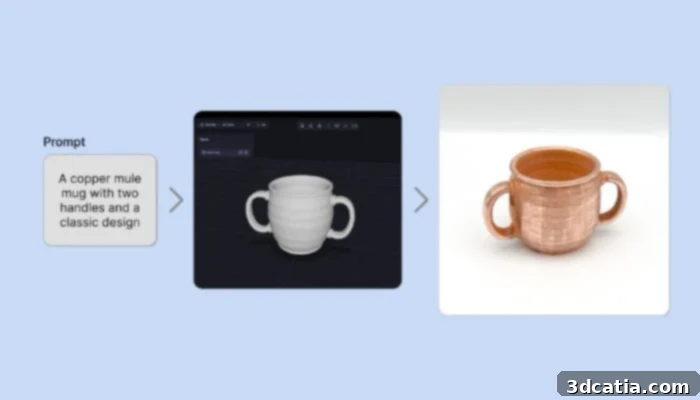
A copper mug, intricately designed using Backflip’s generative AI and then successfully 3D printed, demonstrates the platform’s capabilities for tangible, high-quality output.
Bridging the Gap: AI’s Role in Modern Engineering and Design
For decades, designers and engineers have relied heavily on conventional 3D design software, often referred to as CAD (Computer-Aided Design) tools, to translate their concepts into digital models. These tools have been the bedrock of countless industries, enabling the creation of everything from the breathtaking special effects seen in blockbuster movies to the intricate components of aircraft and the everyday consumer goods that populate our lives. However, despite their foundational importance, many of these traditional tools are inherently cumbersome, demanding extensive training, specialized skills, and often slow, iterative processes.
The Backflip team aims to fundamentally disrupt this paradigm. Their platform is not merely an incremental improvement; it is designed to revolutionize the way AI models are generated, specifically targeting the bottlenecks in producing high-resolution, manufacturing-ready designs. By focusing on models optimized for 3D printing, Backflip directly addresses the growing demand for rapid prototyping and on-demand manufacturing. This means moving beyond generic digital representations to creating precise, structurally sound models that can be directly fabricated without extensive post-processing or re-engineering.
Greg Mark, CEO of Backflip, articulated the broader historical context and ambition behind their venture:
“The last 50 years has brought incredible improvement to the pace of innovation in software and electronics, but the design of physical products has lagged behind. We’re building a next-generation design tool that allows a small team to move with the velocity of the biggest engineering army in the world. This is a giant leap forward in bringing design and manufacturing back to the US.”
Mark’s statement highlights a critical disparity: while software development has achieved incredible agility, the physical world of product design has struggled to keep pace. Backflip seeks to inject this much-needed agility into physical product development. By enabling a small team to achieve the productivity of a large engineering department, the platform has the potential to democratize innovation, reduce barriers to entry for new product development, and significantly accelerate the speed at which ideas become tangible products. This capability is not just an economic advantage; it carries strategic implications for national manufacturing capacity, fostering innovation domestically and enhancing industrial competitiveness. Backflip positions itself as a key enabler for the future of digital manufacturing and advanced engineering.
To delve deeper into Backflip’s innovative platform and its capabilities, interested readers are encouraged to visit their official website here.
Join the Conversation on the Future of AI in 3D Printing
What are your thoughts on Backflip’s approach to generative AI for 3D printing and additive manufacturing? Do you believe this technology will fundamentally change the landscape of product design and engineering? Share your insights and opinions with us! You can let us know in a comment below or engage with our community on our LinkedIn, Facebook, and Twitter pages. Don’t forget to sign up for our free weekly Newsletter here to receive the latest 3D printing news straight to your inbox! For visual content and further explorations, you can also find all our videos on our YouTube channel.
*All Photo Credits: Backflip