

ViscoTec’s Vision for Advanced Additive Manufacturing: Precision Dosing for Unrivaled 3D Printing
ViscoTec has established itself as a global leader in high-precision dosing pumps and systems, serving a diverse international clientele since its inception in 1997. Customer satisfaction remains the core principle driving the company’s continuous innovation and growth. Starting from its Bavarian roots, ViscoTec embarked on a strategic global expansion in 2009 with ViscoTec America in Georgia. This was followed by key establishments in Singapore (2011), China (2013), India (2015), and ViscoTec France in Mérignac (2019). More recently, locations in Hong Kong (2022) and Denmark (2023) further cemented its worldwide presence. These sophisticated dosing systems and components are indispensable across numerous industries for the precise conveying, dosing, filling, and dispensing of various liquids and pastes.
Recognizing the immense potential of additive manufacturing, ViscoTec has skillfully adapted its core technology to enter the 3D printing market. By applying their proven endless piston principle, also known as progressive cavity technology, ViscoTec is pioneering the processing of a new spectrum of materials in 3D printing. Their advanced printheads are engineered to transform liquids and pastes into intricate three-dimensional structures. This innovative approach is particularly advantageous for challenging materials such as silicones, ceramic pastes, and polyurethanes, which often pose difficulties for traditional 3D printing methods. To delve deeper into this exciting development, we recently had the opportunity to speak with Johanna Bruckhuber, a Business Development Manager at ViscoTec, about the company’s groundbreaking advancements in additive manufacturing.
3DN: Could you briefly introduce yourself and your role at ViscoTec?

Johanna Bruckhuber
Certainly. My name is Johanna Bruckhuber, and I’ve been a Business Development Manager at ViscoTec for the past two years, specifically focusing on the dynamic field of additive manufacturing. Prior to joining ViscoTec, I completed my master’s degree in medical technology at OTH Amberg-Weiden, a background that has proven particularly valuable given the increasing demand for precision and specialized materials in healthcare applications. In my current role, I am primarily responsible for the sales and marketing of our innovative 3D printing products. I work closely with my colleague, Mr. Kasböck, who brings over six years of dedicated experience to our team, overseeing the product development and technological aspects of our 3D printing solutions. Together, we strive to bring ViscoTec’s precision dosing expertise to the forefront of the additive manufacturing industry, enabling our customers to explore new possibilities with challenging materials.
3DN: What does ViscoTec do and what is its mission?
For over 26 years, ViscoTec has been at the forefront of designing and manufacturing advanced dosing systems and components that cater to a diverse international customer base. Our mission is to provide unparalleled precision in the handling of liquids and pastes, ensuring optimal performance for conveying, dosing, applying, filling, and dispensing operations. Our core expertise lies in the “endless piston principle,” also known as progressive cavity technology. This innovative approach allows for extremely accurate and gentle processing of even highly viscous or shear-sensitive materials, setting us apart in the market.
This profound know-how, centered around our unique dosing principle, has found extensive applications across numerous industries. For instance, in electronics manufacturing, our systems are critical for applying precise amounts of conductive pastes or encapsulants. In hygienic applications, such as food or pharmaceutical production, our gentle conveying mechanism prevents material degradation and ensures product integrity. Furthermore, in commercial developments, our technology supports a wide range of tasks from precise adhesive application to controlled material deposition in various assembly processes. This versatility underscores the robust and adaptable nature of ViscoTec’s solutions.
In 2015, we strategically expanded our focus to include additive manufacturing, recognizing the growing demand for precision in 3D printing challenging materials. Since then, we have been developing our 3D print heads in-house, leveraging our extensive experience with the endless piston principle. These print heads have since been successfully integrated and utilized in extrusion-based 3D printing for fluids and pastes, opening up entirely new possibilities for material processing in additive manufacturing. Our commitment to in-house development ensures that our 3D printing solutions maintain the same high standards of precision and reliability that ViscoTec is known for across all its product lines.
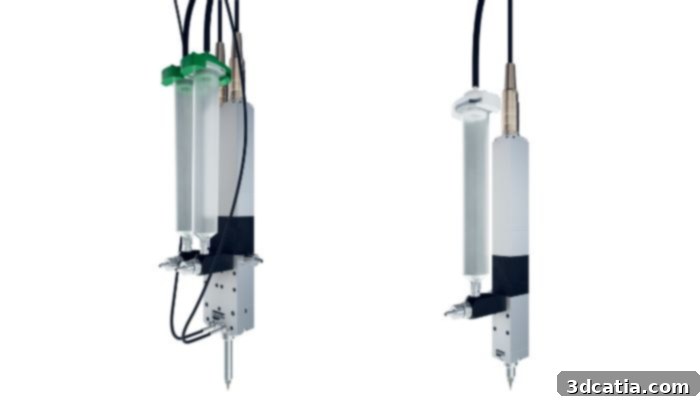
ViscoTec’s 3D print heads are based on the endless piston principle (photo credits: ViscoTec Pumpen- und Dosiertechnik GmbH)
3DN: Could you tell us more about your 3D printing solutions?
Our flagship 3D printing solutions are the vipro-HEADs, engineered for exceptional accuracy when processing both one- and two-component materials. The design of these print heads is fundamentally rooted in our aforementioned endless piston principle. This innovative mechanism enables the printing of highly viscous pastes, with capabilities extending up to an impressive 1,000,000 mPas. This is a crucial advantage, as many advanced materials used in various industries, such as thick silicones or ceramic slurries, fall into this high-viscosity range and are often challenging or impossible to process with conventional 3D printing technologies.
The endless piston principle is not just about handling high viscosity; it also ensures that the material is dispensed volumetrically in an incredibly gentle manner. This volumetric dispensing is key to maintaining the integrity of sensitive materials, preventing shear-induced damage, and ensuring consistent flow rates regardless of changes in material viscosity or pressure. Furthermore, our technology incorporates a feature akin to the “retract” function, widely recognized in FFF 3D printing. In liquid 3D printing, this precise retraction allows for clean start and end points without any undesirable dripping or stringing, which is critical for achieving sharp details and high-quality surface finishes in the final printed object. Consequently, materials are processed with an outstanding dispensing accuracy of up to 99%, ensuring reliability and repeatability across all applications, irrespective of their inherent viscosity.
Beyond standard material processing, the vipro-HEADs offer significant versatility. If the configuration of the print heads is appropriately adapted, they are fully capable of processing filled substances. This includes materials containing abrasive fillers, which are notoriously difficult for many dosing systems due to wear and tear. Our robust design mitigates these issues, allowing for the consistent printing of complex composites. Additionally, colors or other additives can be seamlessly incorporated into the printing process, enabling functional and aesthetic customization. For applications requiring specific temperature control, an optional heating function is available. This feature significantly enhances process stability, particularly when working with temperature-sensitive materials or when a controlled viscosity is needed to achieve optimal printing results, further expanding the range of materials and applications possible with our vipro-HEADs.
3DN: Which technologies, materials and printers are compatible?
The operational principle of our vipro-HEADs shares similarities with fused filament fabrication (FFF), which is one of the most common 3D printing technologies. However, instead of extruding melted plastic filament, our print head volumetrically conveys liquid or paste-like mediums from a dispensing needle. It builds up the object line by line, layer by layer, progressively creating a precise three-dimensional structure. This approach translates the familiar layering concept of FFF to the realm of fluids and pastes, opening up possibilities for materials that cannot be melted or are too viscous for traditional extrusion methods.
A significant advantage of the vipro-HEADs is their broad compatibility with commercially available 3D printers and existing slicer programs. This means that integration into an existing additive manufacturing setup is remarkably straightforward. Our print heads are designed for “plug and play” functionality, allowing them to be easily connected to almost any standard 3D printer currently on the market. The control of our dosing heads is seamlessly managed via the existing signals of the 3D printer, eliminating the need for complex, proprietary control systems. This universal compatibility and ease of integration mean that our dosing heads expand the application range of conventional 3D printers with minimal effort, transforming them into powerful tools for fluid printing. This dramatically lowers the barrier to entry for companies and researchers looking to experiment with or implement advanced material extrusion.
The range of materials that can be processed using our technology is extensive and includes many substances that are otherwise challenging for 3D printing. For example, our vipro-HEADs excel at printing various types of silicones, known for their biocompatibility and flexibility, making them ideal for medical and soft robotics applications. UV adhesives can be accurately dispensed for intricate bonding or rapid prototyping where fast curing is essential. Ceramic pastes can be printed for high-temperature applications or robust structural components, which require subsequent sintering. Polyurethanes offer durability and chemical resistance, suitable for gaskets, seals, and specialized components. Epoxy resins are perfect for high-strength, durable parts, and even metal pastes can be precisely deposited for the creation of intricate metal components, paving the way for advanced manufacturing of functional parts across numerous sectors.
3DN: Which applications benefit most from your solution and who are your customers?
In principle, our vipro-HEADs are highly beneficial wherever the inherent advantages of 3D printing can be leveraged but are limited by material constraints. This includes scenarios such as the rapid development of new products, where our technology eliminates the need for costly and time-consuming injection molding tools. This significantly reduces lead times and development costs, accelerating innovation cycles. Similarly, our solutions are perfect for the production of small series directly on site, offering unparalleled flexibility and efficiency compared to mass production methods. Furthermore, the ability to precisely deposit specific fluids and pastes allows for a high degree of personalization for end products, catering to niche markets or individual customer requirements.
A critical advantage of our purely volumetric conveying system is its ability to retain the inherent material properties of standard industrial materials. This is particularly vital for advanced materials that derive their functionality from their specific chemical and physical characteristics. Silicone serves as an excellent example. It is a highly sought-after material in numerous applications due to its remarkable properties, including biocompatibility, exceptional durability, high thermal stability, and inherent elasticity. With the vipro-HEADs, whether you need to process high or low viscosity silicones, room-temperature vulcanizing (RTV) silicones, or liquid silicone rubbers (LSRs), our systems handle them with ease and precision, ensuring the final 3D-printed part exhibits the same robust qualities as its traditionally manufactured counterpart.
Therefore, the 3D printing of real silicones using our technology offers substantial benefits for a wide array of industries, most notably the healthcare sector. Imagine the ability to 3D print anatomical models from silicone, accurately mimicking the texture and flexibility of human tissue. A prime example is the 3D printing of an aorta, as developed by 3Deus Dynamics using our technology, which can be used for meticulous surgery preparation or for training purposes for complex surgical procedures. Such models provide surgeons with invaluable hands-on experience, enhancing patient safety and surgical outcomes without the risks associated with cadaveric materials. Beyond anatomical models, our technology can support the rapid prototyping of custom medical devices, prosthetics, and even biocompatible implants, addressing critical needs in patient-specific care.
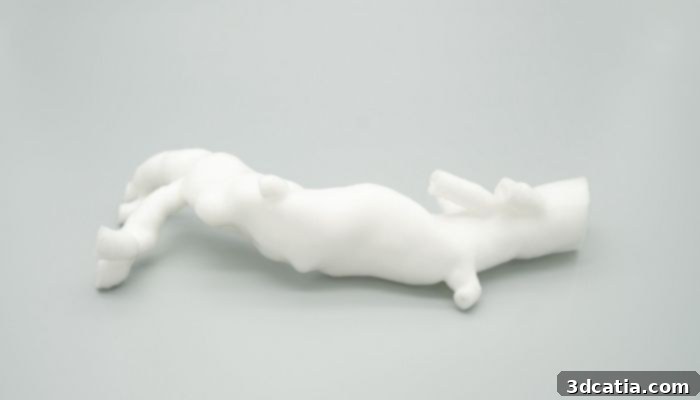
3D-printed aorta made from silicone (photo credits: 3Deus Dynamics)
Our products are specifically tailored for anyone looking to significantly expand their additive manufacturing capabilities by incorporating liquid or paste-like substances. This broad target audience includes several key segments:
- **3D printer manufacturers:** For these companies, our vipro-HEADs offer an invaluable opportunity to differentiate their product lines. By integrating our dosing heads, they can provide their customers with the option of processing a vastly wider range of advanced materials, moving beyond traditional plastics and resins into the realm of high-performance fluids and pastes. This significantly enhances the versatility and market appeal of their 3D printers.
- **Material manufacturers:** Our solutions enable material manufacturers to explore and adapt their innovative liquid and paste-like substances for 3D printing applications. This opens up new markets for their existing materials and encourages the development of novel formulations specifically designed for additive manufacturing. We provide the technology that allows their advanced materials to be precisely deposited and transformed into functional objects.
- **Research institutes:** For academic and industrial research institutions, the vipro-HEADs are invaluable tools. They particularly appreciate the wide and ever-expanding range of materials that can be processed. This capability allows researchers to push the boundaries of material science and additive manufacturing, developing new applications, exploring novel composite materials, and conducting fundamental studies that were previously unfeasible with conventional 3D printing equipment.
3DN: Do you have any last words for our readers?
We are incredibly excited about the future of additive manufacturing, especially in specialized fields. This year, ViscoTec is particularly proud to announce the upcoming launch of a groundbreaking new product. This innovative solution is specifically designed to offer significant benefits for additive manufacturing within the medical technology sector, with a strong focus on compliance with stringent guidelines and enhanced cleaning protocols. This development underscores our commitment to supporting industries where precision, sterility, and regulatory adherence are paramount, enabling the creation of safer and more reliable medical devices and components.
Furthermore, we believe in the power of collaboration and direct engagement with the community. We will be actively participating in numerous trade fairs this year, providing excellent opportunities for stakeholders to experience our innovations firsthand and discuss potential partnerships. Our next key events include the Silicone Expo in Amsterdam in March and the highly anticipated Rapid + TCT in Detroit in April. We are genuinely looking forward to showcasing our latest advancements, learning about new developments across the 3D printing market, and fostering new collaborations that will collectively push the boundaries of additive manufacturing. We invite everyone interested to visit us at these events or to discover more about ViscoTec’s comprehensive range of products and our innovative 3D print heads on our website, available HERE.
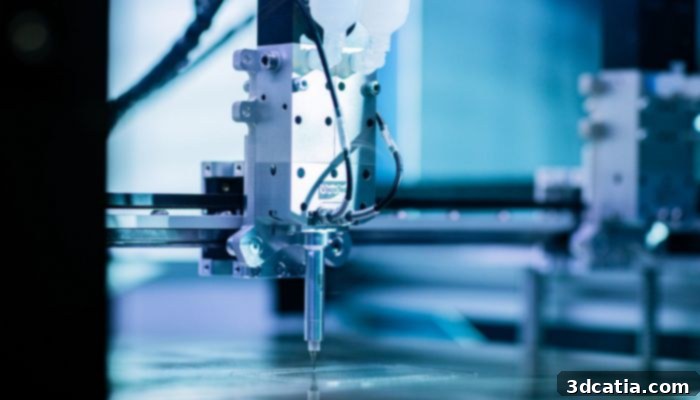
Bild: ViscoTec Pumpen- und Dosiertechnik GmbH
What are your thoughts on ViscoTec’s contributions to the field of fluid and paste 3D printing? We’d love to hear from you! Let us know your comments below or engage with us on our LinkedIn, Facebook, and Twitter pages! Don’t forget to sign up for our free weekly Newsletter here to receive the latest 3D printing news straight to your inbox! You can also find all our compelling videos and demonstrations on our dedicated YouTube channel.
*Cover Photo Credits: ViscoTec Pumpen- und Dosiertechnik GmbH