
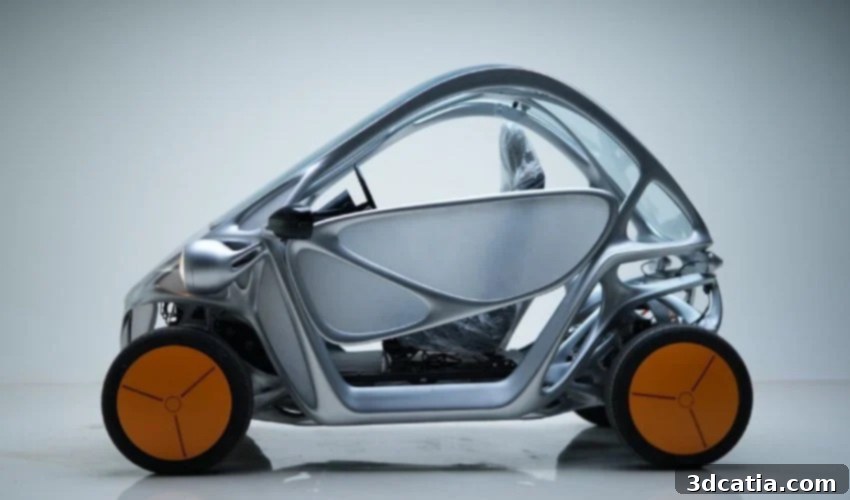
Robo-EV: Pioneering the Future of Automotive with AI-Powered 3D Printed Mobility
Artificial Intelligence (AI) technologies are rapidly permeating nearly every industry, assuming an increasingly pivotal role in our daily lives. Within the automotive sector, this impact is particularly profound, with AI driving significant progress, streamlining complex processes, enhancing safety standards, and fundamentally enabling the evolution of truly intelligent vehicles. This transformative synergy extends even further when AI is combined with 3D printing technologies. This powerful combination unlocks unprecedented possibilities, especially in the production of highly complex and customized vehicle components, leading to innovations previously deemed impossible. The project we are about to delve into, the “Robo-EV,” exemplifies this leap forward, offering an awe-inspiring vision of what the car of the future could truly embody.
Introducing the “Robo-EV,” a visionary 3D-printed micro-metal car conceptualized and produced by PIX Moving, Inc. This isn’t just another vehicle; it’s a testament to how cutting-edge technology can reshape personal mobility. At its core, the “Robo-EV” integrates a sophisticated AI system that functions as an intelligent personal assistant for the driver. This AI goes beyond basic navigation or entertainment; it possesses the unique capability to interpret the driver’s mood and tone of voice, offering emotional support and proactive assistance. While specific details on the intricate workings of this emotional intelligence are currently limited, the development team has indicated that the system leverages a powerful, advanced language model. This model facilitates natural, intuitive interaction between the AI and the driver, aiming to create a truly personalized and empathetic driving experience that adapts to individual needs and emotional states.
The vehicle’s integrated voice system serves as the primary interface, allowing the artificial intelligence to proactively inquire about the driver’s well-being and current needs. Based on these interactions, the AI provides tailored support, whether it’s adjusting ambient lighting, suggesting a calming playlist, or offering navigational advice optimized for a less stressful route. Beyond its advanced AI capabilities, the Robo-EV is engineered for remarkable versatility and adaptability. This modular model car can be flexibly configured to serve a multitude of purposes – from a personal urban transporter to a specialized delivery vehicle or even a dedicated freight carrier. The PIX Moving team is confident that the Robo-EV’s adaptable design and smart features will enable seamless integration into future public transport networks and smart city infrastructures, revolutionizing urban mobility and logistics by offering a versatile, on-demand solution.
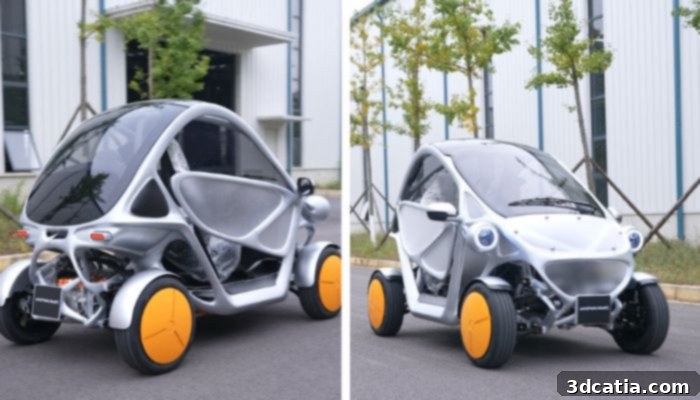
The “Robo-EV” in road traffic (photo credits: PIX Moving, Inc.)
However, what truly distinguishes the “Robo-EV” and makes it a visual spectacle is its striking, open-air design, which boldly challenges and breaks free from conventional automotive norms. This prototype showcases a design philosophy centered on minimalistic elegance and direct engagement with the environment. Critically, the entire vehicle, including its robust frame, intricate interior components, and even the distinctive wheel arches, was meticulously crafted from metal using advanced 3D printing processes. This choice of additive manufacturing was not merely aesthetic; it was a deliberate engineering decision. By leveraging 3D printing, PIX Moving was able to drastically reduce the number of individual parts required for assembly and minimize the need for traditional welds. This innovative manufacturing approach significantly enhances the vehicle’s structural integrity and minimizes potential weak points that are often inherent in conventionally manufactured multi-part assemblies. The result is a more resilient, safer, and ultimately more efficient vehicle structure.
The application of topology optimization played an equally crucial role in the development of the Robo-EV. This advanced engineering technology enabled designers to precisely optimize the material distribution within the vehicle’s components, maximizing structural strength and impact resistance while simultaneously minimizing material usage and reducing unwanted frictional noise. Topology optimization involves using computational algorithms to generate optimal designs based on specific load cases and constraints, resulting in organic, often bionic-like forms that are incredibly strong for their weight. This process allows for creation of parts that are lightweight yet incredibly robust. Furthermore, the suspension system of the Robo-EV incorporates basalt composite materials. These state-of-the-art materials are not only celebrated for their exceptional robustness and superior corrosion resistance, but they are also instrumental in significantly reducing the vehicle’s overall weight and, consequently, its carbon emissions throughout its lifecycle. To further enhance the driver and passenger experience, the vehicle features customizable seats, which were also tailored and produced using precise 3D printing techniques, offering unparalleled ergonomic comfort and personalization.
Beyond its groundbreaking design and advanced manufacturing, the “Robo-EV” boasts an array of compelling sustainable and functional advantages that underscore its forward-thinking nature. Its lightweight construction, a direct benefit of advanced 3D printing and material choices, combined with an aerodynamically optimized profile, plays a crucial role in significantly reducing energy consumption. This efficiency translates directly into an extended driving range and lower operational costs, making it a highly sustainable option for future mobility. Moreover, the vehicle is equipped with a regenerative braking system, a smart technology that recharges the battery during deceleration and braking. This clever mechanism captures kinetic energy that would otherwise be lost as heat, converting it back into usable electrical energy, thereby extending the car’s range even further and contributing to its overall energy independence. Most importantly, the Robo-EV prototype stands as a powerful demonstration of how the fusion of 3D printing and artificial intelligence is fundamentally redefining the automotive industry. It’s not just about creating new vehicles; it’s about paving the way towards a greener, more sustainable future, while simultaneously elevating driving safety and comfort to unprecedented levels. This project offers a tangible glimpse into the transformative potential of these technologies, setting new benchmarks for innovation and responsible manufacturing. Discover more fascinating insights about this revolutionary project HERE.
What are your thoughts on the groundbreaking “Robo-EV” and its potential impact on the future of personal mobility? We’d love to hear your insights and predictions! Let us know what you think in a comment below or join the conversation on ourLinkedIn,Facebook, andTwitter pages! Don’t miss out on the latest advancements and news in the world of additive manufacturing by signing up for our free weeklyNewsletter here, delivering the most current 3D printing news straight to your inbox! You can also find all our engaging videos and in-depth discussions on our dedicatedYouTube channel, exploring the innovations shaping tomorrow’s world.
*Cover Photo Credits: PIX Moving, Inc.