
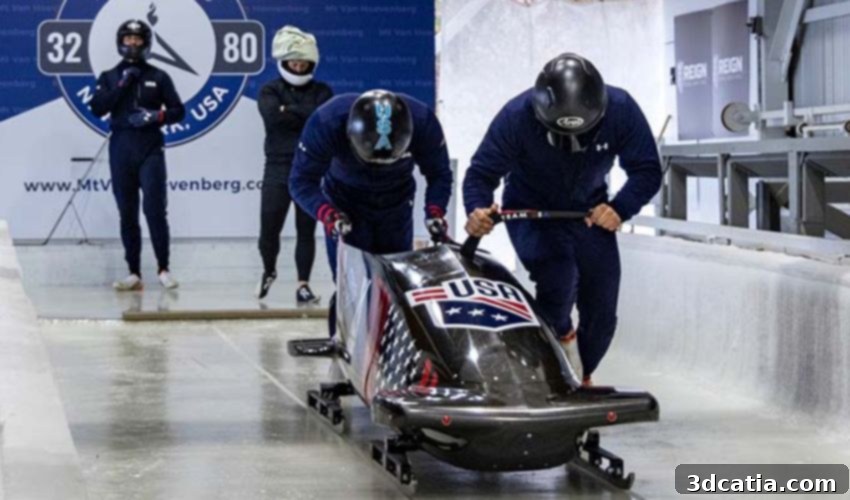
Bobsledding into the Future: How 3D Printing is Revolutionizing Winter Olympic Performance
Bobsledding, a high-octane winter sport, has captivated adrenaline enthusiasts globally for decades. While many in the USA might associate it primarily with the beloved 1990s film “Cool Runnings,” its presence extends far beyond cinematic narratives, now standing as a prominent and intensely competitive winter event. In a significant leap forward, this exhilarating sport is forging a powerful connection with advanced manufacturing, specifically through the integration of 3D printing technology. The United States Bobsled and Skeleton Federation (USABS) has officially announced its proactive preparations for the upcoming 2026 Winter Olympics, embracing additive manufacturing as a cornerstone of its modernization strategy.
The inherent nature of bobsledding demands equipment of unparalleled strength and precision. As sleds hurtle down icy tracks at tremendous speeds, the components must endure increasingly severe loads and immense physical forces. Beyond sheer durability, the modern landscape of elite sports places a growing emphasis on equipment personalization, tailoring designs to individual athletes for optimal performance and comfort. Crucially, the safety of the athletes remains paramount, necessitating rigorous engineering and appropriate protective measures in every design decision. It is precisely these multifaceted demands – high performance, customization, and unwavering safety – that have compelled the USABS to strategically adopt additive manufacturing for the production of critical bobsled components.
The advantages of 3D printing are transformative, particularly in an application as demanding as bobsledding. Unlike traditional manufacturing methods that often necessitate the costly and time-consuming creation of molds, additive manufacturing builds parts layer by layer directly from digital designs, leading to significant reductions in both cost and production time. This digital-first approach also unlocks unprecedented levels of customization, allowing for an almost limitless scope in design. Complex geometries, intricate internal structures, and highly specific ergonomic forms, once impossible or prohibitively expensive to produce, can now be manufactured with remarkable ease. These compelling benefits convinced the USABS team, leading to the announcement of a strategic new partnership with the American 3D printing service provider CRP USA on October 4, 2023. This collaboration signals a profound shift in how elite sports equipment will be designed and produced, harnessing cutting-edge technology to gain a competitive edge.
CRP USA stands as a highly reputable 3D printing service provider, specializing in the production of functional, high-performance parts using advanced processes like Selective Laser Sintering (SLS) and Powder Bed Fusion (PBF). Their expertise spans critical industries such as aerospace, automotive, motorsport, and defense – sectors where component reliability and performance are absolutely non-negotiable. This extensive experience made CRP USA an ideal partner for USABS. As part of this innovative alliance, the collaborating partners embarked on a groundbreaking project specifically aimed at the 2026 Winter Games. The initiative focused on equipping the US team’s racing bobsleds with a suite of bespoke, 3D-printed parts, including crucial elements such as push handles, grab handles, and custom-fitted seats. A key consideration throughout the design and production process was ensuring strict adherence to the rigorous shape and size regulations set forth by the Olympic Sports Authority, ensuring that every innovative component met international competitive standards.
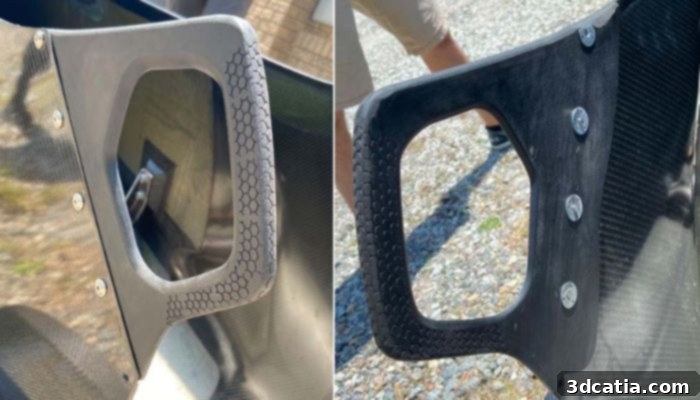
The USABS team leverages 3D printing to create various bobsled parts, including optimized push handles for enhanced performance.
USABS Relies on Windform High-Performance Materials for Unmatched Durability
In bobsledding, the initial push phase is unequivocally critical, serving as the foundation for building maximum speed down the track. During this intense period, an athlete’s trust must extend beyond their teammates (in team events) to the very equipment they are using. The materials employed in bobsled construction must possess a unique combination of flexibility and robustness, capable of absorbing immense stresses without deforming, cracking, or breaking, especially given the high risk of falls at extreme velocities. The integrity of every component directly impacts both performance and, more importantly, athlete safety.
After meticulous and extensive studies, CRP USA and the USABS team made a strategic decision to utilize the advanced Windform materials, developed by the acclaimed Italian company CRP Technology. These high-performance composites are renowned for their exceptional mechanical properties and have a proven track record in the most demanding sectors, including high-stakes motorsports and critical aerospace applications. CRP USA, leveraging its expertise in the SLS (Selective Laser Sintering) process, manufactures the bobsled parts from two specific carbon fiber-reinforced Windform materials: Windform SP and Windform XT 2.0. This choice underscores a commitment to utilizing materials that offer superior strength-to-weight ratios and resilience under extreme conditions.
For the crucial seats and grab handles, the USABS team opted for Windform XT 2.0. This material is particularly chosen for its rigidity, excellent mechanical properties, and ability to withstand repeated stress, ensuring a secure and stable interface for the athletes within the sled. The grab handles, vital for maintaining control and stability during the run, benefit from XT 2.0’s structural integrity. Simultaneously, the seats, which must cradle the athletes securely while enduring constant vibrations and G-forces, require a material that offers both strength and a degree of customizable ergonomics, easily achievable with additive manufacturing.
For the equally vital push handles, CRP USA and USABS collaboratively selected Windform SP. This material is distinguished by its extraordinary resistance to impact, vibration, and deformation – properties that are absolutely essential during the explosive start phase and any potential incidents. Nathanael Baker, Senior Project Coordinator for CRP USA, emphasized the practical advantages: “The USABS team needed to easily produce the push handles, in addition to customize the handles based on each athlete and easily change them out.” This highlights a key benefit of 3D printing: the ability to rapidly iterate designs and produce individualized parts that precisely fit each athlete’s grip and biomechanics, providing a significant competitive advantage through enhanced comfort and control.
Rapid Prototyping and Real-World Validation
The iterative nature of 3D printing significantly accelerated the development cycle for these critical bobsled components. Parts were printed swiftly, allowing for rapid physical prototyping. Following initial tests and minor adjustments based on feedback, the optimized components were quickly moved into real-world validation. Marc van den Berg, Technology and Equipment Lead at USABS, underscored the intensity of this testing approach: “We don’t have an official test program, we assemble the parts and use them in a race. And so we did with the 3D printed parts in Windform: This means that the seat, hand grip and rear push handle were immediately tested in a real race!” This statement not only highlights the confidence in the 3D-printed Windform parts but also the immediate and tangible impact of this technology on the team’s preparations. The primary focus during these real-world tests was on two critical aspects: stress resistance under competitive loads and optimal ergonomics for the athletes.
The official competitive debut of these innovative 3D-printed parts took place at the IBSF North American Cup (NAC), held from November 15 to 19, 2023. A particular emphasis was placed on the performance and durability of the rear push handles, components that are subjected to immense forces during the initial push and must remain perfectly intact even in the event of a crash or fall. Beyond the encouraging results achieved by the team in the competition itself, the 3D-printed components unequivocally passed their baptism of fire. The USABS leadership was not only profoundly impressed by the unparalleled freedom of design offered by additive manufacturing and the logistical advantages of rapid, on-demand part delivery, but also by the tangible enhancement in performance and resilience demonstrated by the parts in a high-stakes competitive environment.
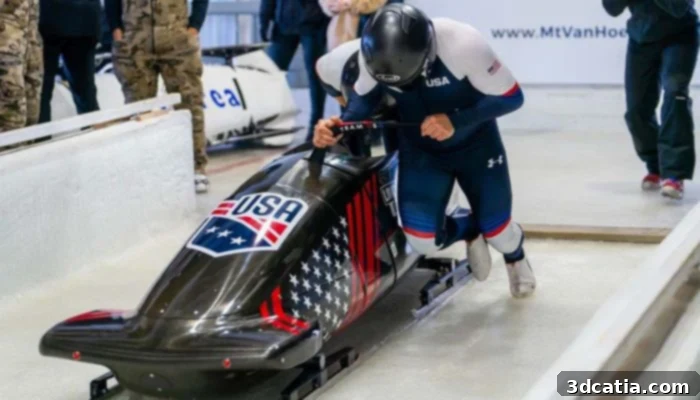
The start phase is crucial for the course of the race, demanding that all equipment meets the highest performance and safety standards.
The Future is Additive: Beyond Bobsled Parts
For Marc van den Berg, the success of these initial applications has sparked further ambitious considerations: “Hopefully we can 3D print more parts in the future, perhaps even a complete bobsled!!” This forward-looking statement hints at the immense potential that additive manufacturing holds for the sport. The ability to create lighter, stronger, and more aerodynamically efficient components, or even entire structures, could redefine bobsled design. Who knows, this pioneering embrace of 3D printing might just be the next strategic advantage in the US team’s ongoing preparations for Olympic glory. This innovative approach not only impacts bobsledding but also paves the way for other winter sports and elite athletic disciplines to explore and integrate additive manufacturing for performance enhancement, safety, and customization. The collaboration between USABS and CRP USA, leveraging Windform materials, represents a significant milestone in sports engineering, demonstrating how advanced technologies can be harnessed to push the boundaries of human performance. You can delve deeper into the specifics of these revolutionary 3D-printed bobsled components and their impact HERE.
What are your thoughts on the USABS team’s innovative 3D-printed bobsled parts and their potential impact on the 2026 Winter Olympics? Share your opinions in a comment below or join the discussion on our LinkedIn, Facebook, and Twitter pages! Don’t forget to sign up for our free weekly Newsletter here, to receive the latest 3D printing news directly to your inbox! You can also find all our compelling videos and interviews on our YouTube channel.
*All Photo Credits: USABS