
Revolutionizing Industries: How 3D Printing is Shaping Space, Energy, and Healthcare
The landscape of manufacturing is undergoing a profound transformation, driven by the relentless innovation of 3D printing, also known as additive manufacturing. This revolutionary technology is no longer confined to rapid prototyping; it’s actively disrupting critical sectors ranging from aerospace and energy to medical devices and construction. This week, we delve into groundbreaking advancements, showcasing how 3D printing is enabling the impossible: building rockets in record time, pioneering off-world habitats, fortifying nuclear power plants, creating life-changing medical implants, and democratizing access to industrial-grade metal 3D printing. Join us as we explore these pivotal developments that highlight the immense potential and tangible impact of additive manufacturing on our future.
3D Printing Rockets: Speeding Up Space Exploration with Relativity Space
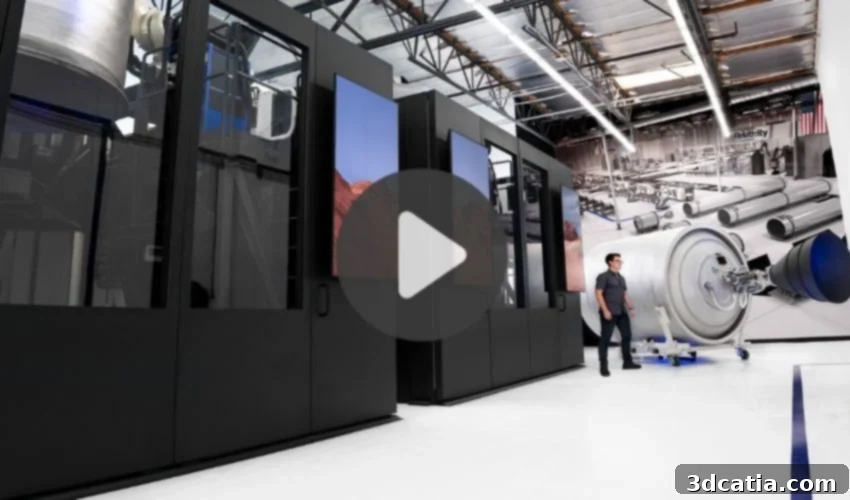
Imagine building an entire rocket in a mere 60 days – a process that traditionally takes up to nine months. This ambitious vision is now a reality thanks to Relativity Space, an American startup that stands at the forefront of aerospace innovation. Utilizing the world’s largest 3D metal printer, named “Stargate,” Relativity Space is fundamentally reshaping how rockets are designed, manufactured, and launched. Their pioneering approach involves printing over 85% of their rockets, including the entire Terran 1 and a significant portion of the larger Terran R, with highly optimized, single-piece structures.
The “Stargate” printer is not just large; it’s a marvel of engineering, capable of printing an entire rocket fuselage from custom aluminum alloys. This process dramatically reduces the part count from thousands to just a handful, significantly simplifying the supply chain and assembly process. The benefits extend beyond mere speed; 3D printed components offer superior strength, durability, and optimized geometries that are impossible to achieve with conventional manufacturing methods. These complex internal structures can lighten the rocket while maintaining structural integrity, leading to greater payload capacity and more efficient launches. By bringing rapid iteration and manufacturing agility to the aerospace industry, Relativity Space is poised to accelerate humanity’s multi-planetary future, making space missions more frequent, affordable, and reliable.
Building on Mars: ICON’s Vision for Extraterrestrial Habitats
The dream of colonizing Mars and establishing permanent extraterrestrial outposts is slowly becoming a tangible reality, largely thanks to advancements in 3D printing technology. Earlier this week, we highlighted the groundbreaking project from ICON, a company renowned for its expertise in developing large-scale concrete 3D printers. ICON is currently constructing a simulated Mars habitat on Earth, designed to replicate the challenging living conditions on the Red Planet. This ambitious endeavor aims to prepare future astronauts for long-duration space missions, providing invaluable insights into what it takes to live and work in an off-world environment.
The structure’s walls are being 3D printed using ICON’s proprietary Vulcan machine, a testament to the versatility and robustness of additive manufacturing in extreme environments. This approach is crucial for future lunar and Martian missions, where transporting conventional building materials from Earth would be prohibitively expensive and logistically complex. By utilizing local resources – such as regolith, the loose soil found on celestial bodies – 3D printing offers a viable solution for “in-situ resource utilization” (ISRU), transforming raw Martian soil into habitable structures. ICON’s project not only advances space architecture but also holds immense promise for sustainable and rapid construction solutions on Earth, particularly in disaster relief or remote locations. This pioneering work brings humanity one step closer to establishing a permanent human presence beyond our home planet.
Nuclear Energy Embraces Additive Manufacturing: ORNL’s Breakthrough
The nuclear energy sector, known for its stringent safety regulations and long qualification processes, is also witnessing a quiet revolution through additive manufacturing. A dedicated team from Oak Ridge National Laboratory (ORNL) has achieved a significant milestone: for the very first time, they have successfully 3D printed and installed four fuel assembly brackets into an operational nuclear power plant. This achievement is not merely an engineering feat; it represents a critical step towards modernizing nuclear infrastructure and improving reactor safety and efficiency.
The project utilized the powder bed laser fusion process, employing a specialized metal additive manufacturing machine developed by Concept Laser. This technique allows for the creation of complex geometries with high precision and material density, crucial for components operating under extreme conditions within a nuclear reactor. The ability to 3D print such vital parts offers numerous advantages, including the potential to create optimized designs that improve cooling, reduce material waste, and accelerate the replacement of aging components. ORNL’s ongoing research aims to expedite the qualification and certification of these 3D-printed nuclear components, paving the way for wider adoption of additive manufacturing in advanced reactor designs. This innovation promises to enhance the safety, extend the lifespan, and boost the overall efficiency of nuclear power plants, contributing significantly to a clean energy future. The video below showcases the detailed production steps:
Advancing Healthcare: 3D Printed Implants by RMS
In the medical field, additive manufacturing is transforming patient care by enabling the creation of highly customized and complex implants. RMS, a key subsidiary of the Cretex Medical group, recognized this potential early on, beginning its significant investment in metal additive manufacturing in 2016. Today, RMS boasts an impressive facility dedicated to this cutting-edge technology, housing over 27 3D printers and dedicating more than 1,000 square meters to the exploration of advanced 3D printing materials and innovative processes. Their primary objective is to significantly increase the production of titanium implants, a material widely favored for its biocompatibility and strength.
The strength of 3D printing in medical applications lies in its ability to create patient-specific devices with intricate internal structures, such as porous lattice designs. These structures promote osseointegration, allowing bone tissue to grow into the implant, leading to better long-term stability and patient outcomes. RMS strategically combines additive manufacturing with traditional subtractive manufacturing solutions and sophisticated post-processing machines. This hybrid approach ensures that they can offer a comprehensive range of adapted and tailor-made medical devices, from orthopedic and dental implants to spinal fusion devices. By leveraging the unique capabilities of 3D printing, RMS is not only accelerating product development but also improving the quality and customization of medical solutions, ultimately enhancing patient recovery and quality of life.
Democratizing Metal 3D Printing: One Click Metal & Autodesk
Historically, industrial metal 3D printing has been an expensive and complex endeavor, largely accessible only to large corporations and specialized research institutions. One Click Metal, a forward-thinking new manufacturer in the metal 3D printer space, is on a mission to change this paradigm. Their core goal is to democratize the use of metal 3D printing by drastically reducing both the cost of entry and the operational complexity. Offering solutions in the ballpark of $60,000, One Click Metal makes advanced metal additive manufacturing significantly more accessible compared to many high-end systems on the market.
To achieve this ease of use and affordability, One Click Metal has strategically relied on Autodesk’s powerful software suite, particularly Fusion 360. This collaboration allows their machines to integrate seamlessly with intuitive design and manufacturing workflows, simplifying the entire production process from CAD model to finished part. Fusion 360 empowers users, regardless of their prior expertise in additive manufacturing, to explore complex geometries, optimize designs, and prepare files for printing with unprecedented ease. This user-friendly approach opens up metal 3D printing to a much broader audience, including small and medium-sized enterprises (SMEs), educational institutions, and individual innovators. By lowering the barriers to entry, One Click Metal is fostering greater innovation, enabling faster prototyping, and facilitating the cost-effective production of functional metal parts across diverse industries, truly bringing industrial additive manufacturing within reach of many.
The transformative power of 3D printing is undeniable, pushing the boundaries of what’s possible across a myriad of industries. From enabling rapid rocket production and laying the foundation for extraterrestrial habitats to securing our energy infrastructure and revolutionizing personalized medicine, additive manufacturing continues to prove its value. Furthermore, initiatives like One Click Metal are ensuring that these advanced capabilities become more accessible, fostering innovation at every level. What are your thoughts on these incredible advancements in 3D printing? Let us know in a comment below or join the conversation on our Facebook and Twitter pages. Don’t forget to sign up for our free weekly newsletter to receive all the latest news in 3D printing delivered straight to your inbox!