
Revolutionizing Space Exploration: The Future of Zero-Gravity 3D Printing and In-Orbit Manufacturing
The ambitious journey of humanity into the cosmos has always been met with immense logistical and technological challenges. For decades, everything required for space missions, from communication satellites to life-support systems, has had to endure the rigors of Earth’s atmosphere and the immense forces of a rocket launch. However, a new era is dawning, spearheaded by groundbreaking advancements in 3D printing in zero gravity. This innovative technology promises to fundamentally transform how we build, repair, and even live in space, paving the way for unprecedented feats of exploration and settlement.
Recent years have witnessed remarkable progress in the application of additive manufacturing for space environments. Leading space agencies, including NASA and the European Space Agency (ESA), have been at the forefront of this research. NASA, for instance, has extensively investigated the use of 3D printing for constructing critical structures and components directly in space, a capability that would drastically reduce launch mass and cost. The ESA has also made significant strides, notably by testing metal 3D printing technologies aboard the International Space Station (ISS), demonstrating the feasibility of manufacturing metallic parts in a microgravity environment. These initiatives underscore the pivotal role that in-space additive manufacturing is set to play in humanity’s extraterrestrial endeavors.
Building on this momentum, researchers at the University of Glasgow in Scotland have unveiled a revolutionary system designed to tackle one of the most persistent hurdles in space manufacturing: the challenges of 3D printing in the absence of gravity. Dr. Gilles Bailet and his team have developed a prototype 3D printer specifically engineered to operate effectively in zero-gravity conditions. This breakthrough marks a critical step towards realizing the vision of self-sufficient space factories, capable of producing essential technologies and infrastructure directly in orbit, precisely when and where they are needed.
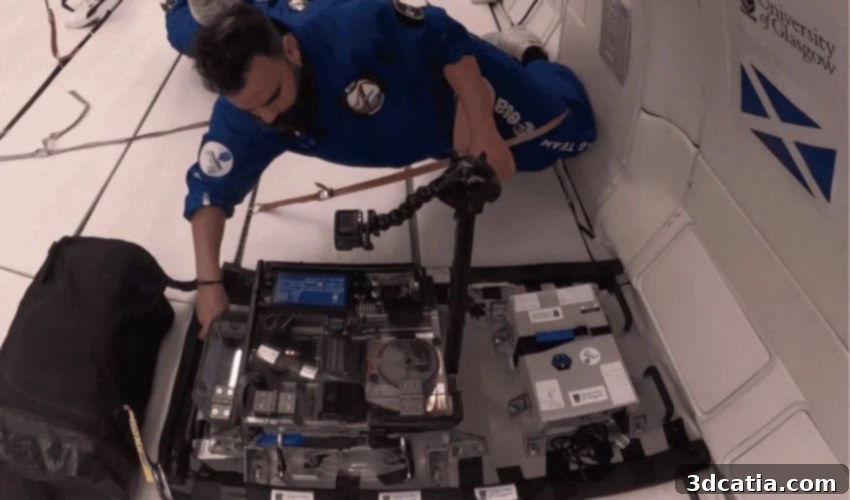
Dr. Bailet’s prototype printer is the culmination of several years of dedicated research and development at the University of Glasgow. Its design directly addresses the unique physics encountered in microgravity, where conventional 3D printing methods, reliant on gravity for material flow and structural integrity, often fail. To validate its innovative design, the technology recently underwent rigorous testing during a series of intensive test flights aboard a specialized research aircraft affectionately, or perhaps notoriously, known as the “vomit comet.” These parabolic flights simulate brief periods of weightlessness, providing an invaluable testbed for technologies destined for outer space. The success of these tests offers compelling evidence that Dr. Bailet’s system could indeed be the solution to unlocking the full potential of zero-gravity 3D printing. But how exactly does this ingenious technology function, and what far-reaching implications does its success hold for the future of space exploration?
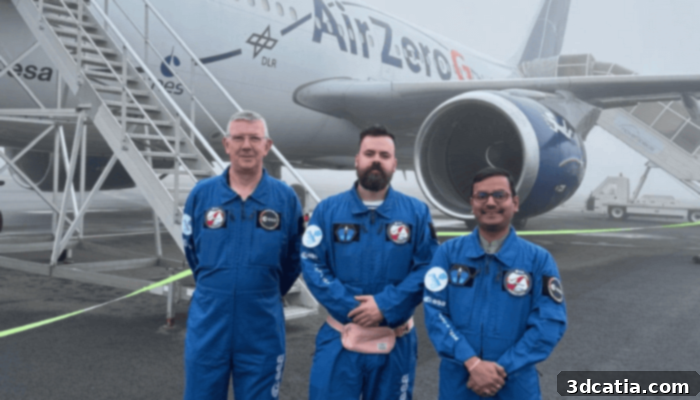
Photo Credits: Media India Group
Space Factories: Advancing Humanity’s Ambitions with In-Orbit Manufacturing
The development of reliable 3D printing capabilities in low-gravity environments is not merely a technical achievement; it is a gateway to a transformative future. According to Dr. Bailet, this capability will enable the establishment of sophisticated space factories, capable of manufacturing a wide array of complex devices and structures directly in orbit. Imagine the possibilities: massive solar reflectors, far larger than anything that could be launched from Earth, deployed to power distant outposts or reshape planetary environments. Advanced communication antennas, custom-built for optimal performance in specific orbital configurations, could revolutionize global connectivity and deep-space communication. Furthermore, the ability to manufacture specialized equipment for producing more efficient medicines or even synthetic biological materials in space could have profound implications for astronaut health and long-duration missions. These in-space manufacturing facilities would free humanity from the inherent limitations of Earth-based production and launch logistics.
A key innovation central to Dr. Bailet’s system lies in its approach to printing materials. Unlike conventional FDM (Fused Deposition Modeling) 3D printers that rely on filament spools, which can present significant challenges in microgravity due to issues with material feed, thermal control, and extrusion consistency, the team at the University of Glasgow designed a specialized granular material. This granular feedstock is specifically formulated for space applications, offering distinct advantages. Its unique properties allow for rapid and consistent delivery to the printer’s nozzle, even in the absence of gravitational forces that would typically aid in material flow. This ensures a stable and efficient printing process, overcoming many of the hurdles faced by traditional filament-based systems in a microgravity environment. The ability to precisely control the dispensing and fusion of granular materials opens up new avenues for materials science and engineering in space, potentially allowing for the creation of components with superior properties tailored for the harsh conditions of orbit.
Dr. Bailet eloquently articulates the profound shift this technology represents: “Currently, everything that goes into Earth’s orbit is built on the surface and sent into space on rockets. They have tightly limited mass and volumes and can shake themselves to pieces during launch when mechanical constraints are breached, destroying expensive cargo in the process. If instead we could place fabricators in space to build structures on demand, we would be freed from those payload restrictions. In turn, that could pave the way to creating much more ambitious, less resource-intensive projects, with systems actually optimized for their mission and not for the constraints of rocket launches.” This statement encapsulates the core philosophy behind in-space manufacturing: to decouple the design and functionality of space systems from the crushing limitations imposed by rocket fairings and launch dynamics. Imagine building a telescope with an aperture far exceeding anything that could fit into a rocket, or constructing an entire habitat for a lunar outpost using locally sourced materials, piece by piece, as needed. Such capabilities would unlock truly ambitious projects that are currently deemed impractical or prohibitively expensive.
The potential of 3D printing to produce complex materials quickly and cost-effectively makes it an invaluable asset for future space missions. Dr. Bailet emphasizes that this ability would be extraordinarily useful in space for manufacturing components and tools essential for on-orbit assembly, maintenance, and even long-duration human missions. However, he also highlights a critical caveat: what works flawlessly on Earth’s surface may prove unreliable, or entirely inoperable, in the unforgiving vacuum and microgravity of space. The challenges extend beyond simply extruding material; they involve managing heat dissipation, ensuring layer adhesion without gravity, and contending with material behavior in an environment utterly devoid of atmospheric pressure. Until now, significant 3D printing activities beyond the controlled environment of the International Space Station’s dedicated printing areas have been limited. The filaments used in conventional terrestrial printers often exhibit problematic behavior in microgravity and vacuum conditions, making their application in the wider space environment exceedingly difficult. Dr. Bailet’s research directly confronts these fundamental obstacles, leading to the development of a technology that brings us significantly closer to ubiquitous in-space manufacturing, promising potential benefits not just for space exploration, but for our entire planet in the coming decades.
Rigorous Testing and Future Prospects of Off-World Construction
The viability of Dr. Bailet’s prototype was conclusively demonstrated in November of last year during the 85th parabolic flight campaign conducted by the European Space Agency (ESA) in Bordeaux, France. This rigorous testing regimen involved the team completing three separate flights, each designed to expose the prototype to multiple phases of microgravity. During these flights, the aircraft performed a series of rollercoaster-like maneuvers, creating over 90 short bursts of weightlessness. Each precious 22-second phase of microgravity provided a crucial window for the research team to meticulously test and confirm the prototype’s functionality. The successful operation of the system in these demanding conditions provided unequivocal proof that Dr. Bailet’s design is robust and effective in simulating the conditions of outer space. This crucial validation marks a significant milestone, moving the technology from theoretical concept to a proven, working prototype. Further details on this successful campaign and its implications can be found in the University of Glasgow press release HERE.
The implications of this breakthrough extend far beyond simply printing a few tools on the ISS. The ability to reliably manufacture in zero-gravity opens up a future where space missions are no longer constrained by what can be launched from Earth. Imagine lunar bases constructed using materials extracted and processed directly on the Moon. Picture Martian outposts expanded with components fabricated on-site, reducing the immense cost and risk of transporting everything from Earth. This technology is a cornerstone for sustainable space exploration, enabling astronauts to repair critical equipment, print custom parts, and even develop new structures on demand, making long-duration missions and permanent human settlements a more realistic prospect. It reduces the dependence on Earth for resupply, turning space travelers from mere visitors into self-sufficient pioneers.
Looking ahead, the next steps for Dr. Bailet’s research will likely involve further refinement of the granular material, optimization of the printing process for extended operation, and eventually, testing the prototype in actual orbital conditions. Collaboration with international space agencies will be crucial to integrate this technology into future missions, potentially leading to its deployment on lunar gateways, Mars-bound spacecraft, or next-generation orbital platforms. The future of zero-gravity 3D printing promises to usher in an era of unprecedented self-reliance and ambition in space, transforming humanity’s reach across the solar system.
What are your thoughts on this groundbreaking prototype for zero-gravity 3D printing? Do you believe that in-space factories could fundamentally change how astronauts explore and settle outer space? Share your insights and join the conversation by leaving a comment below or engaging with us on our social media platforms: LinkedIn, Facebook, and Twitter! And for all the latest developments in additive manufacturing and space technology, don’t forget to sign up for our free weekly Newsletter here, delivering the most important 3D printing news straight to your inbox! You can also explore our extensive library of videos on our YouTube channel for more in-depth content.
*Cover Photo Credits: University of Glasgow