
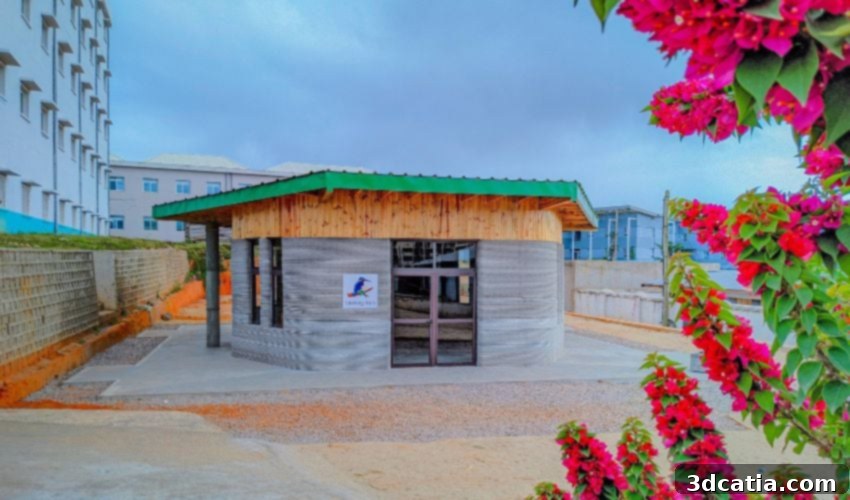
Pioneering Education: Thinking Huts Unveils Madagascar’s First 3D Printed School
In a significant leap forward for global education and sustainable construction, Thinking Huts, an American nonprofit organization, proudly announced the completion and official opening of its pilot project: Madagascar’s first-ever 3D printed school. Located in Fianarantsoa, a vibrant city in south-central Madagascar, this innovative educational facility marks a pivotal moment in the organization’s mission to enhance access to education in underserved regions worldwide. Founded in 2015, Thinking Huts leverages advanced additive manufacturing technologies to construct schools more ecologically and sustainably. This groundbreaking approach not only drastically reduces construction waste but also significantly shortens build times, offering a compelling alternative to traditional building methods in areas with critical infrastructure needs.
The ambitious project, affectionately named “Bougainvillea,” was conceived seven years ago as a direct response to the urgent global demand for educational institutions in regions lacking adequate resources. Thinking Huts strategically selected Madagascar as the inaugural site for its pioneering initiative due to a confluence of compelling factors. The East African island nation faces an acute shortage of educational infrastructure, making it an ideal location to demonstrate the transformative potential of 3D printing. A stark UNESCO report underscores the severity of the crisis, revealing that a staggering 97% of Malagasy children aged 10 lack the fundamental reading comprehension skills required to understand a single sentence. This alarming statistic places Madagascar among the countries with the most profound educational disadvantages globally. The nation grapples with widespread school overcrowding and immense travel distances for students, contributing to an estimated need for approximately 22,000 new schools across Malagasy soil. The “Bougainvillea” project stands as a beacon of hope, addressing this critical need head-on with an innovative and efficient solution.
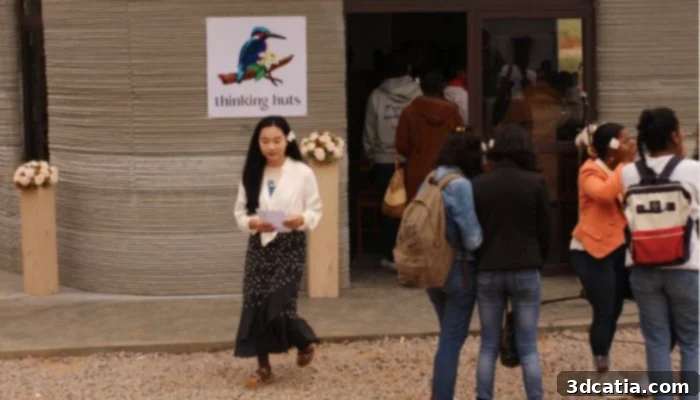
Maggie Grout, CEO, and founder of Thinking Huts
A Personal Vision: Maggie Grout’s Transformative Inspiration
At the heart of Thinking Huts’ profound mission is the deeply personal conviction of its founder and CEO, Maggie Grout. Her journey is a testament to the life-changing power of education and opportunity. “I was adopted from China when I was a baby,” Grout shares, “and I am here today because of my parents and the opportunities I achieved through education. I founded Thinking Huts when I was 15 after becoming fascinated with the potential of technology to create architectural solutions for a world of good. My life could have followed a very different timeline, and I do not take that for granted. My hope is to find a solution that increases global access to education because it is at the root of empowering people to lift themselves out of poverty.” This profound sentiment fuels the organization’s unwavering commitment to making quality education accessible to every child, recognizing it as the fundamental pathway out of destitution and towards a brighter future. Grout’s vision extends beyond mere construction; it aims to catalyze socio-economic transformation through the strategic deployment of innovative technological solutions.
The “Bougainvillea” Project: A Blueprint for the Future
The successful realization of the “Bougainvillea” project in Fianarantsoa stands as a powerful demonstration of collaborative innovation and humanitarian resolve. This pilot school, while serving immediate educational needs, is also conceived as a robust blueprint for future expansions, showcasing the scalability and efficacy of 3D printing in educational infrastructure development. Its completion represents not just a building, but a proof-of-concept for a new paradigm in global school construction.
Strategic Partnerships for Optimal Construction
To ensure the optimal design and construction of this pioneering school, Thinking Huts forged strategic alliances with key partners, each bringing specialized expertise to the endeavor. A crucial collaboration was established with 14 Trees, a company renowned for its extensive experience in 3D printing buildings, having already successfully delivered similar projects in countries like Kenya and Malawi. Their practical knowledge of additive manufacturing in real-world construction scenarios was invaluable. The architectural vision for the school was skillfully crafted by Bruno Silva and Yash Mehta of Defining Humanity, who translated Thinking Huts’ mission into a functional and aesthetically pleasing design.
Within the Thinking Huts team, Matteo Pietrobelli played a pivotal role as the structural engineer. He meticulously designed all structural components of the school, encompassing the foundations, the innovative 3D printed concrete walls, reinforced concrete columns, and the timber roof. Beyond his engineering responsibilities, Pietrobelli also served as a vital liaison for the project team, leveraging his fluency in French—one of Madagascar’s official languages alongside Malagasy. This linguistic proficiency was instrumental in facilitating seamless coordination between the design team and the local construction crew and contractor, ensuring that the project’s vision was accurately and effectively implemented on the ground.
Community Engagement and Local Empowerment
Further enriching the project’s foundation, Thinking Huts actively engaged with local institutions and businesses. Partnerships were established with the prestigious university Ecole de Management et d’Innovation Technologique (EMIT) and the local construction company SECOA. These collaborations fostered a strong sense of community ownership and ensured that the project benefited from local knowledge and resources. The school’s robust walls were intricately 3D printed using a specially formulated cement mixture engineered to withstand diverse environmental pressures, ensuring durability and longevity. Critically, elements such as the roof, doors, and windows were fabricated using locally-sourced materials, further bolstering the local economy and reducing the project’s carbon footprint.
A cornerstone of Thinking Huts’ philosophy is local empowerment. Throughout the construction process, local manufacturers and laborers were actively involved and received comprehensive training in 3D operational skills. This capacity-building initiative is designed to leave a lasting legacy, equipping the community with valuable, cutting-edge construction expertise that can be applied to future projects, fostering self-sufficiency and sustainable development within Madagascar. This approach transforms a temporary construction project into a long-term investment in human capital.
Beyond Bricks and Mortar: The Broader Vision
The successful completion of the “Bougainvillea” project represents far more than just the erection of a new building; it sets an important global milestone for the viability and potential of 3D printed schools in addressing critical educational disparities. By demonstrating the efficacy of additive manufacturing in a challenging, remote environment, Thinking Huts has provided a compelling proof-of-concept that can be replicated and scaled across the globe. The organization is already looking forward with anticipation to commencing new projects in different countries, driven by the belief that this innovative approach can unlock educational opportunities for millions of children.
Maggie Grout encapsulates this forward-looking vision: “The past two years have shed light on the urgency of human-centric, innovative solutions to tackle the world’s most pressing problems. We look forward to growing as we address the need for schools while bringing people together and inspiring the next generation to make a difference. This is only the beginning.” This sentiment underscores Thinking Huts’ commitment to continuous innovation, community collaboration, and the broader goal of fostering a more educated and empowered global citizenry. The “Bougainvillea” school in Madagascar is not merely an architectural achievement; it is a symbol of hope, a testament to what is possible when technology, empathy, and ingenuity converge to solve some of humanity’s most persistent challenges. Through this pioneering effort, Thinking Huts is not just building schools; it is laying the foundation for a future where education is a universal right, not a privilege.
You can find out more about the organization and their inspiring work HERE.
What are your thoughts on the groundbreaking 3D printed school created by Thinking Huts? We’d love to hear your perspective! Share your comments below or engage with us on our Facebook, Twitter, and LinkedIn pages! Don’t miss out on the latest advancements in additive manufacturing; sign up for our free weekly Newsletter here to receive the most current 3D printing news directly in your inbox!
*All Photo Credits: Thinking Huts