
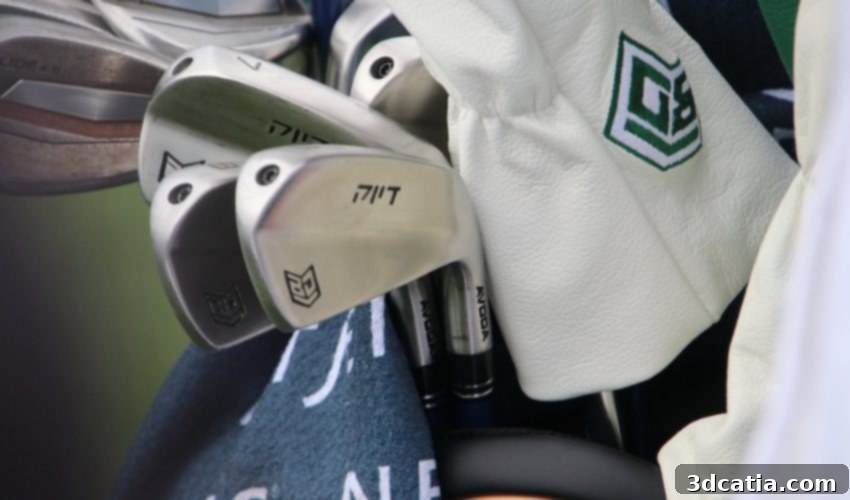
Bryson DeChambeau and Avoda Golf: The 3D Printed Irons Redefining Performance at the Masters
Bryson DeChambeau, famously known as ‘The Mad Scientist’ for his analytical and often unconventional approach to golf, has undoubtedly become one of the most compelling figures at the 2024 Masters Tournament. His remarkable performance on the greens has not only captivated fans but has also garnered significant attention from golf experts worldwide. Beyond his impressive scores, what truly sparked intrigue and admiration was his groundbreaking choice of equipment: a custom set of 3D printed irons from Avoda Golf. These innovative clubs, meticulously crafted using advanced 3D printing technology, represent a bold and significant departure from conventional club manufacturing. DeChambeau’s decision to integrate this tailored approach into his golfing arsenal highlights a growing trend towards hyper-personalization in elite sports, pushing the boundaries of what’s possible in equipment design and performance optimization.
The Genesis of Innovation: DeChambeau’s Vision and Collaboration
DeChambeau’s willingness to experiment with these unorthodox irons added an electrifying layer to his already extraordinary Masters journey. This pioneering venture began as a collaborative effort involving DeChambeau himself, his long-time coach Mike Schy, and Tom Bailey, the visionary founder of Avoda Golf. Avoda Golf specializes in leveraging cutting-edge 3D printing technology to create bespoke golf equipment. The initial phase of this partnership involved extensive experimentation and rapid prototyping. The goal was clear: to develop clubs that would perfectly complement DeChambeau’s distinctive and powerful playing style, addressing his specific needs for accuracy, consistency, and ball flight control. This innovative spirit, combined with a deep understanding of golf mechanics and the precision capabilities of additive manufacturing, laid the foundation for what would become a potentially game-changing set of irons.
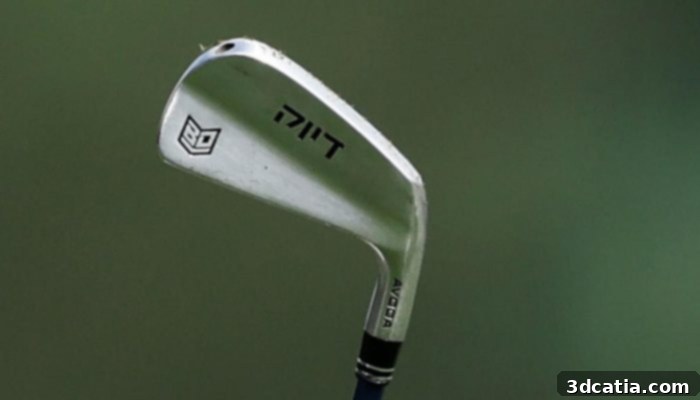
An Avoda Golf iron wielded by DeChambeau. (Photo Credits: Golf Digest)
Unpacking the Technology: How 3D Printing Transforms Golf Clubs
The distinctive design of DeChambeau’s Avoda Golf irons showcases the unparalleled advantages of 3D printing in sports equipment manufacturing. Unlike traditional forging or casting methods, additive manufacturing allows for the creation of incredibly complex geometries and internal structures that are impossible to achieve otherwise. These irons feature strategically placed ports in the toe area and a subtle bulge in the clubface. This intricate engineering is designed to optimize performance and significantly enhance forgiveness on off-center strikes. The precision offered by 3D printing ensured that every curve, every weight distribution, and every minute detail meticulously aligned with DeChambeau’s exacting specifications and preferences. This level of customization ensures that the clubs are not just mass-produced items, but extensions of the player’s unique swing characteristics, providing an unprecedented level of control and feel.
The Avoda Golf Irons: A Deep Dive into Design and Mechanics
Mike Schy, DeChambeau’s coach, elaborated on the specific advantages these 3D printed clubs offer. He explained, “The faces have some bulge to them, they are one-of-a-kind. What happens if you hit it on the toe? It hooks a lot, right? What happens if you hit it on the heel? It cuts a lot. When you have bolts, that offsets that.” This design philosophy directly tackles common golfer frustrations. By incorporating bulge and specific weighting features, the irons are engineered to counteract the natural rotational forces that cause hooks and slices when the ball isn’t struck perfectly on the sweet spot. A slight bulge, for instance, can help steer off-center toe hits back towards the target line, while similar design considerations apply to heel strikes. This innovative compensation mechanism is a testament to how 3D printing allows for precise material placement and geometry, essentially building forgiveness directly into the clubface, leading to a more consistent ball flight even on imperfect contact. This level of design intricacy and performance enhancement would be incredibly difficult, if not impossible, to achieve with traditional manufacturing techniques, making these 3D printed irons a true marvel of modern golf engineering.
Navigating Regulatory Hurdles: The USGA’s Scrutiny
DeChambeau’s path to wielding these revolutionary irons at the Masters was not without its obstacles. Initial prototypes of the 3D printed irons immediately drew scrutiny from the United States Golf Association (USGA), the sport’s governing body responsible for ensuring fair play and equipment conformity. Questions arose regarding the legality of the irons’ grooves and overall design, challenging their adherence to the USGA’s stringent regulations. This phase highlighted the critical interplay between innovation and compliance in professional sports. DeChambeau and his dedicated team, alongside Avoda Golf, embarked on a rigorous refinement process. They meticulously redesigned, re-printed, and re-tested the clubs, iterating multiple times to ensure full compliance with every rule. This commitment to both cutting-edge technology and established regulations ultimately paid off, culminating in the USGA’s official endorsement. This crucial approval cleared the way for DeChambeau’s admittance into the prestigious tournament, granting him the opportunity to put his uniquely tailored, 3D printed irons to the ultimate test when it truly mattered.
On-Course Performance: The Impact at the Masters
The on-course impact of these 3D printed irons on DeChambeau’s performance has been significant and immediately noticeable. He has publicly attributed increased accuracy and remarkable consistency in his ball striking to the customizability and unique design of these clubs. DeChambeau himself articulated the key benefit, stating, “It’s a speed thing. When I miss-hit on the toe or the heel, it seems to fly a lot straighter for me, and that’s what has allowed me to be more comfortable over the ball.” This “speed thing” refers to the maintained ball speed and minimal loss of directional control even on strikes that aren’t perfectly centered. For a player who generates immense clubhead speed like DeChambeau, minimizing the penalizing effects of slight mishits is paramount. The forgiveness engineered into the Avoda irons means that even less-than-perfect contact still yields a powerful and relatively straight shot, which translates directly into more greens hit, tighter approaches, and ultimately, lower scores. This tangible improvement underscores how targeted design enabled by 3D printing can provide a measurable competitive edge in high-stakes environments.

Bryson DeChambeau’s 3D printed irons in use at the 2024 Masters Tournament. (Photo Credits: Golfweek)
The Future of Golf Equipment: Beyond DeChambeau and Avoda Golf
When DeChambeau’s top performance is coupled with the undeniable success of these 3D printed irons, it heralds a significant shift in the landscape of sports equipment manufacturing. The golf world, traditionally resistant to radical change, is now witnessing firsthand the transformative potential of additive manufacturing. This success story will likely accelerate the adoption of 3D printing technology across various sports, as more athletes and brands recognize its profound benefits for improved customizability, personalization, and performance enhancement. Imagine tailored running shoe soles that perfectly match an athlete’s foot strike, bicycle frames optimized for an individual’s biomechanics, or even protective gear custom-fitted for maximum safety and comfort. 3D printing not only allows for rapid prototyping and iterative design but also opens doors to using advanced materials with specific properties, potentially leading to lighter, stronger, or more flexible equipment. This trend towards bespoke, performance-driven gear, championed by pioneers like DeChambeau and Avoda Golf, suggests a future where every athlete can wield equipment uniquely designed to unlock their full potential, fundamentally altering how professional and amateur athletes approach their game.
What are your thoughts on Bryson DeChambeau’s innovative 3D printed irons by Avoda Golf and their potential impact on the future of golf? Share your insights and join the conversation by leaving a comment below or connecting with us on our LinkedIn, Facebook, and Twitter pages! Don’t miss out on the latest advancements and news in the world of additive manufacturing – be sure to sign up for our free weekly newsletter here for direct updates straight to your inbox! Additionally, you can explore all our engaging videos and content on our dedicated YouTube channel.
*Cover Photo Credits: Golf WRX