
Innovating Sustainable Architecture: The WASP-IAAC 3D Printed Wall with Integrated Staircase Steps
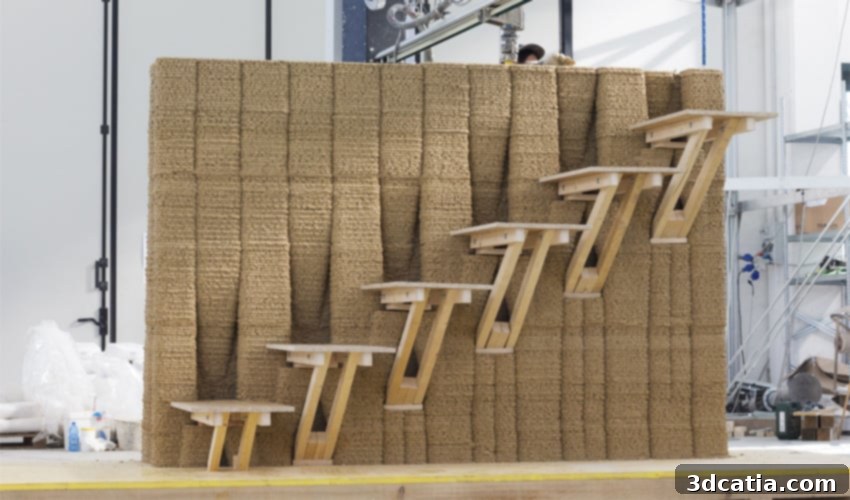
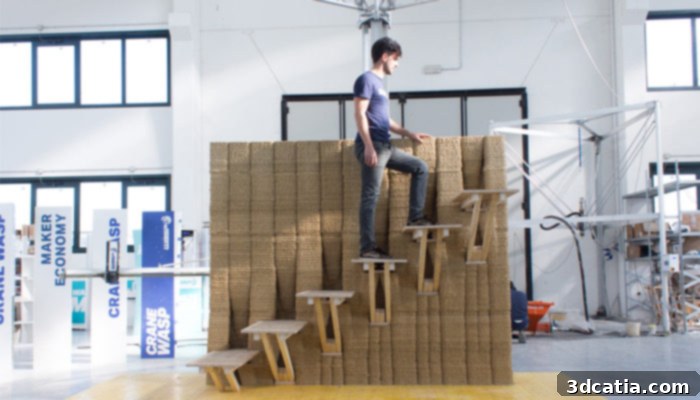
In a groundbreaking collaboration set to redefine the future of sustainable construction, Italian concrete 3D printer manufacturer WASP has joined forces with the Institute of Advanced Architecture of Catalonia (IAAC) to unveil an impressive new prototype. This innovative creation is a 3D printed wall that seamlessly integrates the steps of a staircase directly into its structure. Utilizing WASP’s advanced modular 3D printer, the Crane WASP, the partners successfully constructed a robust 40 cm thick wall designed with anchor points for attaching wooden stair elements. This pioneering prototype is not only a testament to architectural ingenuity but also a strong statement on environmental responsibility, as it was fabricated entirely from a sustainable mixture of clay and rice fibers, aligning perfectly with WASP’s overarching mission to create more eco-friendly and resource-efficient buildings.
The development of this integrated stair-wall marks a significant leap in additive manufacturing for the construction sector. It highlights the immense potential for creating complex, multi-functional architectural elements directly on-site, drastically reducing waste and transportation costs. The project further underscores the commitment of both WASP and IAAC to pushing the boundaries of what is achievable with large-scale 3D printing, especially when focusing on natural and locally sourced materials. This approach is critical for developing affordable housing solutions and promoting a circular economy within the building industry, paving the way for a more sustainable future for global construction practices.
A Legacy of Sustainable Innovation from WASP
WASP (World’s Advanced Saving Project) has consistently been at the forefront of sustainable 3D printing in construction. Their vision extends beyond merely printing structures; it encompasses the creation of self-sufficient, ecologically responsible communities. One notable initiative is the Italian village of Shambalha, an ambitious project launched by WASP with the goal of 3D printing the majority of its houses and buildings using readily available local and natural materials. This commitment to leveraging regional resources minimizes environmental impact and fosters local economies.
More recently, WASP introduced “Gaia,” a small, bio-based house that garnered significant attention for its innovative use of rice waste as its primary building material. Gaia exemplifies WASP’s dedication to transforming agricultural by-products into valuable construction resources, showcasing how waste streams can be repurposed into durable, aesthetically pleasing, and energy-efficient homes. These past projects serve as a powerful foundation, demonstrating WASP’s profound expertise and unwavering commitment to advancing ecological building practices through additive manufacturing.
IAAC’s Vision for Architectural Additive Manufacturing
The Institute of Advanced Architecture of Catalonia (IAAC) is a renowned research and education center dedicated to exploring the future of architecture in an increasingly digital and ecological world. IAAC’s collaboration with WASP is a natural synergy, as the institute actively seeks to develop and integrate additive manufacturing technologies into the architectural sector. Their shared objective is to unlock new construction opportunities, particularly by enhancing the capabilities of 3D printing directly on construction sites. This on-site printing capability offers numerous benefits, including faster construction times, greater design flexibility, reduced logistical complexities, and ultimately, lower costs.
IAAC’s academic rigor and innovative research methodologies complement WASP’s practical manufacturing prowess, creating a robust partnership focused on translating cutting-edge ideas into tangible, impactful architectural solutions. Together, they are not only creating prototypes but are actively defining new paradigms for how we design, build, and inhabit our spaces, with a strong emphasis on integrating digital fabrication with sustainable material practices.
Credit: WASP & IAAC
Engineering the Integrated Stair-Wall: Process and Materials
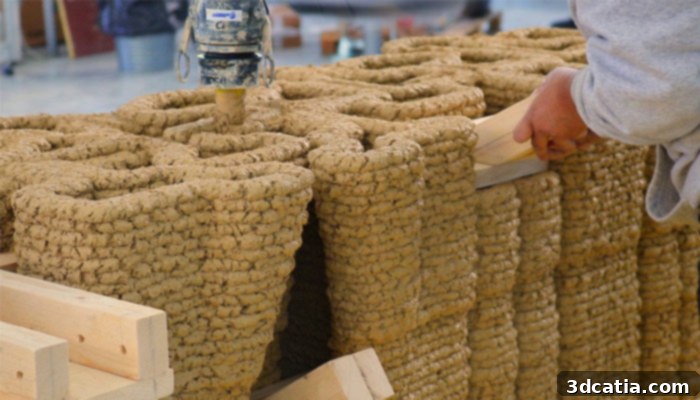
The fabrication of this pioneering 3D printed wall with integrated stairs was a meticulous process. According to IAAC and WASP, the additive manufacturing of the wall structure alone took an efficient 40 hours. This impressive speed showcases the significant time-saving advantages of construction 3D printing compared to traditional methods. The total amount of material consumed for the prototype was 2 cubic meters, resulting in a final wall thickness of 40 cm. This substantial thickness not only ensures structural stability but also allows for the complex internal geometries necessary for integrated features.
A key aspect of the design involved sophisticated internal modeling. Multiple surfaces were carefully designed and integrated within the wall’s structure to provide sufficient strength and rigidity, ensuring the prototype could safely support the added wooden staircase elements and potential loads. This intricate internal lattice work is crucial for optimizing material usage while maximizing structural performance. Beyond functionality, these internal models also contributed to the overall aesthetic appeal of the wall, demonstrating that additive manufacturing can combine engineering precision with artistic design.
The Power of Bio-Based Materials: Clay and Rice Fibers
The choice of raw material for this project is central to its sustainable ethos. The blend of clay and rice, supplied by RiceHouse, is a testament to the viability of bio-based materials in modern construction. Clay, an abundant natural resource, offers excellent thermal mass and breathability, contributing to comfortable indoor environments. Rice fibers, often an agricultural waste product, enhance the material’s strength and provide a sustainable aggregate, reducing the need for energy-intensive conventional additives.
This unique composite material not only aligns with WASP’s commitment to ecological building but also demonstrates the versatility of their Crane WASP printer in handling diverse material formulations. The ability to print with local earth-based materials drastically reduces the carbon footprint associated with material production and transportation, making such structures ideal for regions seeking self-sufficient and environmentally responsible development. Furthermore, these materials are often recyclable and biodegradable, contributing to a circular economy in construction and minimizing long-term environmental impact.
Integrating Wooden Elements and the Path to Load-Bearing Earth Structures
A critical aspect of the prototype’s design is the seamless integration of different material types. While the wall itself is 3D printed from the clay-rice mixture, various wooden elements are designed to fit naturally and securely into the structure, forming the actual stair treads and risers. This hybrid approach capitalizes on the strengths of both additive manufacturing and traditional woodworking, allowing for intricate structural forms to be printed while utilizing wood for its warmth, aesthetic appeal, and load-bearing properties for direct human interaction.
The partners emphasize that this collaborative project represents a crucial first step towards the realization of truly load-bearing earth structures. Historically, earth-based construction has faced challenges in achieving high structural loads without extensive reinforcement. By demonstrating the ability to print robust, geometrically optimized walls from natural materials that can effectively integrate other structural components like wood, WASP and IAAC are paving the way for larger, multi-story buildings constructed predominantly from earth. This advancement has profound implications for low-cost housing, disaster relief, and general sustainable urban development worldwide.
Forging a Collaborative Future for Sustainable Construction
Beyond this single prototype, the collaboration between WASP and IAAC is underpinned by a strategic program of shared projects, intensive research, and ongoing activities. Their ultimate goal is to establish an affordable, accessible, and highly sustainable on-site 3D printing solution that can be deployed globally. This ambitious vision requires a broad and inclusive approach, leading them to consolidate a wide network of partners across various sectors.
This network is envisioned to include architectural design firms, university research institutions, humanitarian associations, and international organizations. Such a multidisciplinary ecosystem is vital for driving innovation, sharing knowledge, and ensuring that sustainable construction technologies are not only developed but also implemented where they are needed most. By bringing together diverse expertise, WASP and IAAC aim to accelerate the adoption of additive manufacturing in architecture, making sustainable and resilient housing a reality for communities worldwide, especially those in developing regions or areas affected by natural disasters.
Credits: WASP & IAAC
The Future is 3D Printed and Sustainable
The WASP-IAAC integrated stair-wall prototype is more than just an architectural experiment; it’s a tangible vision of the future of construction. It encapsulates the core principles of sustainability, innovation, and efficiency that are desperately needed in a world facing growing environmental challenges and housing demands. By demonstrating the feasibility of printing complex, functional structures from bio-based materials on-site, this project sets a new benchmark for what is possible in additive manufacturing for architecture.
This collaboration serves as an inspiring example of how cutting-edge technology, combined with a deep commitment to ecological principles, can lead to revolutionary solutions. As these technologies continue to evolve, we can anticipate even more complex, adaptive, and sustainable buildings emerging from the fusion of digital fabrication and natural materials, fundamentally transforming our built environment for the better. This pioneering work by WASP and IAAC truly heralds a new era of eco-conscious and technologically advanced building practices.
What are your thoughts on this revolutionary prototype and its implications for the future of architecture? We’d love to hear your insights! Let us know in a comment below or join the conversation on our Facebook and Twitter pages. Don’t forget to sign up for our free weekly Newsletter to receive all the latest news and innovations in 3D printing delivered straight to your inbox!