
Mercedes-Benz Trucks Pioneers Metal 3D Printing for Spare Parts: Revolutionizing the Automotive Aftermarket
The landscape of manufacturing is undergoing a profound transformation, with additive manufacturing, commonly known as 3D printing, emerging as a pivotal technology. What was once confined to rapid prototyping has now expanded into the production of high-performance, end-use components across various industries. In a significant leap forward for the heavy vehicle sector, the renowned Stuttgart-based automotive manufacturer, Mercedes-Benz, has proudly announced a groundbreaking achievement: becoming the first company to integrate metal 3D printing into the series production of spare parts for its trucks. This monumental strategic move not only underscores Mercedes-Benz’s commitment to innovation but also heralds a new era of efficiency, sustainability, and enhanced customer service in the global automotive aftermarket.
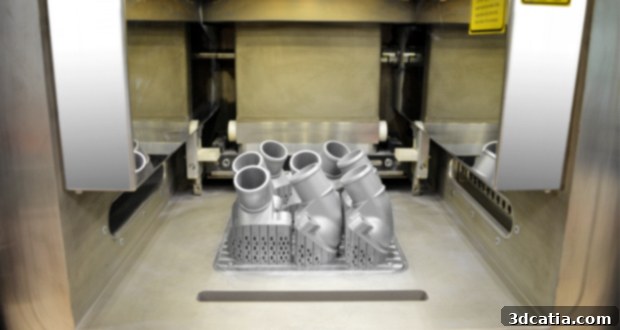
This landmark initiative follows an exhaustive and rigorous quality assurance process, a hallmark of Mercedes-Benz’s unwavering dedication to superior engineering, safety, and reliability. After extensive validation and meticulous testing to meet the company’s stringent industrial standards, these pioneering 3D-printed metal spare parts are now ready for commercial release. The inaugural component to hit the market is a critical thermostat cover designed for the venerable Mercedes-Benz Unimog model trucks. Crafted from high-grade aluminum, this part demonstrates exceptional resistance to heat and robust durability, specifically engineered to withstand the demanding operational environments of heavy-duty vehicles. The successful development and deployment of this specialized component firmly position Mercedes-Benz Trucks at the forefront of additive manufacturing adoption within the automotive industry, establishing a new benchmark for how replacement parts can be efficiently and effectively supplied to customers worldwide.
The 3D printed part Photo// Daimler
This venture into advanced 3D printing is not an overnight revelation for Mercedes-Benz Trucks. The company’s dedicated Customer Services and Parts division has been actively engaged in exploring and developing additive manufacturing solutions for over a year, with a primary focus on optimizing the availability and delivery of after-sales replacement parts. Initially, these efforts centered on plastic components, leveraging the agility of 3D printing for rapid prototyping and low-volume production. This foundational work laid the groundwork for a more ambitious strategic collaboration with researchers and pre-developers at Daimler AG, Mercedes-Benz’s parent company. This powerful synergy of internal expertise and advanced R&D capabilities has been instrumental in continuously improving and expanding the applications of the latest 3D printing processes. Over time, this meticulous and iterative process has facilitated a crucial transition from plastic to highly robust metal components, opening up entirely new possibilities for extending vehicle lifecycles, enhancing performance, and drastically improving the responsiveness of spare parts logistics.
The technical approach to producing these innovative parts is equally noteworthy. While Mercedes-Benz utilized Selective Laser Sintering (SLS) for the creation of its earlier plastic components, a powder bed fusion process ideal for thermoplastics, a more sophisticated technology was required for metal parts. To produce the robust metal components, the company strategically opted for Selective Laser Melting (SLM). SLM is an advanced additive manufacturing technique that employs powerful lasers to precisely melt specific areas of a fine metal powder bed, typically comprising aluminum powder and silicon for the thermostat cover. This localized melting process ensures complete fusion, creating fully dense, homogenous metallic structures layer by layer. Unlike sintering, which fuses particles at a molecular level without full melting, SLM achieves full melting and solidification, resulting in parts with superior mechanical properties, high strength, excellent material integrity, and exceptional heat resistance – attributes critical for the demanding environment of truck engine components. This careful selection of SLM underscores Mercedes-Benz’s commitment to not just adopting 3D printing, but to implementing the most appropriate and advanced technology tailored to the specific material and functional requirements of each component, ensuring optimum performance and longevity.
By seamlessly integrating metal 3D printing into its production workflow, Mercedes-Benz Trucks is poised to make significant advancements across diverse automotive markets. One of the most impactful benefits is the ability to efficiently produce spare parts for older vehicle models, components that might otherwise be challenging or impossible to source through traditional manufacturing methods. This capability effectively extends the operational life and value of classic or legacy trucks, offering a crucial solution to customers who might struggle with prolonged downtime due to part unavailability. Furthermore, additive manufacturing facilitates unprecedented design freedom, allowing for the creation of parts with optimized geometries and internal structures. This means the 3D-printed components are often stronger, lighter, and more resistant to wear, corrosion, and extreme temperatures than their conventionally manufactured counterparts. These enhanced material properties translate into increased durability, potentially reducing maintenance cycles and improving overall vehicle reliability, thus providing a distinct competitive edge and superior value for truck owners.
Andreas Deuschle, Head of Marketing & Operations in Customer Services & Parts at Mercedes-Benz Trucks, eloquently articulated the profound implications of this innovation: “The availability of spare parts during a workshop visit is essential for our customers – no matter how old the truck is, or where it is located.” He further emphasized the strategic advantages, stating, “The particular added value of 3D printing technology is that it considerably increases speed and flexibility, especially when producing spare and special parts. This gives us completely new possibilities for offering our customers spare parts rapidly and at attractive prices.” Deuschle’s statement powerfully captures the core benefits of this technological leap: unparalleled speed in production, critical flexibility in responding to diverse market demands, and the potential for more attractive pricing structures for customers. This ability to deliver parts on demand, bypassing the extended lead times and extensive warehousing costs associated with traditional manufacturing, represents a transformative paradigm shift. It empowers Mercedes-Benz to uphold its reputation for exceptional customer service, ensuring that trucks remain operational, minimizing costly downtime, and maximizing efficiency for businesses globally.
Older trucks will now have a new life thanks to the 3D printed spare parts photo // Bild über Wikipedia
This pioneering move by Mercedes-Benz Trucks into the serial production of metal spare parts via 3D printing is more than a mere technological achievement; it is a clear strategic declaration of intent. It firmly positions the company at the vanguard of automotive innovation, demonstrating a proactive commitment to leveraging advanced manufacturing techniques to address critical challenges in vehicle maintenance, optimize supply chain logistics, and significantly enhance customer satisfaction. This forward-thinking approach is anticipated to inspire other major players within the heavy vehicle and broader automotive sectors to accelerate their own adoption of additive manufacturing, thereby driving further innovation and efficiency across the entire industry. The potential applications of this technology extend far beyond current spare parts, envisioning a future where custom-designed components, performance-optimized parts, and even on-site, distributed manufacturing capabilities become standard practice. By embracing and championing this transformative technology, Mercedes-Benz is not simply adapting to the future of manufacturing; it is actively shaping it, ensuring their trucks remain robust, efficient, and serviceable for decades to come, thereby solidifying their market leadership and reinforcing their enduring legacy of engineering excellence.