
Global 3D Printer Shipments: Navigating Post-Pandemic Recovery and Evolving Market Dynamics
The global landscape dramatically shifted last year with the onset of the pandemic, leading to severe disruptions across numerous industries. Amidst this widespread economic turbulence, 3D printing, also known as additive manufacturing, demonstrated remarkable resilience, proving more robust than many other sectors. While it certainly didn’t escape the pandemic’s reach entirely, its impact was more nuanced compared to the profound downturns experienced elsewhere. Initial studies indicated that while the industry was affected, particularly in terms of printer sales, it navigated the challenges with greater agility. Recent market intelligence from CONTEXT, a leading IT market intelligence company, has further substantiated this observation. Their analysis reveals that although 3D printer shipments in 2021 have not yet fully surpassed the robust levels recorded in 2019, they have experienced significant growth since 2020. This positive trajectory suggests a strong recovery is underway, with expectations for shipment levels to fully rebound and potentially exceed pre-pandemic figures by the coming year. This trend underscores the unique position of additive manufacturing as a dynamic and adaptive technology in a changing world.
Throughout this year, numerous surveys have consistently highlighted the underlying strength and growing potential of the 3D printing market. However, it’s equally clear that the industry, like many others, felt the effects of the pandemic’s initial shockwaves. CONTEXT’s comprehensive market research pinpointed two distinct and crucial trends that characterized the market in the preceding year, 2020. While global supply chains faltered and businesses faced unprecedented uncertainty, leading to a significant decrease in shipments of industrial and design 3D printers, a contrasting phenomenon emerged in the consumer segment. Intriguingly, sales of hobby and DIY 3D printers actually surged by an impressive 18% in 2020. CONTEXT attributed this divergent performance to the drastic shift in consumer behavior: with millions confined to their homes due to lockdowns and restrictions, individuals, particularly hobbyists and enthusiasts, discovered or rediscovered the immense value and utility in owning their own 3D printers. This period saw a rise in personal projects, educational pursuits, and the exploration of desktop manufacturing, demonstrating a strong appetite for accessible additive technology during a time of global standstill. This split in market performance illustrated the complex interplay of economic forces and changing consumer needs during the height of the pandemic.
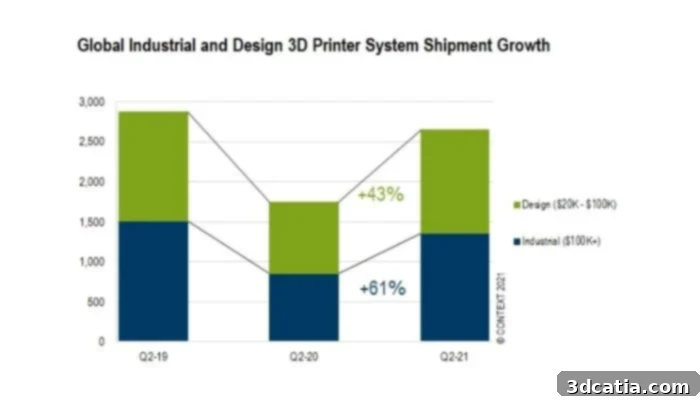
The sale of industrial and design 3D printers has grown significantly since 2020, though the numbers are still slightly below pre-pandemic levels. The rebound indicates renewed confidence and investment in advanced manufacturing (photo credits: CONTEXT).
As the world began to adapt and economies cautiously reopened, the findings from 2021 present a significantly different picture, indicating a substantial reversal of the previous year’s trends. CONTEXT’s analysis reveals a clear shift in market dynamics. The explosive growth seen in personal and hobby printers in 2020 has largely subsided, with this segment experiencing considerably less expansion than in the preceding year. Shipments of fully-assembled printers priced below $2.5K, which primarily cater to this consumer segment, notably declined by -32%. This deceleration could be attributed to a combination of factors, including market saturation among early adopters and a general return to pre-pandemic activities that reduced leisure time at home. Conversely, the commercial and industrial sectors witnessed a robust resurgence. Sales of industrial and design 3D printers, which had faced headwinds in 2020, bounced back with remarkable vigor. As illustrated in the accompanying graph, the design 3D printer category, defined by CONTEXT as machines costing between $20,000 and $110,000, saw an impressive increase of 43% since 2020. Even more striking was the performance of the high-end industrial 3D printer segment, comprising systems priced over $100,000, which surged by a substantial 61%. This powerful rebound signifies renewed corporate confidence and increased investment in advanced manufacturing technologies for prototyping, tooling, and increasingly, end-use production. Furthermore, CONTEXT highlighted geographical variations in this recovery; positive changes in industrial printer shipments were most pronounced in North America, reflecting a strong economic recovery and strategic focus on domestic manufacturing, while growth remained more modest in Western Europe and China, suggesting different paces of market recovery and investment across regions. This reversal underscores the dynamic nature of the 3D printing market and its sensitivity to broader economic and social shifts.
Amidst these fluctuating trends, there is particularly good news regarding professional price-class printer shipments, a segment crucial for small to medium-sized businesses, engineering firms, and educational institutions. This category has not only fully recovered but has successfully grown beyond pre-COVID levels, demonstrating exceptional resilience throughout the pandemic. According to CONTEXT, professional price-class printer shipments were comparatively less impacted by the initial COVID-induced shutdowns, experiencing only a minor decrease from 2019. This suggests a foundational demand and consistent utility for these machines, which typically bridge the gap between hobbyist and full-scale industrial systems, offering greater precision, material versatility, and reliability. Now, with market conditions improving, shipments in this professional segment have surged by an additional 38% from 2020, translating into an impressive cumulative increase of approximately 33% from their 2019 figures. This significant growth indicates a robust return to investment in professional-grade additive manufacturing tools as businesses resume normal operations and seek efficient solutions for prototyping, low-volume production, and specialized applications. Notably, several of the top 10 manufacturers in the 3D printing space, including industry giants like Stratasys, Markforged, 3D Systems, and Desktop Metal, reported particularly strong quarters. Their success highlights not only the sector’s recovery but also the continuous innovation and increasing adoption of additive manufacturing solutions across various professional applications. This segment’s strong performance serves as a key indicator of the underlying health and ongoing expansion of the 3D printing ecosystem, driven by tangible business needs and technological advancements.
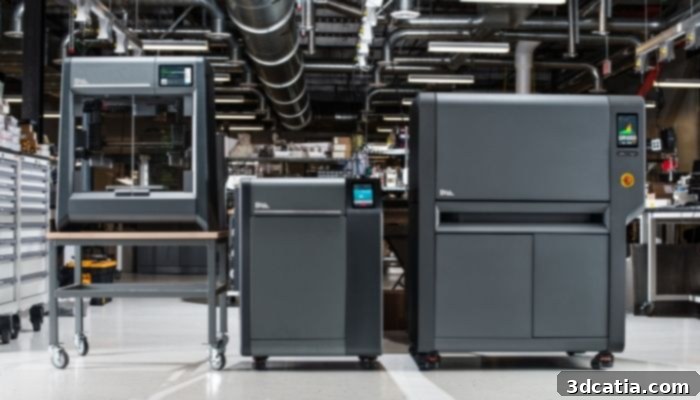
Desktop Metal was one of the 3D printing companies that experienced a successful quarter, largely attributed to strategic acquisitions like ExOne and EnvisionTEC, expanding its market reach and technological portfolio (photo credits: Desktop Metal)
Despite the undeniably positive trends and promising figures, Chris Connery, VP of Global Research at CONTEXT, offers a measured and insightful caution regarding the interpretation of market growth. He highlights that while, “Companies, especially those based in the US and China, are increasingly bullish about prospects for growth in H2 2021 as in-person trade events begin again around the world,” this optimism requires careful consideration. Connery emphasizes the need to temper expectations when reported growth is primarily driven by factors external to organic 3D printer sales. For instance, some growth narratives might be heavily influenced by marketing activities associated with new public listings, creating a perception of rapid expansion that doesn’t solely reflect increased printer shipments. Furthermore, the nuances of growth need to be thoroughly examined, especially since many individual companies are looking to expand their revenue streams by adding non-3D printing technologies to their product portfolios. This diversification, while beneficial for the companies themselves, can sometimes obscure the true growth trajectory of the pure 3D printing market. Moreover, the outlook for the “3D-printer-only” market becomes even more complex due to growth driven by mergers and acquisitions (M&A). When a larger company acquires a competitor, the combined entity reports increased sales and market share, but this represents consolidation rather than an increase in the total number of new printers shipped globally. For example, Desktop Metal’s impressive performance, while genuine, was significantly bolstered by strategic acquisitions such as ExOne and EnvisionTEC, integrating their existing sales into Desktop Metal’s overall figures. Connery stresses the importance of parsing out individual technology trends and focusing exclusively on “net-new 3D printer shipments” to gain a clearer, unadulterated understanding of market health. Despite these critical caveats and the need for nuanced analysis, the underlying forecasts for genuine 3D printer shipments in 2021 remain robust. This indicates a strong foundational recovery and sustained demand for additive manufacturing, even when accounting for these broader market dynamics.
All in all, the latest market data paints an overwhelmingly promising picture for the future of 3D printing. Despite the complexities highlighted by CONTEXT regarding various growth drivers, the core numbers confirm a strong rebound and a healthy underlying demand for additive manufacturing technologies across different segments. The market research company anticipates this growth trajectory to continue steadily, with a strong possibility of the market not only fully recovering to pre-pandemic levels but potentially moving even beyond them by the next year. This forward-looking projection underscores the increasing integration of 3D printing into mainstream manufacturing, product development, and consumer applications. As industries globally seek greater supply chain resilience, customization capabilities, and accelerated innovation cycles, additive manufacturing stands poised to play an increasingly pivotal role. This robust outlook cements 3D printing’s position as a transformative technology, ready to capitalize on evolving industrial needs and consumer demands in the years to come.
What are your thoughts on this latest research? Do you anticipate 3D printing to maintain its strong growth momentum through the end of this year and into the next? We invite you to share your insights in a comment below or join the conversation on our Facebook and Twitter pages. Don’t forget to sign up for our free weekly newsletter to receive all the latest news and developments in the dynamic world of 3D printing delivered straight to your inbox!
*Cover Photo Credits: Formlabs