
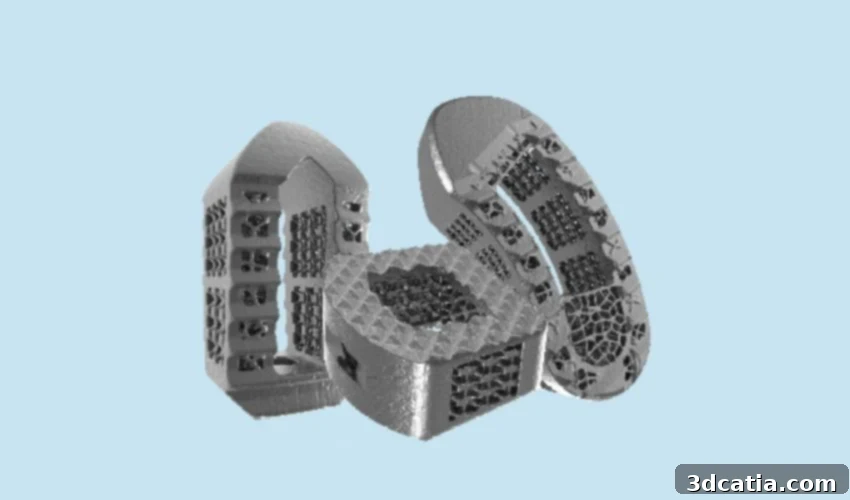
Pioneering Spinal Care: ZSFab’s 3D Printed Titanium Implants Make Clinical Debut in the US
The landscape of healthcare is undergoing a profound transformation, largely driven by the relentless innovation in additive manufacturing, commonly known as 3D printing. This revolutionary technology is consistently unveiling new applications across the entire medical sector, from intricate surgical guides and highly customized prostheses and orthoses to advanced dental solutions and even the cutting edge of bioprinted organs. The unparalleled precision, customization capabilities, and efficiency offered by 3D printing underscore its pivotal and ever-expanding role in modern medicine. This exciting trend continues with the latest announcement from ZSFab, marking a significant milestone: the first clinical use in the United States of its groundbreaking InterConnect™️ 3D Printed Ti Lumbar Interbody System.
Based in the vibrant Greater Boston area, ZSFab stands at the forefront of medical device innovation. The company is singularly focused on developing and manufacturing high-performance, patient-matched, and exquisitely customized medical implants, alongside specialized surgical guides and other additively manufactured end-use products. Their commitment to improving patient outcomes through advanced manufacturing is evident in their impressive track record. Prior to this latest achievement, ZSFab had already secured critical FDA 510(k) clearance for both its 3D printed lumbar cages and 3D printed cervical interbody systems. This regulatory approval underscores the safety, efficacy, and quality of their innovative solutions. Central to ZSFab’s success is its proprietary technology, which masterfully combines state-of-the-art titanium 3D printing with sophisticated, self-developed algorithms. This powerful synergy enables them to engineer orthopedic and spinal devices that are not only precisely tailored to the unique anatomical and biomechanical needs of each patient but also actively promote natural bone growth and integration. The result is a new generation of implants designed for superior fit, enhanced stability, and ultimately, more successful long-term patient recovery.
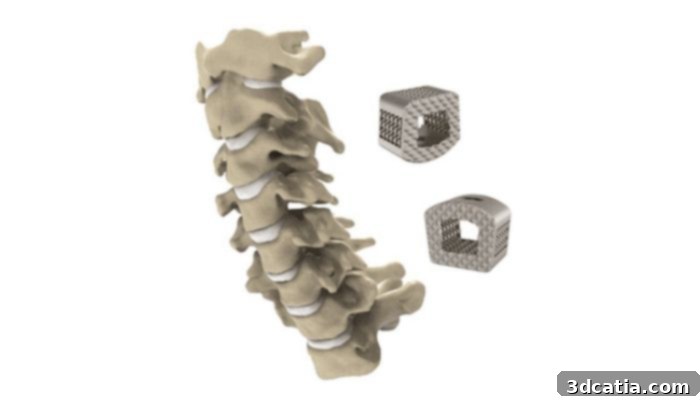
Titanium spinal implant parts made by ZSFab
Dr. David Ma, the esteemed Director of Research and Development for ZSFab, eloquently articulates the company’s core philosophy and the scientific rigor behind their designs. He emphasizes, “ZSFab specializes in creating implants that better harmonize with the patient’s biomechanics by addressing issues like load distribution, stress on adjacent segments, and construct stability. To help ensure lasting stability, our optimized designs also help promote beneficial elastic deformation within the lattice structures to induce mechanical stress, activating osteoblasts for new bone growth and achieving a more efficient fusion process.” This statement highlights a crucial aspect of ZSFab’s advanced implants: they are not merely passive replacements but active participants in the healing process. By meticulously engineering the internal lattice structures of their titanium implants, ZSFab ensures that the device mimics the natural mechanical properties of bone. This “beneficial elastic deformation” creates localized mechanical stress within the tissue, a known osteogenic stimulus that encourages the body’s own cells, specifically osteoblasts, to initiate and accelerate new bone formation. This sophisticated biomechanical approach directly contributes to a more robust and efficient spinal fusion, minimizing potential complications and enhancing long-term stability.
The landmark first clinical utilization of the InterConnect™ system involved a series of three successful spinal surgeries. These pioneering procedures were conducted at the prestigious Tulsa Spine & Specialty hospital by two highly respected spine surgeons, Dr. Daniel Harwell and Dr. Michael Thambuswamy, both affiliated with the Oklahoma Spine & Brain Institute. The implants deployed in these critical surgeries were ZSFab’s digitally structured P-TLIF interbody cages. P-TLIF, or Posterior Transforaminal Lumbar Interbody Fusion, is a widely adopted surgical technique aimed at stabilizing the spine and relieving pressure on nerves by fusing two vertebrae. ZSFab’s innovative cages are meticulously designed with state-of-the-art porous titanium, which is specifically engineered to foster an ideal environment for biological integration. The profound success of these advanced devices is directly attributable to a unique and powerful combination of cutting-edge structural geometries: triply periodic minimal surfaces (TPMs) and stochastic lattice structures. TPMs are mathematically defined, infinitely connected surfaces that create highly ordered, intricate porous architectures, while stochastic lattices offer a more random, yet optimized, distribution of pores. This dual-structure approach, according to ZSFab, is instrumental in enhancing osseointegration – the direct structural and functional connection between living bone and the surface of a load-bearing implant. By expertly mimicking the natural, complex architecture of human bone, these devices are designed to promote faster, more comprehensive, and significantly more robust fusion processes, fundamentally improving the efficacy of spinal fusion surgery and patient recovery.
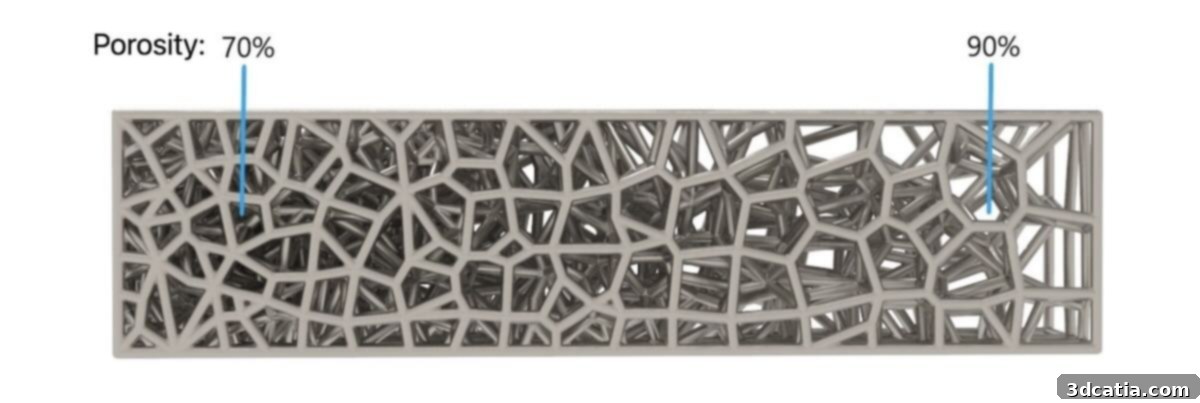
The company is able to customize porosity, pore sizes and modulus according to patients’ bone needs on both periodic and stochastic lattices
While it is naturally premature to ascertain the definitive long-term outcomes of these specific surgeries, the scientific foundation and previous testing of ZSFab’s technology provide strong indicators of promising results. Earlier studies involving HE (Hematoxylin and Eosin) staining on ZSFab fusion cages have consistently demonstrated clear and compelling evidence of new bone formation within the intricate porous structures just 12 weeks post-implantation. HE staining is a standard histological technique used to visualize tissue architecture and cellular morphology, and the presence of new bone signifies successful biological integration and the onset of fusion. This preclinical evidence reinforces the biological compatibility and osteoconductive properties of ZSFab’s implants. Both Dr. Harwell and Dr. Thambuswamy have expressed considerable optimism regarding the potential results and the transformative impact of these implants. Dr. Thambuswamy, in particular, highlighted his extensive experience as an early adopter and user of ZSFab’s previous implant products, including both cervical and lumbar cages, further solidifying his confidence in the company’s innovative approach and the consistent performance of their devices. This long-standing clinical trust, coupled with robust scientific data, paints a very positive outlook for the future of spinal care. The ability to customize porosity, pore sizes, and modulus according to individual patient bone needs, on both periodic and stochastic lattices, further elevates the potential for superior anatomical and functional matches, leading to better clinical outcomes and improved quality of life for patients undergoing spinal fusion.
Dr. Harwell concludes with a powerful affirmation of ZSFab’s patient-centric development philosophy, stating, “ZSFab’s digital design and optimization platform for implants incorporates clinical needs from the early research phase. I believe this approach enhances innovation efficiency and ultimately ensures excellent long-term patient outcomes.” This statement perfectly encapsulates the holistic approach taken by ZSFab, where direct clinical insights and requirements are integrated into every stage of product development, from initial research to final design. This collaborative model between engineers, material scientists, and clinicians not only streamlines the innovation process but also ensures that the resulting implants are precisely engineered to meet real-world surgical challenges and optimize patient recovery. The emphasis on “long-term patient outcomes” speaks to the durability, efficacy, and improved quality of life that ZSFab aims to deliver, moving beyond immediate surgical success to sustained health and well-being. This innovative methodology represents a paradigm shift in medical device design, promising a future where implant solutions are not just effective, but truly transformative for individuals suffering from spinal conditions.
ZSFab’s InterConnect™ system represents a significant leap forward in spinal fusion technology, showcasing the immense potential of 3D printing to create highly advanced, patient-specific medical solutions. This first clinical use in the US is not just a success for ZSFab, but a beacon of hope for countless patients worldwide who stand to benefit from more effective, biologically integrated, and personalized spinal care. As additive manufacturing continues to evolve, we can anticipate even more groundbreaking applications that will redefine standards of treatment across various medical specialties.
What are your thoughts on these innovative 3D printed spinal implants from ZSFab and the future of additive manufacturing in healthcare? Let us know your perspective in a comment below or engage with us on our LinkedIn, Facebook, and Twitter pages! For the latest advancements and news in the world of 3D printing delivered directly to your inbox, don’t forget to sign up for our free weekly newsletter here! You can also explore all our insightful videos and interviews on our dedicated YouTube channel.
*All Photo Credits: ZSFab