
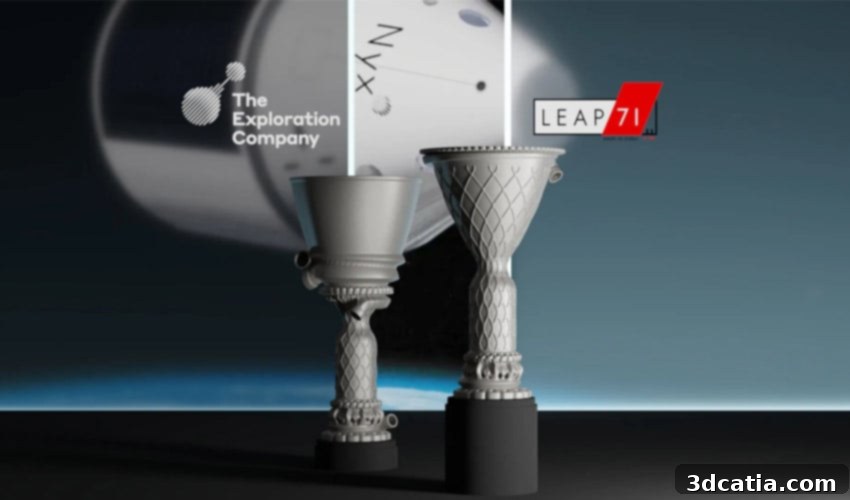
AI and Additive Manufacturing Propel Space Exploration: LEAP 71 and The Exploration Company Forge a New Frontier
In an era echoing the competitive spirit of the historic space race, the private sector is now leading an unprecedented drive toward the stars, fueled by relentless innovation. At the forefront of this ambitious endeavor, engineering powerhouse LEAP 71 and visionary spacecraft manufacturer The Exploration Company have recently unveiled a strategic partnership poised to dramatically accelerate the pace of space exploration. This powerful collaboration aims to pioneer the development of significantly more efficient calculation and manufacturing models essential for designing the next generation of space vehicles. Their groundbreaking approach harnesses the combined potential of artificial intelligence (AI) and advanced additive manufacturing techniques. LEAP 71, renowned for its cutting-edge computational engineering models, is developing the capability to design exceptionally complex, high-performance rocket engines specifically optimized for efficient 3D printing. By merging the iterative power of AI with the fabrication freedom of additive manufacturing, these two innovative partners anticipate not only a substantial reduction in production costs but, more importantly, a significant acceleration of innovation across the entire aerospace sector, paving the way for more frequent, affordable, and successful missions beyond Earth.
Revolutionizing Aerospace: The Synergy of AI and Additive Manufacturing
The aerospace industry has long recognized the transformative potential of additive manufacturing, particularly with metallic materials. This technology already boasts a strong history within aerospace and space exploration, where it has been instrumental in the design and production of intricate, finished parts for critical components in rockets and satellites. Building upon these established successes, LEAP 71 and The Exploration Company have a clear, ambitious objective: to push the boundaries of what’s possible. Their focus is squarely on drastically reducing component weight and accelerating manufacturing timelines, thereby offering a more viable business model and enabling the creation of higher-performance spacecraft. While some industry leaders concentrate on developing specialized machines capable of printing increasingly large parts, others, like Dubai-based LEAP 71, are dedicating their efforts to crafting sophisticated computational models. These models are designed to unlock unprecedented levels of complexity and optimization for parts that can be 3D printed today, such as advanced rocket engines, ensuring they are lighter, stronger, and more efficient than ever before. This dual approach of enhanced design and advanced fabrication is setting new standards for the future of space technology.
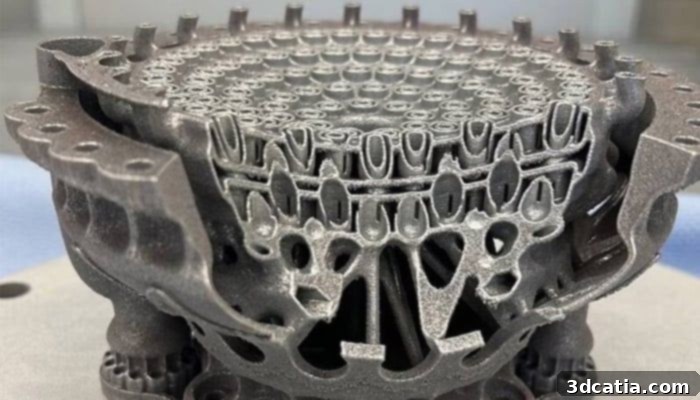
Cross-section of a LEAP 71 engine piece showcasing complex internal geometries achievable through computational engineering and 3D printing.
The Exploration Company’s Vision: Affordable and Reusable Spacecraft with Nyx
The team at LEAP 71 has strategically aligned with The Exploration Company, a dynamic Franco-German enterprise known for its ambitious project, Nyx. Nyx is envisioned as a modular, reusable orbital space vehicle specifically engineered to democratize and significantly reduce the cost of space exploration. Hélène Huby, co-founder and CEO of The Exploration Company, articulated the compelling rationale behind their decision to collaborate with LEAP 71. She highlighted the inherent challenges of traditional engineering approaches in the aerospace sector: “One of the challenges for reducing the cost of space exploration is the conventional approach to engineering. Complex parts like rocket engines are hard to design, and each iteration can sometimes take a significant amount of manual rework with traditional CAD-based tools. Using computational models, we want to engineer faster, so that we can print and test faster – hence accelerating the improvement and validation of our engines.” This statement underscores the critical need for a paradigm shift in design and manufacturing methodologies, moving away from laborious manual processes towards automated, data-driven computational engineering. By adopting LEAP 71’s advanced models, The Exploration Company aims to dramatically shorten design cycles, allowing for more rapid prototyping and testing. This accelerated iteration process is vital for the continuous improvement and rigorous validation of their rocket engines, ultimately bringing the vision of affordable and reusable space travel closer to reality. The partnership exemplifies a forward-thinking strategy to overcome long-standing barriers in space technology through intelligent automation and cutting-edge fabrication.
The Power of Computational Engineering: From Concept to Orbit
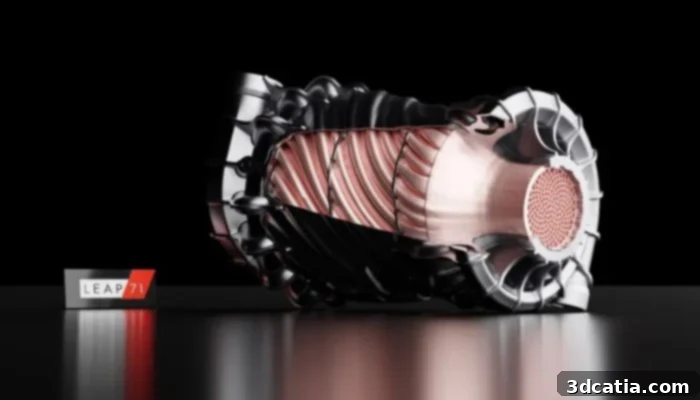
At the heart of this transformative partnership is LEAP 71’s innovative computational engineering model. This sophisticated model is designed to autonomously generate and optimize various rocket engine designs, which can then be directly 3D printed for rigorous testing and eventual validation. The inherent flexibility and speed of additive manufacturing provide the ideal platform for rapidly producing and evaluating multiple design iterations of a single product. This capability is paramount for accelerating the development cycle, allowing engineers to quickly identify and implement improvements. Josefine Lissner, Founder and Managing Director of LEAP 71, eloquently captured the profound impact of their technology: “We are excited to put our Computational Engineering Model to the test and get real-world feedback, to fine-tune it to the point, where we have a robust foundation. I expect a tipping point in the space industry when our model successfully starts producing operational engines across a wide range of parameters. As each new test feeds back into the model, the resulting objects will improve exponentially. This is a key building block on our path to a space-faring society.”
Lissner’s vision paints a compelling picture of a future where iterative design and manufacturing, driven by AI and computational engineering, lead to exponential improvements in performance and efficiency. Each physical test provides invaluable data that is fed back into the computational model, allowing it to learn, adapt, and refine subsequent designs. This continuous feedback loop creates a self-improving system, dramatically accelerating the path from conceptual design to fully operational, flight-ready components. This iterative optimization not only promises higher-performance engines but also significantly de-risks the development process by thoroughly validating designs through real-world testing. The ability to produce operational engines across a broad spectrum of parameters signifies a leap forward in customizing propulsion systems for diverse mission profiles, from low-Earth orbit logistics to deep-space exploration. The collaboration between LEAP 71 and The Exploration Company is not just about building better rocket engines; it’s about fundamentally reshaping the capabilities and accessibility of space travel, moving closer to the ambitious goal of a truly “space-faring society.” This alliance represents a critical step in democratizing access to space and unlocking its vast potential for scientific discovery, economic development, and human expansion.
The Future of Space Innovation: Beyond Traditional Boundaries
The collaboration between LEAP 71 and The Exploration Company represents more than just a technological advancement; it signifies a new paradigm in space innovation. By integrating AI-driven computational engineering with advanced additive manufacturing, they are challenging the traditional, often protracted, and prohibitively expensive development cycles that have characterized the aerospace industry for decades. This partnership exemplifies how cutting-edge digital tools can enable unparalleled design complexity and performance optimization, moving beyond the constraints of conventional manufacturing methods. The ability to rapidly design, print, and test rocket engine components means that new concepts can be validated in a fraction of the time and cost, fostering an environment of accelerated learning and innovation.
Furthermore, the focus on reducing component weight and manufacturing time through these technologies has significant implications for the payload capacity and operational efficiency of spacecraft. Lighter engines mean more cargo can be carried, or less fuel is required, translating directly into lower launch costs and expanded mission capabilities. This directly supports The Exploration Company’s goal of developing the reusable Nyx vehicle, making space more accessible and sustainable. The ‘tipping point’ envisioned by Josefine Lissner is not merely a hypothetical future, but an imminent reality where advanced algorithms and precise fabrication techniques converge to unlock unprecedented engineering possibilities, creating engines that are not only high-performing but also inherently more reliable and cost-effective. As the private space sector continues to grow, such partnerships will be crucial in defining the next frontiers of human endeavor beyond our planet.
As we eagerly await further news and results regarding the first 3D-printed parts emerging from this dynamic partnership, the implications for the entire space industry are profound. This approach is set to inspire other companies to explore similar integrated design and manufacturing strategies, creating a ripple effect of innovation. You can delve deeper into LEAP 71’s pioneering work and their vision for the future by visiting their official site HERE. This alliance marks a significant step towards realizing a future where advanced technology makes space not just a destination for a select few, but an increasingly accessible domain for exploration and development, fundamentally altering our relationship with the cosmos.
What are your thoughts on LEAP 71 and The Exploration Company’s groundbreaking collaboration and its potential impact on the future of space exploration? Share your insights in a comment below or join the conversation on our LinkedIn, Facebook, and Twitter pages! Don’t miss out on the latest advancements in 3D printing and aerospace; sign up for our free weekly Newsletter here to receive top industry news directly in your inbox. You can also explore all our videos and interviews on our YouTube channel for more in-depth content.
*All photo credits: LEAP 71